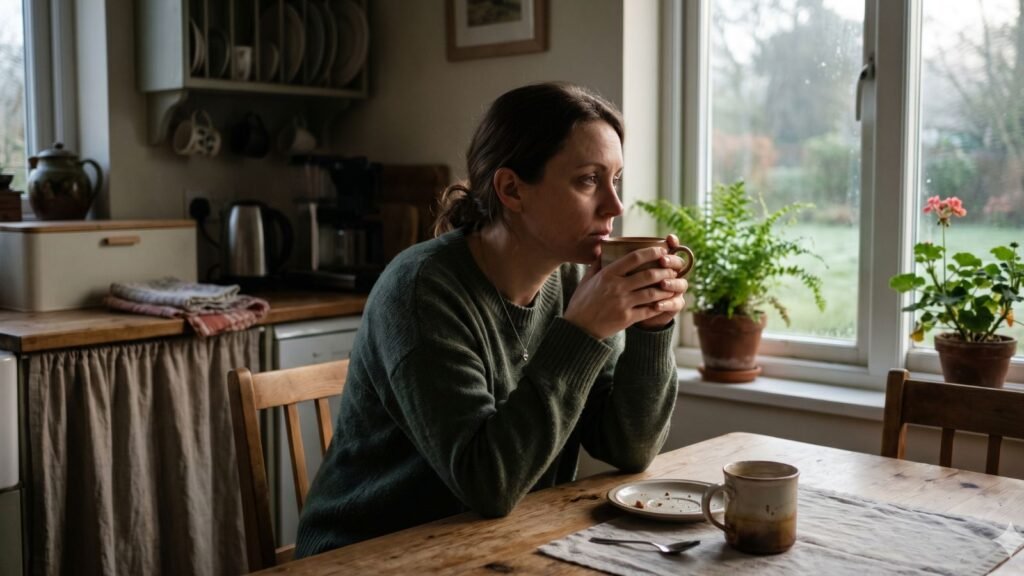
Imagine sitting on your couch on a quiet Sunday afternoon, watching the sunlight pool across the floor. The chores are done, the house is quiet, and for a brief, rare moment, absolutely nothing is wrong. You have a warm cup of coffee in your hand, and a gentle wave of contentment washes over you. But then, almost instantly, a tiny, cold whisper starts in the back of your mind. It asks, What am I forgetting? or worse, When is the other shoe going to drop?
It is a strange, heavy feeling that many of us know intimately. It is the sudden tightening in your chest when a project goes perfectly, the quiet dread that creeps in when a relationship feels peaceful and safe, or the immediate urge to downplay a compliment. If someone tells you your kitchen looks lovely, you might find yourself pointing out the chipped paint on the baseboards. If a colleague praises your work, you might quickly explain how you just got lucky. We treat unexpected goodness not as a moment to breathe, but as a debt we haven’t paid yet.
The Invisible Ledger We Carry
For many of us, happiness feels like a transaction. We grow up believing that everything of value must be bought with struggle, sacrifice, or exhaustion. If we didn’t sweat for it, if we didn’t worry ourselves sick over it, or if we didn’t suffer a little bit along the way, we feel like we are holding something we didn’t pay for. It is as if we are walking out of a store with a beautiful item, convinced the alarm is about to go off at any second.
This internal ledger makes receiving kindness or success feel incredibly risky. We start to view peace as a luxury we cannot afford, or worse, a setup for a future disappointment. We tell ourselves that if we allow ourselves to fully feel the warmth of a good season, we will be completely blindsided when things eventually get difficult. So, as a defense mechanism, we stay on guard. We refuse to unpack our bags in the quiet house of happiness because we are convinced we will be asked to leave by morning.
The Brain’s Search for the Catch
There is a quiet intelligence to why our minds do this, even if it feels exhausting. People who study human behavior have long noted how our minds are naturally wired to look for threats. When we have spent years adapting to unpredictable circumstances, our nervous systems learn to associate calm with danger. In those environments, a quiet moment wasn’t actually peace; it was just the silence before a storm. If you grew up in a home where the mood could tilt in an instant, or if you went through a season where heartbreak arrived without warning, your mind learned that being happy was synonymous with being off guard.
Studies on emotional regulation show that this hesitation to accept good things can become a deeply ingrained pattern. When we experience joy, our bodies can actually misinterpret the physical sensation of excitement as anxiety. The racing heart, the flutter in the stomach, the sudden rush of energy—it all feels remarkably similar to fear. Rather than leaning into the excitement of a new opportunity or a loving partner, our minds quickly search for a reason to feel anxious, simply because anxiety feels more familiar and, strangely, safer than undefended joy.
The Armor of Anticipating Pain
We often use worry as a shield, believing that if we visualize every worst-case scenario, we will be protected from the pain of reality. We think that if we expect a relationship to fail, it won’t hurt as much when it does. But the quiet truth of being human is that practicing disappointment does not make us any better at handling it. It doesn’t soften the blow when hard things happen. Instead, it simply robs us of the strength we could have gathered during our peaceful seasons.
This struggle to receive also shows up in how we allow people to love us. When someone offers genuine kindness, we might immediately look for their motive. We wonder what they want from us, or we begin calculating how we can quickly return the favor so we don’t owe them anything. It is hard to simply sit in the warmth of being cared for when you believe that every kind act is a loan you are expected to pay back with interest.
Learning to Sit in the Warmth
Perhaps the hardest part of this pattern is realizing how much energy we spend trying to earn what is already here. We treat our lives like a continuous exam where we are always waiting for the grade, failing to notice that the classroom has been empty for hours and the door is wide open. We do not have to pay for our joy in advance with sleepless nights, and we do not have to apologize for the moments of ease that find us.
Goodness is not a finite pool of water that we are selfishly draining from someone else. Experiencing a smooth week, a loving friendship, or a quiet afternoon of contentment does not mean you have taken something you do not deserve. Maybe the realization we are all quietly waiting for is that happiness was never meant to be a prize we win through suffering. Sometimes, it is simply a gift that is allowed to sit on our doorstep, and our only job is to open the door, let it in, and let ourselves breathe.