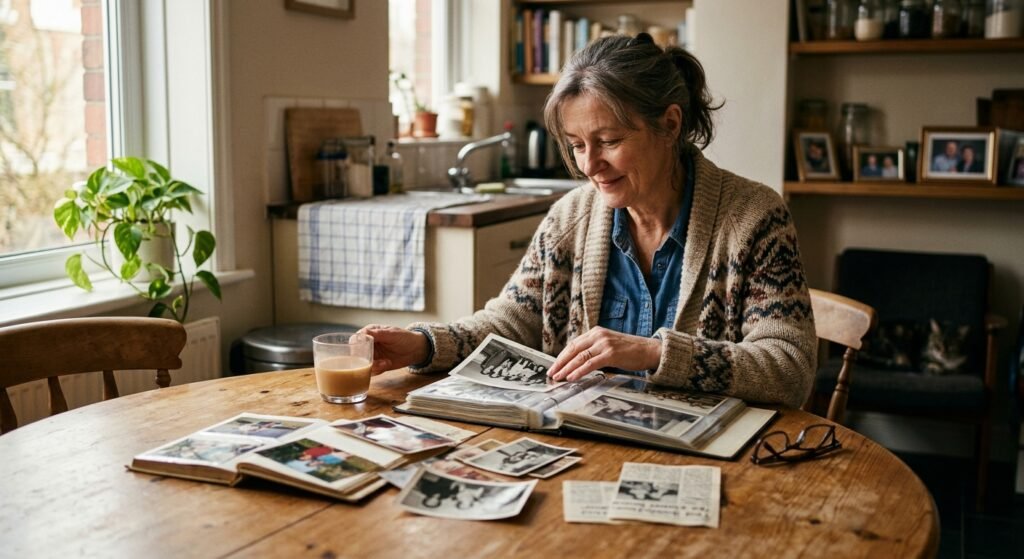
Maybe you are cleaning out a closet on a quiet Sunday afternoon, or maybe you are just scrolling through your phone trying to find an old receipt, when you stumble across a photo of yourself from five years ago. You look happy. Or maybe you look tired, or a little lost, wearing a shirt you haven’t seen in years, standing in a kitchen you no longer live in, next to someone who is no longer in your life.
But as you look at your own eyes in that picture, a strange, heavy sensation settles in your chest. It isn’t nostalgia, exactly. It is a quiet, specific ache that feels a lot like mourning. You realize you are looking at a stranger whom you used to know intimately, and you suddenly, desperately miss them.
We talk a lot about self-improvement and personal growth as if they are purely celebratory events. The cultural narrative around changing your life is almost always wrapped in triumph. We are told to embrace the next chapter, to let go of what no longer serves us, and to step boldly into the future. But what the self-help books and motivational posters forget to mention is that every single step forward requires leaving something behind. When you change your life—whether you leave a career, work through old habits, set boundaries with family, or simply outgrow an old way of thinking—you don’t just lose a pattern or a situation. You lose a version of yourself.
The Silent Loss Hidden Inside Growth
It is an unsettling experience to look back at your younger self and realize you can’t get back to them. You might look at the version of you who trusted easily, who stayed up until dawn laughing with friends, or who simply didn’t carry the worries you carry now, and wonder where they went. Even if you are healthier, wiser, and happier today, there is a distinct sorrow in realizing that the younger, softer, or more reckless version of you has faded away. It feels like a quiet betrayal of the person you used to be, as if by growing, you have somehow abandoned them.
This emotional weight is something counselors and researchers who study human development recognize as a vital, though often ignored, part of change. When we experience major life transitions, our minds go through a process that behaves remarkably like physical bereavement. Research into the psychology of transition suggests that we cannot fully commit to a new identity until we have properly acknowledged the ending of the old one. We tend to think of grief as something reserved for losing other people, but we also grieve the roles we used to play, the dreams we had to let go of, and the familiar ways of protecting ourselves that once kept us safe.
Why We Miss the Versions of Us That Hurt
This is why you might find yourself missing a version of yourself that wasn’t even particularly happy. You might find yourself longing for the chaotic, people-pleasing version of you from years ago, or the defensive, guarded version of you who didn’t let anyone get too close. It doesn’t make sense on paper. Why would you miss being anxious? Why would you miss being a pushover? But that old version of you, as flawed or wounded as they might have been, was comfortable. They knew how to survive in the world they had. Letting them go means stepping into an unfamiliar space where you don’t entirely know the rules yet.
Living in this middle space can feel incredibly lonely. You are no longer the person who tolerates being treated poorly, but you aren’t yet fully confident in your new boundaries. You are no longer the person who works sixty hours a week to prove their worth, but you feel deeply uneasy when you try to rest. It is easy to mistake this discomfort for a mistake. You might think that because you feel sad, or because you miss your old life, you must have made the wrong choice. But the sadness isn’t a sign that you’re going backward. It is simply the cost of moving forward.
Carrying Your Past Self Forward
Growth is not a clean, linear upgrade. It is a messy, circular process of shedding and rebuilding. The person you were did the absolute best they could with the tools, the knowledge, and the strength they had at the time. They got you to this exact moment. If you are able to stand here today, looking toward a healthier future, it is only because that past version of you carried you across the bridge.
So maybe the next time you look at an old photo and feel that familiar, heavy ache, you don’t have to push it away. You don’t have to force yourself to only feel grateful for how far you’ve come. You can allow yourself to sit with the quiet sadness of the loss. Maybe you aren’t actually afraid of the future. Maybe you are just grieving the brave, imperfect person you had to say goodbye to so you could finally become who you are today.