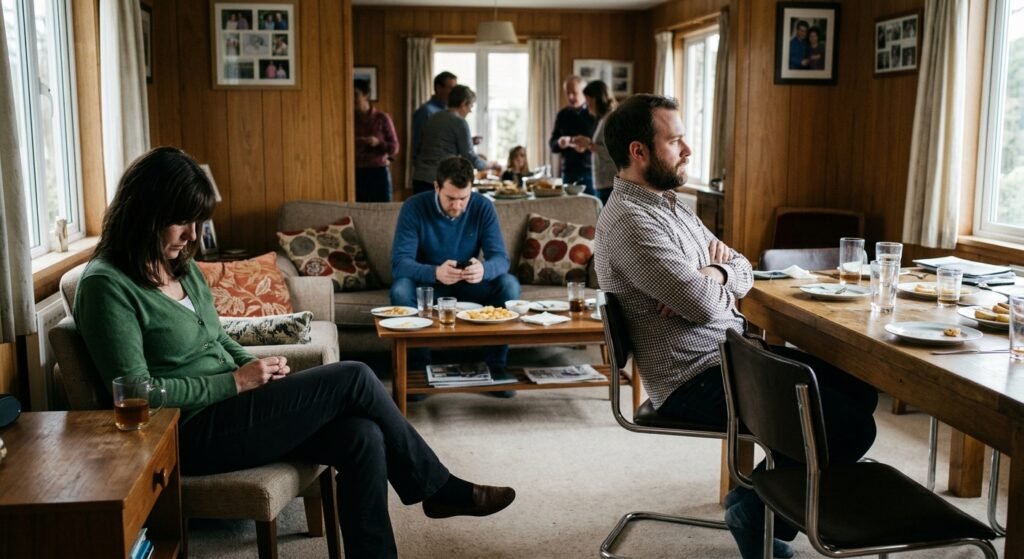
You are standing in the kitchen, perhaps rinsing a mug or staring into the pantry, when the noise begins. It starts with a sharp tone, a sudden scraping of a chair, and then the familiar, escalating chorus of two voices colliding. For years, you might have rolled your eyes, muttered a quiet sigh, and stepped in to play referee. You knew the script by heart: who took whose toy, who sat on whose side of the couch, who breathed too loudly in the other’s direction. It was annoying, sure, but it felt like the normal, noisy weather of raising children.
But lately, something in the air has changed. The fights do not sound like weather anymore. They sound like erosion. The words have a quieter, sharper edge, aiming for the soft spots instead of just the surface. When the door slams now, the silence that follows does not feel like a temporary truce. It feels like a widening gap. You find yourself sitting in the quiet, feeling a cold bloom of worry in your chest, wondering if this is still just a phase, or if you are watching the slow unraveling of a bond you always assumed would last forever.
The Quiet Weight of the Backseat War
It is easy to dismiss sibling conflict when children are small because the stakes feel so low. We tell ourselves that they will grow out of it, that they will laugh about these kitchen-floor standoffs when they are sharing a table decades from now. We look at our own family memories, remembering the wrestling matches and the stolen shirts, and we assume time is a magic eraser that automatically cleans the slate.
But when the bickering matures into something more targeted, that comforting narrative starts to fray. You notice the way one sibling retreats into their room and stays there, not out of anger, but out of self-preservation. You see the way another sibling uses their intimate knowledge of the other’s insecurities as a weapon during an argument. It is no longer about who gets the last slice of pizza; it is about who holds the power in the room. This is when the concern sets in, because you realize they are not just fighting. They are practicing how to hurt each other, and they are doing it with the people who know them best.
The Laboratory of First Connections
There is a unique intensity to sibling relationships because they represent our very first laboratory of human connection. Within the walls of a childhood home, we learn how to negotiate, how to share, how to voice our anger, and how to stand up for ourselves. It is a safe space to fail because, theoretically, the family unit is unconditional. We assume the safety net will always catch us, which is why we often treat our siblings with a raw honesty we would never dare show a classmate or a friend.
People who study family dynamics often point out that this friction is actually necessary. It helps children develop social skills, empathy, and emotional resilience. But there is a crucial line between the healthy friction of two distinct personalities learning to coexist and the kind of conflict that leaves lasting scars. When a child begins to feel consistently unsafe, unseen, or diminished by their brother or sister, the laboratory stops being a place of learning. It becomes a place of survival. And when survival becomes the goal, the heart naturally begins to close itself off to protect against further pain.
We Often Leave Them to Figure It Out
As parents, we are often advised to step back and let our children resolve their own differences. The conventional wisdom says that if we intervene too quickly, we rob them of the opportunity to develop conflict resolution skills. We tell them to work it out, or we banish them to opposite sides of the house until the storm passes. We treat time as the active ingredient in healing, hoping that a few hours of separation will naturally restore the peace.
The trouble is that time alone does not teach reconciliation; it only teaches distance. Research on sibling relationships reveals a sobering truth: children do not automatically learn how to repair a relationship simply because they have been told to go to their rooms. When we leave them entirely to their own devices without guiding them toward restoration, they often learn that the easiest way to deal with conflict is to withdraw. They discover that if they stay in their separate corners long enough, the heat of the anger will fade, but the coldness of the distance will remain. The fight might be over, but the relationship has not been mended. It has only been paused.
The Power of the Repair
If you look back at your own life, you can probably identify the relationships that felt safest. They were rarely the ones that were entirely free of disagreement. Instead, they were the ones where you knew, without a shadow of a doubt, that a rupture would be followed by a repair. You knew that even after a terrible argument, someone would eventually reach out, soften their voice, and help rebuild the bridge.
This is the piece we often miss in the flurry of daily family life. We focus so much energy on stopping the fighting—on managing the noise, handing out consequences, or demanding quick, empty apologies—that we forget to teach the art of coming back together. A forced apology muttered under a breath while staring at the floor is not a repair. It is a transaction designed to end a parent’s lecture. It does not heal the hurt, and it does not restore the trust. True repair requires a willingness to acknowledge the other person’s feelings, and that is a skill that must be modeled, practiced, and gently guided over time.
A Different Way to Look at the Noise
Perhaps the most exhausting part of watching your children fight is the fear of what it means for their future. You worry that you are failing as a parent, or that they are destined to become strangers who only see each other once a year. It is easy to internalize their conflict as a personal shortcoming, a sign that you have not loved them well enough or created a peaceful enough home.
But maybe the realization that changes everything is that sibling harmony was never about achieving a house free of conflict. It was never about raising children who never push each other’s buttons or lose their tempers. Maybe the goal is much smaller, and much more beautiful. Maybe our role isn’t to prevent the breaks from happening, but to show them that a break does not have to be permanent. When we help them navigate the quiet, awkward moments after a storm, when we encourage them to look each other in the eye and acknowledge the hurt, we are teaching them something far more valuable than how to win an argument. We are teaching them that love is strong enough to survive a fracture, and that returning to each other is always worth the effort.