
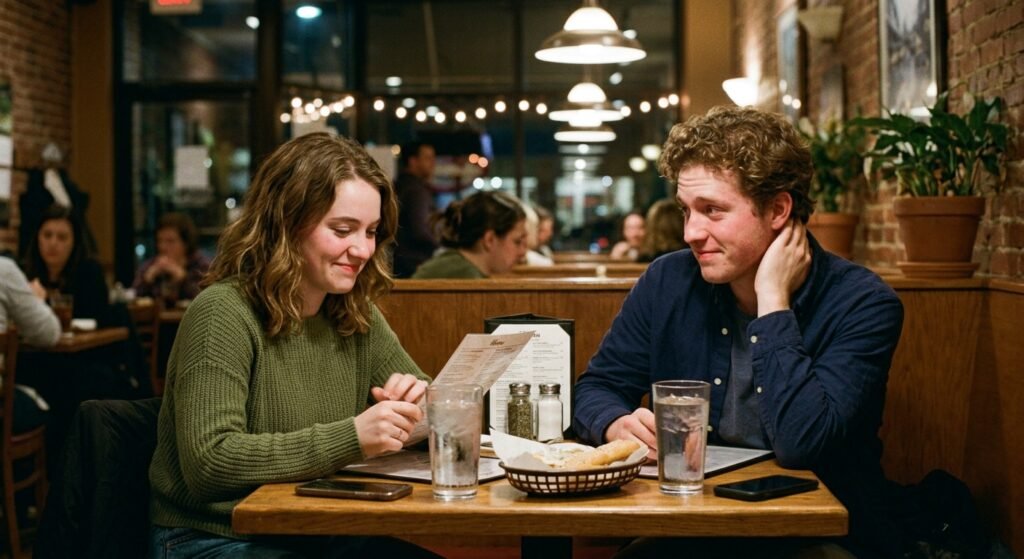
You’re sitting across from someone in a quiet corner of a neighborhood bistro, and suddenly you realize you’ve forgotten what to do with your hands. You reach for your water glass, misjudge the distance, and set it down with a sharp clink that feels remarkably loud in the quiet room. You laugh it off, but inside, a familiar wave of self-doubt rises. You’re a capable adult who manages projects, pays a mortgage, and navigates complex workplace dynamics with a steady hand. Yet here, in the presence of someone you genuinely want to know, you feel like a teenager who’s suddenly outgrown their own shoes.
It’s a strange kind of vulnerability, this feeling of sudden clumsiness. We spend decades building our lives, cultivating competence, and learning how to present ourselves to the world with a sense of polished ease. We know who we are in our careers, we know how to be dependable friends, and we know how to manage our solitary routines. But when it comes to the quiet invitation of emotional closeness, all that hard-won confidence can seem to vanish, leaving us feeling entirely unprepared for the simple act of letting someone in.
If you’ve felt this way, you’re far from alone. Many of us carry a silent expectation that as we grow older, our capacity for intimacy should automatically mature alongside our career paths and savings. We assume that because we can lead a meeting or organize a home, we should naturally know how to navigate the delicate, unfamiliar territory of a new connection. When we find ourselves stumbling over our words or overthinking a text message for three hours, we treat it as a personal defect rather than what it actually is: the natural friction of learning to share your space again.
The Competence Trap of Adulthood
One of the reasons adult vulnerability feels so difficult is because we’re no longer used to being beginners. In almost every other area of our lives, we’ve earned our comfort. We’ve learned how to avoid mistakes, how to anticipate problems, and how to protect our peace of mind. We’ve spent years building a version of ourselves that feels safe, stable, and predictable.
Then, someone comes along who makes us want to dismantle that safety. Intimacy, by its very nature, demands that we step out from behind our accomplishments and allow ourselves to be seen in all our unpolished reality. Relationship experts often point out that we can’t build a real connection while maintaining complete control over how we’re perceived. To be loved, we must risk being seen, and that risk immediately brings us face-to-face with our deepest uncertainties.
It’s like trying to learn a delicate new dance while wearing shoes that were designed for standing still. Psychology tells us that the patterns we rely on to survive, which researchers call our self-protective strategies, are often the very things that make us feel stiff and awkward when we try to open our hearts. You want to be close, but your hard-earned self-preservation keeps pulling you back toward the safety of isolation.
The Illusion of Effortless Connection
It’s remarkably easy to look around and assume everyone else received an instruction manual that somehow bypassed your mailbox. We see couples walking through the park or sharing quiet jokes at a coffee shop, and we imagine their journey to that point was a series of seamless, elegant steps. We live in a culture that loves to showcase the destination of love while hiding the messy, awkward roads it takes to get there.
But the truth is much quieter. Most people are simply hiding their hesitation behind better-fitting clothes. The clumsy feeling isn’t unique to you; it’s the universal cost of admission for stepping into the territory of the unknown. No one enters a new relationship with a perfect roadmap because every connection’s a brand-new country with its own language, customs, and terrain.
When you feel awkward, you’re not failing a test. You’re simply experiencing the reality of two separate lives trying to find a shared rhythm. That process is bound to have a few missteps, some misunderstood signals, and a fair share of nervous laughter.
Why the Stakes Feel Higher Now
When we’re young, stumbling is just part of the scenery. We’re clumsy with our career choices, our friendships, and our identities, so being clumsy in love feels like a natural extension of youth. We expect to make mistakes because we haven’t figured anything else out yet.
But when you attempt this dance later in life, the landscape feels entirely different. You’ve accumulated history. You’ve collected a few bruises from past disappointments. You’ve learned exactly how much it hurts when a connection falls apart. Consequently, the hesitation you feel isn’t just simple awkwardness; it’s actually your wisdom trying to keep you safe from being hurt again.
Your adult mind knows the risks, which is why it hesitates. You’re trying to protect the beautiful, independent life you’ve built for yourself while simultaneously wanting to share it with someone else. Balancing those two desires is a delicate act, and it’s completely natural to feel a bit unsteady as you try to find your footing.
The Beauty of the Unrehearsed Self
Perhaps the mistake we make is believing that love’s supposed to feel smooth. We treat closeness like a presentation that needs to be rehearsed until it’s flawless, hoping to impress the other person with our composure and emotional maturity. But a flawless presentation’s often just a shield designed to keep people at a safe distance.
When we’re perfectly poised, we’re rarely truly present. We’re managing our image rather than experiencing the connection. The moments that actually bring people together are almost always the unscripted ones: the shared confession of nervousness, the silly mistake that leads to genuine laughter, or the quiet admission that we don’t quite know what we’re doing.
These small, clumsy moments are the doors through which real intimacy enters. They signal to the other person that it’s safe for them to be imperfect too. They break the tension of expectation and allow both of you to stop performing and start simply being together.
So maybe being clumsy isn’t a defect after all. Maybe it’s proof that you still care enough to let your guard down, even when it feels terrifying. The awkward pause, the fumbled word, the nervous laugh, they’re not signs of emotional incompetence. They’re the quiet, beautiful evidence that you’re willing to step out of your comfortable safety and try to connect with another soul, even if you stumble along the way. You’re not the only one who feels this way, and sometimes, the most comforting thing we can tell someone we like is simply, “I’m a little nervous too.”