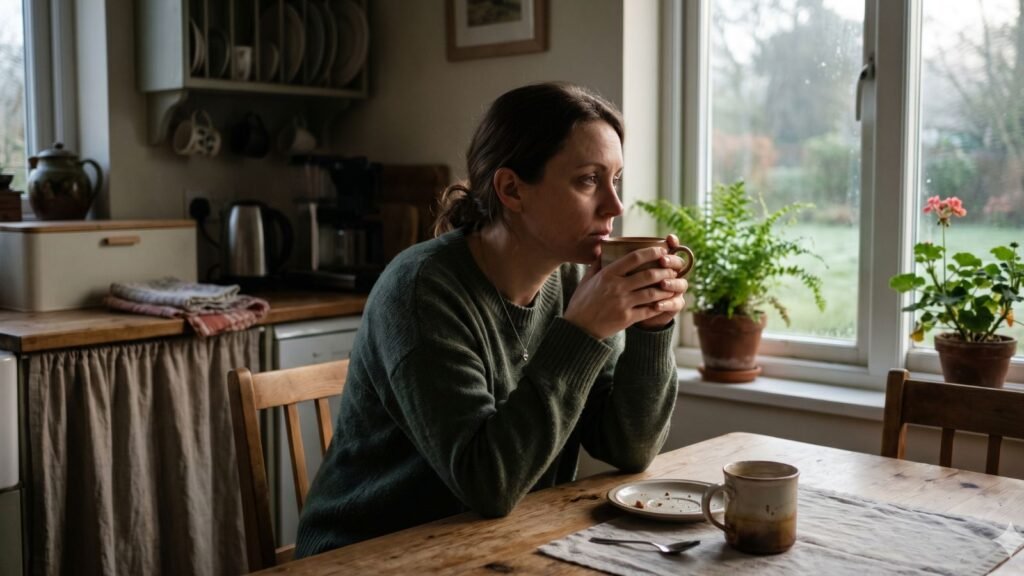

You’re sitting on the couch on a quiet Friday evening, looking around a room that’s actually clean for once. Your partner’s laughing at a silly show, the dog’s asleep at your feet, and for a few seconds, everything feels completely, beautifully alright. But then, almost instantly, a cold prickle of unease creeps up your neck. You find yourself wondering when the other shoe’s going to drop. You start scrolling through your bank app to find a hidden bill, or you suddenly remember a slightly tense email from three days ago and decide now’s the perfect time to obsess over it. Within minutes, the warmth of the evening’s gone, replaced by a familiar, nervous buzz.
It’s a strange way to live, yet so many of us do it every single day. We treat peace not as a resting place, but as a setup. When things are going well, we become suspicious. We look at a happy relationship, a successful week at work, or a rare moment of ease, and instead of leaning in, we pull back. We pick a small argument, find something to worry about, or quietly distance ourselves from the very people who are trying to love us. It’s as if we believe that if we get too comfortable, life will catch us off guard and hurt us even worse.
The Cozy Trap of Constant Alertness
Psychologists have a name for this habit of waiting for the disaster, and it often traces back to how our minds are wired to protect us. For thousands of years, survival depended on scanning the horizon for danger, not sitting around appreciating the scenery. But when this instinct gets tangled up in our modern lives, it turns joy into a threat. We begin to feel that being happy makes us vulnerable. We think that if we let our guard down and actually enjoy the moment, we’re leaving ourselves open to a surprise attack from life.
Researchers who study emotional resilience often point out that joy’s actually one of the most difficult emotions for people to tolerate. It feels exposed. When you’re feeling disappointed or stressed, you already know where you stand. You’re already on the ground, so you don’t have to fear falling. But when you allow yourself to feel true delight, you’re climbing up high. You’re admitting that you care about something, which means you have something to lose. Preemptively ruining the moment becomes a way to stay in control. If you break the glass first, you don’t have to worry about when it might shatter on its own.
The Stories We Tell Ourselves to Stay Safe
You can see this play out in the smallest interactions. Think of the last time someone paid you a genuine compliment. Did you simply say thank you, or did you quickly deflect it by pointing out a flaw? Or think about those times when a relationship feels peaceful and steady, and you suddenly feel an urgent need to bring up an old, resolved argument just to see how they react. We do these things because the quietness of a good moment can feel terrifyingly loud. We’re so accustomed to managing chaos that when the chaos disappears, we feel lost.
It’s easy to label this behavior as sabotage, but that word’s too harsh for what’s actually happening. It isn’t that you want to ruin your life. It’s that you’re trying very hard to protect yourself from pain. You’re attempting to negotiate with the future. By anticipating the disappointment, you believe you’re softening the blow. You tell yourself that if you expect the trip to be canceled, or the job offer to fall through, or the person to leave, it won’t hurt as much when it happens.
The Cost of Preempting the Pain
But if you look back at the times when life did actually fall apart, you might notice something interesting. The disappointment didn’t hurt any less because you spent weeks worrying about it beforehand. When the bad news arrived, the anxiety you felt earlier didn’t act as a shield. It didn’t make the sadness easier to carry. All it did was rob you of the peaceful days you could’ve enjoyed before the storm arrived. You paid the tax on a disaster that hadn’t even happened yet, and sometimes on one that never happened at all.
This realization changes how we look at those fleeting, beautiful moments of our lives. When we try to protect ourselves from the drop, we don’t actually keep ourselves safe. We only make sure that we never truly get to experience the heights. We spend our lives preparing for a future grief, missing the actual present that’s sitting right in front of us, waiting to be lived.
Perhaps the goal isn’t to stop feeling anxious, because that nervous hum’s a natural part of being alive. Maybe the goal’s simply to notice when we’re trying to break our own glass. The next time you find yourself waiting for the other shoe to drop, you can take a breath and look around the room. You can acknowledge the fear, but you can also choose to stay on the couch, watch the silly show, and let the good moment be exactly what it’s meant to be, even if it’s only for a little while.