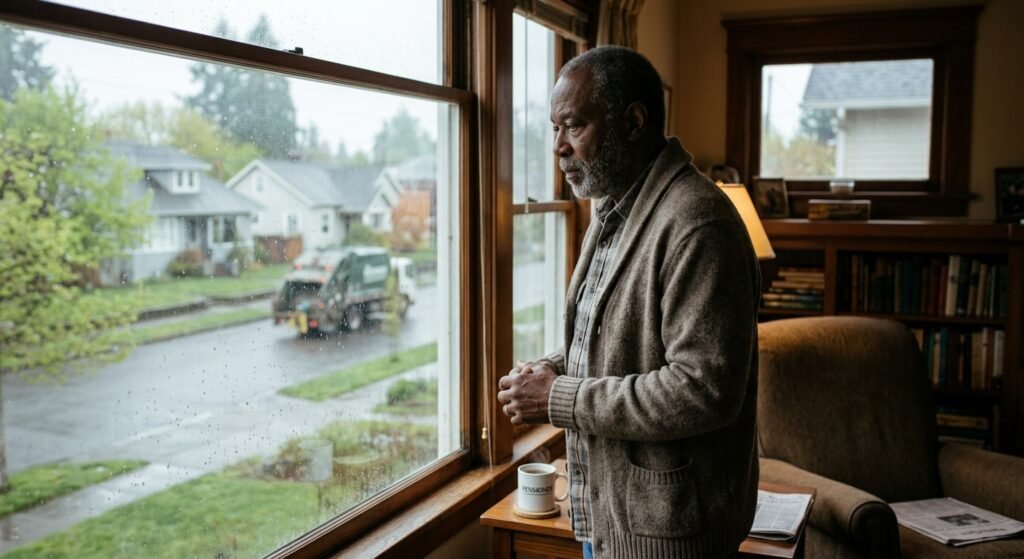
Imagine waking up on a random Tuesday, walking into the kitchen, and making a cup of coffee. For decades, this moment was a blur of running shoes, misplaced keys, and the quiet pressure of a morning commute. But today, there’s no train to catch, no inbox waiting for you, and no morning huddle. You look at the clock on the microwave. It’s 7:15 AM. You realize you’ve got at least fourteen unstructured hours ahead of you before you can reasonably justify going back to bed, and suddenly, a strange, cold wave of panic washes over you.
We spend our entire working lives dreaming of this exact moment. We tell ourselves that if we just had more time, we’d read more books, learn to bake sourdough, travel, or finally organize the basement. We treat unscheduled time like a beautiful, distant destination. But when you finally arrive, the silence of a completely empty day can feel less like a tropical beach and more like standing on the edge of a cliff.
It’s a quiet confession that many retirees and people going through major life transitions rarely make out loud: unlimited freedom can feel terrifying. When the congratulations cards are put away and the retirement party ends, you’re left with a calendar that doesn’t need you. That’s when you realize that the structure you spent years complaining about was actually keeping you steady.
The Comfort of a Preconstructed Day
For most of our lives, we don’t actually have to decide how to spend our days. Society gives us a ready template. We wake up, go to work, take care of our families, run errands, squeeze in a little recreation, and collapse into sleep. The hours are already claimed. There’s comfort in that because it removes the burden of choice.
When you remove that existing blueprint, every single hour becomes a decision. You have to decide when to eat, when to move, when to rest, and when to speak to another person. Without a boss, a client, or a deadline telling you what matters, you have to invent your own reasons to get out of bed.
This transition is particularly jarring because our culture praises productivity above almost everything else. From the time we’re children, we’re taught to measure our worth by what we accomplish. When you suddenly have nothing you’re required to accomplish, you’re forced to face a difficult question: Who are you when you’re not producing anything?
The Invisible Support of Our Lives
Decades ago, a social psychologist named Marie Jahoda studied what makes work so emotionally important to us, and her findings are still deeply relevant today. She pointed out that employment provides what she called latent benefits, such as a predictable daily schedule, regular contact with other people, a sense of collective purpose, and a clear status in the community.
When you stop working, those benefits vanish overnight. The panic you feel on a Tuesday afternoon isn’t because you’re bored or lazy. It’s because the invisible scaffolding that held your life together has been dismantled. You aren’t just missing your salary or your job title; you’re missing the rhythm that kept you connected to the world around you.
Without that rhythm, time can start to feel elastic and strange. An hour can feel like a day, and a day can feel like an eternity. You might find yourself checking the clock repeatedly, wondering how it can only be 11:30 AM when you feel like you’ve already lived a full lifetime since breakfast.
Learning the Art of Inner Direction
The secret to navigating this transition isn’t to immediately fill your calendar with artificial busyness. Many people try this. They sign up for every volunteer group, take on complex home renovation projects, or book consecutive trips in an effort to outrun the emptiness. But keeping busy just to avoid the quiet isn’t the same as finding meaning.
Instead, the real task of this chapter of life is learning how to hold your own hand through the quiet. It’s about building a new kind of structure, one that comes from within rather than being imposed by an employer or a clock.
This doesn’t happen overnight. It requires patience and a willingness to feel a little lost for a while. You might start by creating tiny, personal rituals that have nothing to do with productivity. Perhaps it’s reading the paper on the porch for exactly one hour, or walking a specific route through your neighborhood at the same time every afternoon. These small anchors help rebuild a sense of predictability and agency.
Finding Peace in the Unscheduled Hours
Eventually, the vertigo of the empty calendar begins to fade. You start to realize that a day without a plan isn’t a void to be feared; it’s a space where you can finally listen to your own voice.
Perhaps the real realization of retirement isn’t that you’ve earned the right to do nothing. It’s that you finally have the freedom to decide what matters to you, completely on your own terms. The panic of having fourteen hours to fill slowly turns into a quiet curiosity about what those hours might hold.
You don’t need to change the world anymore. You don’t need to prove your value to a manager or a company. You just need to learn how to exist comfortably in your own company, one quiet hour at a time. And in the end, learning how to be the author of your own day is one of the most courageous things you’ll ever do.