The Quiet Relief of the Capable Child
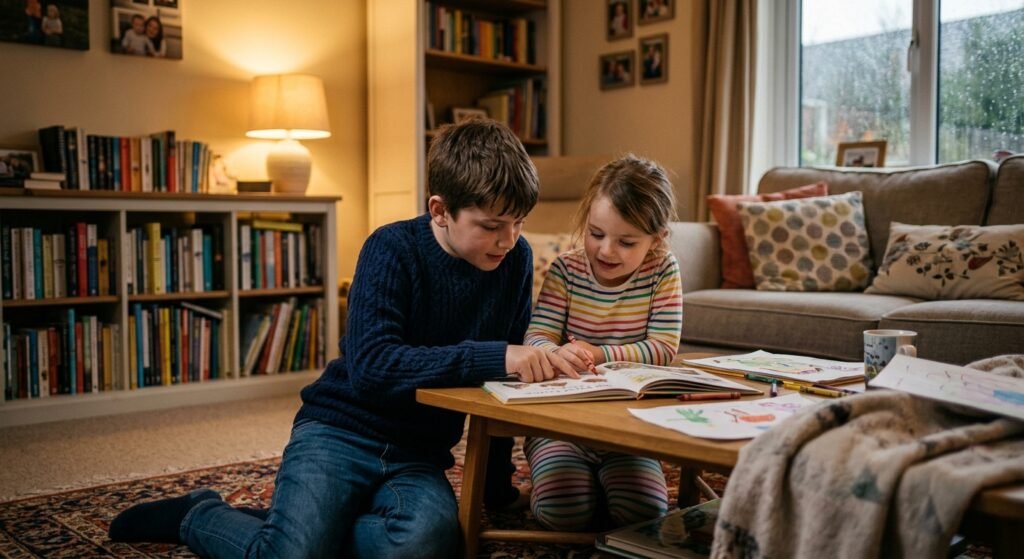
You’re standing in the kitchen, trying to coordinate dinner while answering a work email on your phone, when you hear the familiar sound of a younger child starting to melt down in the living room. Before you can even put your phone down to intervene, the commotion stops. You walk to the doorway and see your oldest child sitting on the floor, holding out a favorite toy and speaking in a calm, soothing voice they’ve clearly copied from you. The crisis is averted. You feel a wave of immense gratitude, a quiet breath of relief, and you think to yourself how lucky you are to have a child who’s so mature, so helpful, and so reliable.
It’s a beautiful moment, but it also carries a subtle complexity that most parents recognize if they look closely enough. There’s a distinct comfort in having an older child who can help run the household, whether that means keeping an eye on their siblings, putting away their own laundry without being asked, or noticing when you’re tired and quietly stepping in to ease the burden. We often praise these children for being wise beyond their years. We tell our friends how dependable they are, and we rely on them to be the steady anchor in the swirling chaos of family life.
But sometimes, if we pay close attention during the quiet moments after the toys are put away and the lights are turned down, we might notice a different side to this maturity. We might see an older child who feels a quiet obligation to keep everyone else happy. We might notice that they’re constantly scanning the room, watching our faces for signs of stress, and deciding that their own needs can wait because they don’t want to add to our daily struggles.
How the Helper Role Quietly Expands
Children are remarkably perceptive. They’re experts at reading our energy, our sighs, and the tight lines around our eyes when we’re overwhelmed. Because they love us and want to feel secure, their natural instinct is to try to fix whatever’s causing us distress. If they see us struggling to balance everything, they’ll quietly step into the empty spaces, taking on tasks and emotional responsibilities that belong to the adults in the house.
Family researchers often study the roles people adopt during childhood, noting how easily the oldest child can slip into the position of a deputy parent. While assigning chores is a healthy part of teaching responsibility, there’s a fine line between giving a child a sense of contribution and expecting them to carry the emotional stability of the home. When we rely too much on their capability, we might accidentally teach them that their worth is directly tied to how useful they can be.
This dynamic often develops with the best of intentions. No parent sets out to overburden their child. Instead, it happens slowly, through a series of small, daily decisions. It’s asking them to watch their sibling for just ten minutes while you take a phone call, which gradually turns into an hour every afternoon. It’s venting to them about your day because they’re such a good listener, forgetting that they don’t yet have the emotional tools to process adult worries. Over time, the capable child learns to put their own feelings in a drawer, believing it’s their job to keep the peace and make life easier for everyone else.
The Long-Term Cost of Being the Easy One
There’s a unique kind of loneliness that comes with being the easy child. When a child’s always cooperative, always helpful, and never seems to cause any trouble, we naturally focus our attention on the siblings who are louder, more demanding, or struggling more obviously. We assume the capable child is doing fine because they don’t ask for help. We think they’re thriving, when in reality, they may just be very good at hiding their own confusion and anxiety.
When children grow up believing they must always be the strong ones, they often carry that pattern into their adult lives. They might find themselves constantly rescuing others in their relationships, struggling to set boundaries, or feeling deeply anxious whenever they can’t solve someone else’s problem. They become adults who feel responsible for everyone else’s happiness while completely losing touch with their own desires and needs.
This is why it’s so important to look past their capability and see their vulnerability. An older child may be perfectly capable of packing their own lunch, managing their homework, and keeping their room clean, but they still need to feel the warmth of our care. They still need to know they’re allowed to have bad days, to make mistakes, to lose their temper, and to be entirely dependent on us, even when they’re fully equipped to handle things on their own.
Finding the Balance of Contribution
Allowing children to help isn’t the problem; in fact, contributing to the household gives children a sense of belonging and purpose. The distinction lies in how those tasks are framed and held. Healthy contribution feels like being part of a team where everyone does their part, but the ultimate responsibility for the team’s safety and well-being still rests entirely on the coach’s shoulders.
We can protect this balance by being mindful of the boundaries we set around their childhood. We can thank them for their help while explicitly reminding them they don’t have to fix our bad days or manage their siblings’ behavior. We can make a conscious effort to carve out quiet moments where we offer them our full attention, asking them about their world without any expectation of them being helpful or productive in return.
Maybe the realization we need to reach isn’t that we should stop asking our older children to help. Perhaps it’s remembering that their maturity is still a work in progress, and their capability should never become a reason for us to withdraw our support. Even the strongest, most dependable children deserve the comfort of knowing they don’t have to hold everything together. They deserve to step back, let go of the reins, and simply be children who are safely held by the adults who love them.