
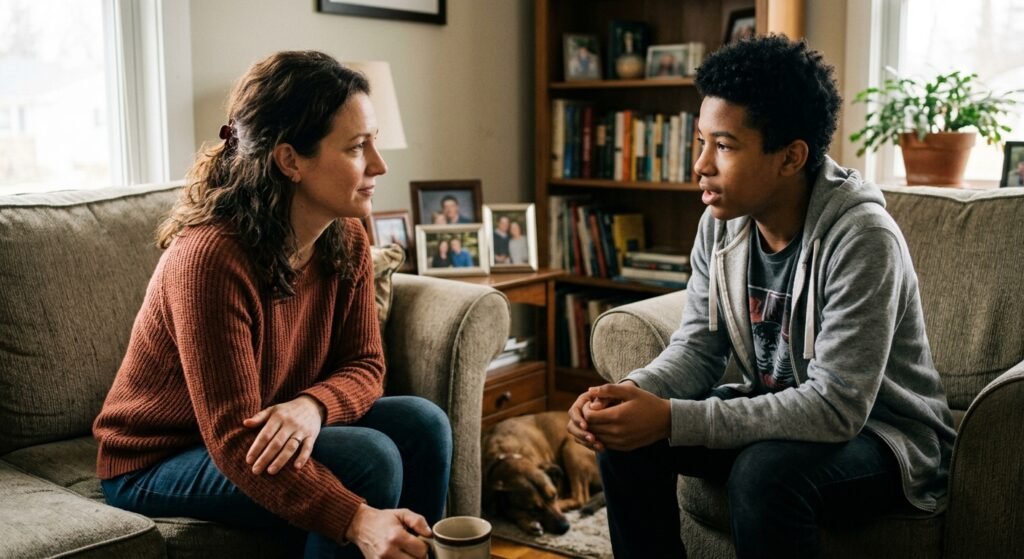
There is a specific kind of quiet that settles into a car during a drive with a teenager. It’s not the comfortable stillness of two people who know each other so well that words aren’t needed, nor is it an angry silence. It’s more like a waiting room. You look over at the passenger seat and see someone who, just a few years ago, would not stop talking about school, playground friendships, or the exact details of a cartoon episode. Now, they’re wearing headphones, staring out the window, occasionally typing something on their screen with a speed that seems to defy physics.
If you ask them a question, you might get a single syllable, or perhaps a word you’ve never heard before that makes you feel ancient. You find yourself wanting to look up their new vocabulary on your phone when they aren’t watching, just to make sure you aren’t missing something important. It’s easy to feel a quiet panic in these moments, wondering when you crossed an invisible border into a country where you no longer speak the native tongue.
The Language of Growing Up
When our children are small, we’re the authors of their world. We teach them the names of things, we interpret their cries, and we translate their early, messy sentences to the rest of the world. We get used to being the ultimate authority on what they mean and what they need. Then, almost overnight, the dynamic flips. They begin constructing a world that purposely excludes us, using slang, music, and interests designed to establish a boundary between their growing self and their family.
It’s tempting to view this change as a personal rejection. When they shrug off your questions or roll their eyes at your attempt to use their new slang, it hurts. But developmental researchers who study family dynamics suggest that this linguistic and emotional distance isn’t a sign of a failing relationship. In fact, studies show that teenagers who feel most secure in their parents’ love are often the ones who feel safest exploring these new boundaries. They can experiment with different identities, languages, and attitudes precisely because they know your support is unconditional. They aren’t pulling away because they don’t love you; they’re pulling away because they trust you to stay put while they figure out who they are.
Moving From Expert to Explorer
The challenge for most of us is that we want to fix the distance. When we feel the gap widening, our instinct is to push harder, to demand answers, or to offer unsolicited advice about how they should navigate their lives. We want to regain our status as the expert who knows exactly what to do. But teenagers don’t need us to be experts anymore; they need us to be curious.
When we meet their new, unfamiliar world with frustration, we inadvertently close the door. Laughing at their music, criticizing their interests, or lecturing them about how much simpler things were when we were young only teaches them that their current reality isn’t safe with us. On the other hand, meeting their changing world with quiet curiosity changes the entire energy of the room. You don’t have to love their music or understand every phrase they use. You just have to show them that you’re interested in the person who does.
The Art of Staying Put
Staying connected during these years often requires us to learn a new way of listening. It means sitting in the car and letting the silence exist without trying to fill it with interrogation. It means paying attention to the small details they do choose to share, even if it’s just a funny video or a song they like, and treating those offerings like the valuable gifts they are.
We often think that parenting is about keeping our children close by maintaining constant, deep conversations. But perhaps the real work of parenting a teenager is learning to stand comfortably at the edge of their lives, holding the door open. It’s about letting them know that they don’t have to explain themselves perfectly to be welcome at our table.
Maybe we don’t need to understand every single word they say to show them we’re listening. Maybe connection isn’t about speaking the exact same language. It’s about being the person who is still standing there, warm and waiting, when they finally decide to translate their world for us.