
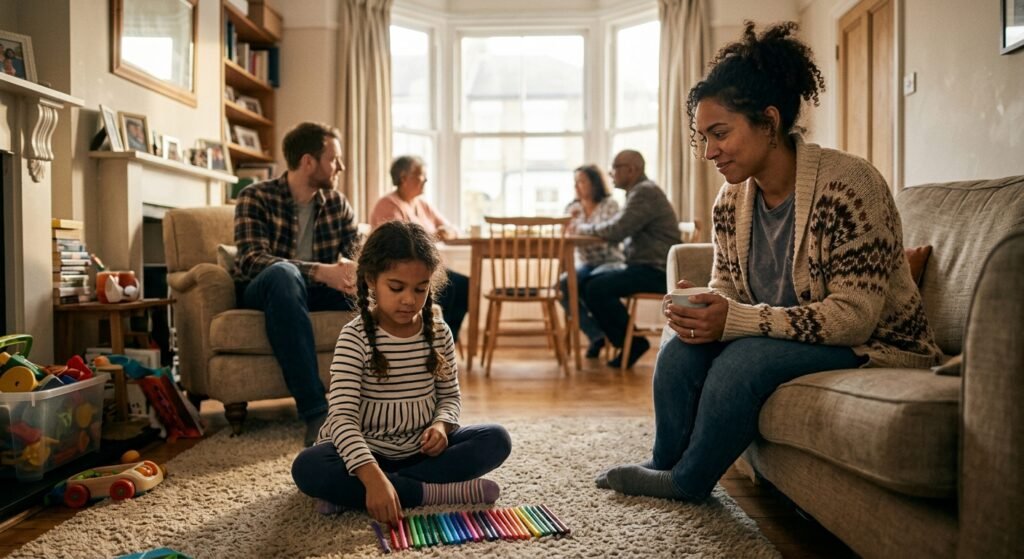
You are standing in the kitchen, watching a puddle of juice slowly expand across the hardwood floor, and before you can even think, a voice comes out of your mouth. It is loud, sharp, and instantly recognizable. The strange thing is that the voice does not actually belong to you. It belongs to your mother from thirty years ago, or perhaps your father on a stressful Saturday morning. You stand there, sponge in hand, feeling a sudden chill of recognition. You promised yourself you would never react that way over something as small as spilled juice, yet there you are, delivering the exact same lecture with the exact same tone.
Most of us spend our twenties believing we are entirely our own creation. We move away from home, decorate our spaces differently, choose different careers, and adopt different lifestyles. We tell ourselves that we have learned from our families’ mistakes and that our own homes will be different. But then we have children, or we find ourselves living with a partner, and the quiet scripts we didn’t even know we memorized begin to play. It happens when we are tired, when the budget is tight, or when we are running ten minutes late. Suddenly, the autopilot takes over, and we are repeating behaviors we once swore we would leave behind.
The Scripts We Memorize Without Trying
These patterns do not show up as grand statements of philosophy. Instead, they live in the tiny, daily routines that make up a life. It is the way you immediately start cleaning the house when you are anxious, because that is how your mother managed her stress. It is the way you shut down and go silent during a disagreement, because conflict in your childhood home was always followed by days of icy quiet. Or perhaps it is the way you feel an intense pressure to finish every single thing on your plate, even when you are full, because of a story about empty pantries that was told to you decades ago.
We do not repeat these actions because we agree with them. We repeat them because they are the earliest blueprints we were given for how to navigate the world. When a child watches their parents move through life, they are not just watching; they are absorbing. They are learning how to handle anger, how to express affection, how to respond to failure, and how to deal with disappointment. Those early experiences create deep pathways in our minds. When we find ourselves in similar situations as adults, our brains naturally search for the path of least resistance, which is almost always the path we walked when we were small.
The Quiet Logic of Our Recreations
People who study family systems often point out that children are excellent observers but poor interpreters. A child might notice that their parents only seem to pay attention to them when they are achieving something, whether it is getting good grades or winning a game. The child interprets this to mean that love is something you must earn through constant effort. Thirty years later, that same person is now a parent who is constantly pushing their own children to achieve, feeling a strange anxiety whenever their child just wants to rest. The cycle continues, not out of malice, but because we genuinely do not realize we are using an old guidebook to navigate a completely new landscape.
There is a comforting explanation for why our minds do this. Experts in developmental psychology suggest that repeating familiar patterns, even the stressful ones, feels safer to our brain than stepping into the unknown. There is a strange predictability in the chaos we already know. If you grew up in a home where love was always accompanied by high anxiety, peaceful relationships might actually feel boring or even unsettling to you now. You might unconsciously create tension or find things to worry about just to bring the room back to a level of anxiety that feels familiar. It is a way of trying to solve an old puzzle using the same pieces, hoping that this time, the picture will turn out differently.
Seeing the Pattern is the Hardest Part
The trickiest thing about these habits is that they are completely invisible to us until they aren’t. We do not wake up and choose to copy our parents. We simply react to our children or our partners in the moment, convinced that our response is the only logical one. It is only in the quiet moments afterward, when the house is still and everyone is asleep, that we get that lingering feeling that we have played this scene before. We start to see that the irritation we felt when our child refused to put on their shoes was not actually about the shoes. It was about our own deep fear of being late, of looking disorganized, or of being judged by others, a fear we inherited long ago.
Deciding What to Carry Forward
Once you begin to notice these echoes, it is easy to feel a sense of defeat. You might worry that you are destined to pass down every single struggle you experienced to the next generation. But there is a profound difference between repeating a pattern unconsciously and repeating it with awareness. The moment you stand in the kitchen, feel that old anger rising, and simply choose to take a breath instead of shouting, the cycle changes. You are not just changing your reaction to a spilled glass of juice; you are quietly rewriting the future.
This is not about achieving perfect composure or never losing your temper again. Nobody parenting in the real world can live up to that standard. Rather, it is about developing a gentle curiosity toward your own reactions. When you find yourself overreacting to a minor mess, or feeling deeply uncomfortable with your child’s sadness, you can stop and ask yourself where that feeling actually belongs. Does it belong to this moment, right now, or is it a visitor from your past?
Ultimately, we do not have to be defined by the patterns we inherited. We can appreciate the ways our parents tried to protect us, even if their methods were imperfect, while still deciding that we want to build a different kind of home. Awareness does not arrive all at once in a grand moment of clarity. It arrives in the small choices we make every day, in the pauses we take before we speak, and in the grace we offer ourselves when we occasionally slip back into old habits. Perhaps the goal was never to be perfect parents or partners. Perhaps the goal is simply to be awake to the lives we are actually living, so we can finally decide which stories are ours to keep, and which ones we are finally ready to put down.