
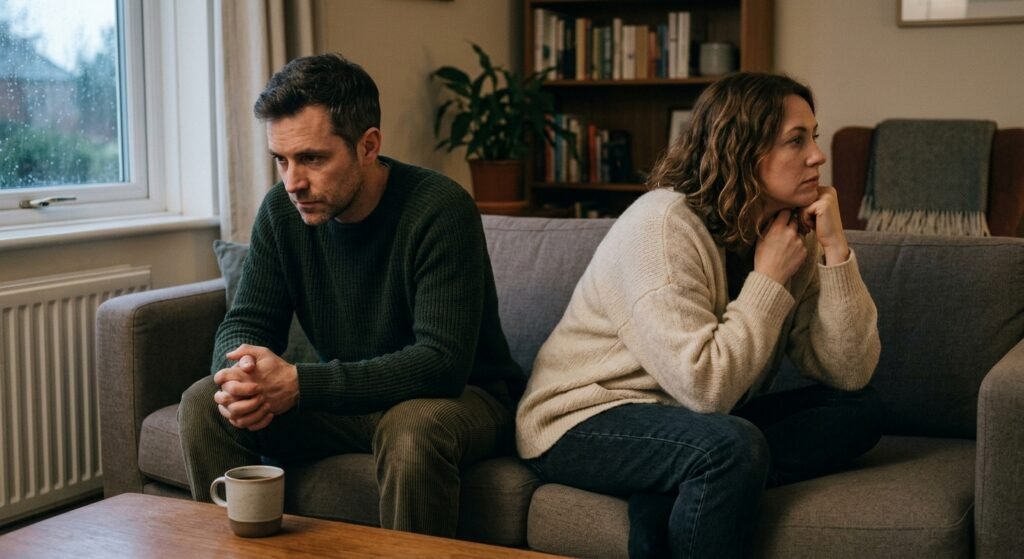
Have you ever sat on a couch right next to someone you love, close enough that your shoulders are practically touching, yet felt like you’re trying to shout across a canyon? You might be watching the same show, sharing the same blanket, or even occasionally exchanging quiet, polite remarks about your day. On paper, you’re together. To anyone looking through the living room window, you look like the picture of a stable, peaceful relationship. But inside, you’re carrying a quiet ache that feels far more profound than the simple solitude of being single. It’s the realization that you’re completely, undeniably alone in their presence.
It’s a strange kind of heartbreak, isn’t it? When you’re single, loneliness makes sense. It’s a natural response to an empty apartment, a quiet phone, or a Friday night without plans. You expect it, so you can prepare for it. You can call a friend, step outside for a walk, or throw yourself into a hobby. But when you feel that exact same emptiness while looking directly at the person who’s supposed to be your home, it catches you off guard. It feels like a betrayal of the promise of partnership, leaving you stranded in a place where comfort is supposed to live.
Think about those small, ordinary moments that happen in every household. You see a funny picture online and turn to show them, but they give a quick, polite nod without really looking. Or you try to share a lingering worry about your career, hoping for reassurance, but they offer a distracted, one-word answer before returning to their screen. You don’t get angry. You don’t start an argument. Instead, you quietly fold that little piece of yourself back up and tuck it away. Over time, those tiny moments of missed connection start to accumulate, leaving a quiet space where closeness used to be.
The Architecture of Emotional Distance
When these missed connections become your everyday reality, your behavior starts to change in subtle ways. You stop sharing the little things because it feels less painful to keep them to yourself than to watch them land in empty space. You find yourself carefully editing your thoughts before you speak, asking yourself if this is worth the effort of trying to bridge the gap. Eventually, the silence between you stops being comfortable and starts feeling like a deliberate wall. You’re still sharing a life, but you’re no longer sharing yourself.
This is the quiet landscape of emotional loneliness. It’s not about physical distance. You can live in the same house, sleep in the same bed, and share the same daily routines, yet still feel entirely unseen. True connection isn’t created by sharing a zip code or a calendar; it’s built through the steady, mutual exchange of tiny, everyday vulnerabilities. When that exchange stops, the relationship becomes a shell of itself, maintained by habit rather than genuine interest.
People who study relationships often look at how couples interact during these ordinary moments. There’s a well-known concept in relationship research that looks at these attempts to connect as simple invitations. Every time you share a thought, ask a question, or point out something interesting, you’re extending a small invitation for closeness. You’re essentially asking if they see you, and if they care about what you’re feeling in that moment. It’s the emotional currency that keeps a partnership alive.
The Distrust That Grows in Empty Spaces
When the other person consistently ignores or misses those invitations, something quiet but significant begins to turn. It’s not usually a sudden conflict that ends a relationship; it’s the slow, steady erosion of trust. You begin to realize that your emotional world isn’t being mirrored back to you. When you share joy and it isn’t met with warmth, or when you share sadness and it isn’t met with comfort, your mind registers that as a subtle rejection. To protect yourself, you slowly stop extending those invitations altogether.
You become roommates who share responsibilities, coordinate schedules, and divide chores, but who no longer share their inner lives. You might become highly efficient partners running the household, but the emotional heart of the relationship has gone quiet. This survival strategy keeps the peace, but it also solidifies the distance. By protecting yourself from the pain of being ignored, you also lock yourself out of the possibility of being reached.
Studies on partnership and emotional health consistently show that having an unresponsive partner can be more taxing on our peace of mind than actually being alone. When we’re entirely single, our minds adjust to the independence. We build networks of friends, find comfort in our own routines, and don’t expect our domestic space to hold our emotional needs. But when we’re in a partnership, our nervous systems are wired to seek safety and reassurance from that specific person. When that reassurance is absent, it creates a constant, quiet state of distress.
Finding Your Way Back to Yourself
We’re constantly reaching out for a hand that isn’t quite there, which is far more exhausting than simply learning to walk on our own. It’s why so many people look back on their most lonely chapters and realize those periods didn’t happen when they lived by themselves, but rather when they were sharing a life with someone who had emotionally checked out. The presence of another person can sometimes act as a mirage, making you believe help is close by when you’re actually wandering the desert alone.
Recognizing this kind of loneliness doesn’t mean you have to immediately make drastic decisions or pack your bags. Relationships go through seasons, and stress, exhaustion, or grief can temporarily pull anyone away from their partner. Sometimes, the distance is just a sign that both of you have run out of emotional resources and need a quiet space to recharge. But when the silence becomes a permanent resident in your home, it demands a different kind of attention.
Maybe the deepest heartbreak of a lonely relationship isn’t that the other person is failing to meet your needs. Maybe it’s that you’re slowly abandoning your own needs to make the silence feel normal. You stretch yourself thin trying to match their quietness, shrinking your world so that your loneliness doesn’t feel so loud. But in doing so, you lose the very things that make you who you are. The realization that changes everything is that you can’t keep yourself small just to make an empty relationship feel full. True connection requires space for both of you to exist, and sometimes, remembering how to be yourself is the first step toward finding a space where you actually belong.