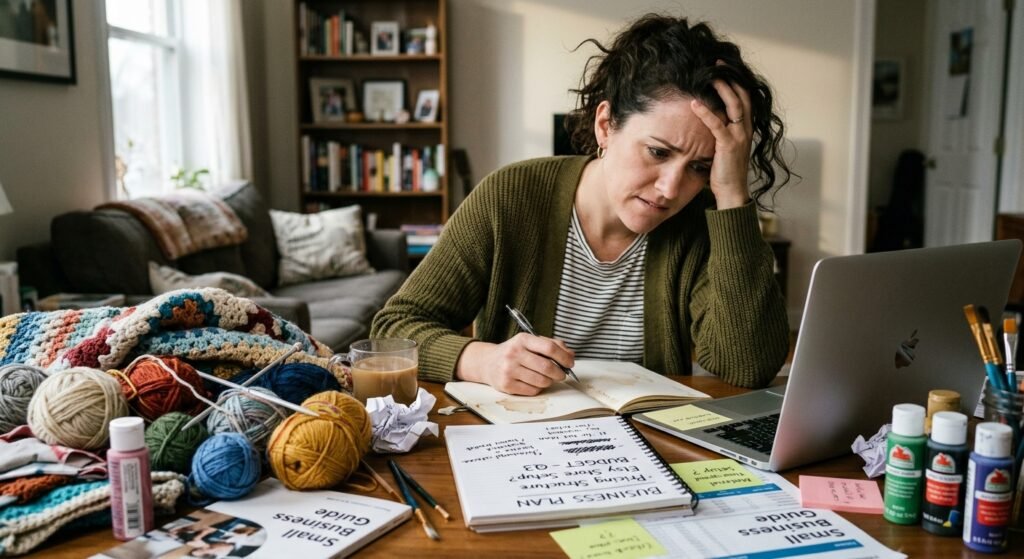
Can we talk about this for a second?
You decide to take up watercolor painting. Or maybe you buy a bag of flour to try making your own sourdough bread. You spend a quiet Saturday afternoon mixing, measuring, and actually enjoying the process. The bread comes out of the oven looking surprisingly like bread. You take a picture, send it to a friend, and take a delicious, warm bite.
But then, a strange thing happens.
Instead of just eating the bread and enjoying your weekend, you find yourself staring at the kitchen counter, doing mental math. You start thinking about how much flour costs in bulk. You wonder if you could fit three more loaf pans in your oven. By the time you’ve finished your second slice, you’re looking up the vendor fees for the local farmers market and trying to decide if “Sourdough Secrets” is too cheesy of a name for an Instagram page.
Somehow this always happens.
For some reason, it suddenly feels completely reasonable to take something you did purely for fun and try to turn it into a tiny, stressful business.
The Golden Age of the Side Hustle
We’ve all been there. You learn how to knit a scarf, and three hours later you’re looking up shipping rates online. You buy a camera to take pictures of your dog, and suddenly you’re designing a wedding photography pricing guide in your head. You start a garden, grow three tomatoes, and immediately begin calculating how much you could save on groceries if you expanded your backyard into a full-scale organic farm.
At some point, it stops being about the activity itself.
Instead, it becomes about the potential. We look at our spare time and feel this quiet, nagging pressure to make every single hour count. If we’re enjoying ourselves, we assume we should be charging someone for it. It’s like we need permission to have a hobby, and the only way to get that permission is to attach a price tag to it.
The Invisible Price of Optimization
The funny part is how quickly the math falls apart.
You convince yourself that selling your homemade candles will be a fun way to make a little extra cash. You buy the wax, the jars, the scents, and the cute little labels. You spend your Tuesday evening pouring wax into glass jars, enjoying the sweet smell of vanilla filling your kitchen.
Five minutes later, you’re sitting on the living room floor surrounded by cardboard boxes, trying to figure out how to print shipping labels while your dinner gets cold.
Suddenly, your peaceful hobby has turned into customer service.
You’re responding to messages from people who want to know if the vanilla scent has notes of cedar. You’re stressing over whether the postal service is going to melt your inventory. You’ve successfully converted your relaxing evening ritual into an unpaid internship for yourself.
We all know how this ends.
Eventually, the candle supplies sit in a box in the closet because making them feels like going to a second job where the boss is exceptionally demanding and also happens to be you.
Why We Can’t Just Play
Why do we do this to ourselves?
Maybe it’s because we’ve grown so used to being busy that we don’t really know how to exist without a goal. Sitting on the couch and knitting a blanket because it feels nice in your hands can feel almost uncomfortable. Our brains start whispering that we’re being lazy, or that we should be doing something more productive with our hands.
So we invent a goal. We tell ourselves we’re building a brand.
That way, when we’re sitting on the floor surrounded by yarn, we aren’t just wasting time. We’re working on our startup. We’ve managed to trick our brains into letting us relax by pretending we’re actually on the clock.
But here’s the secret we keep forgetting.
You’re allowed to be completely terrible at something and still do it.
You can paint lopsided flowers that look like scrambled eggs. You can write poetry that doesn’t make any sense. You can bake cookies that are slightly burnt on the bottom and just eat them yourself without posting a single photo or asking anyone for five dollars.
There’s a quiet joy in making something that is just for you.
It doesn’t need to be optimized. It doesn’t need to be scalable. It doesn’t need to have a logo, a business plan, or a target demographic.
Finding the Joy in Doing Nothing Useful
So the next time you find yourself looking at a hobby and wondering how much you could charge for it on the internet, take a breath.
You don’t need to monetize your peace of mind.
Go ahead and make that sourdough bread. Eat it while it’s still warm. Share a slice with someone you like. And when you’re done, let the kitchen be messy for a little while without worrying about your brand’s aesthetic.
Honestly, we all do this.
You’ll probably think about starting an online store again next week when you try your hand at pottery. But for today, just enjoy the clay on your hands.