
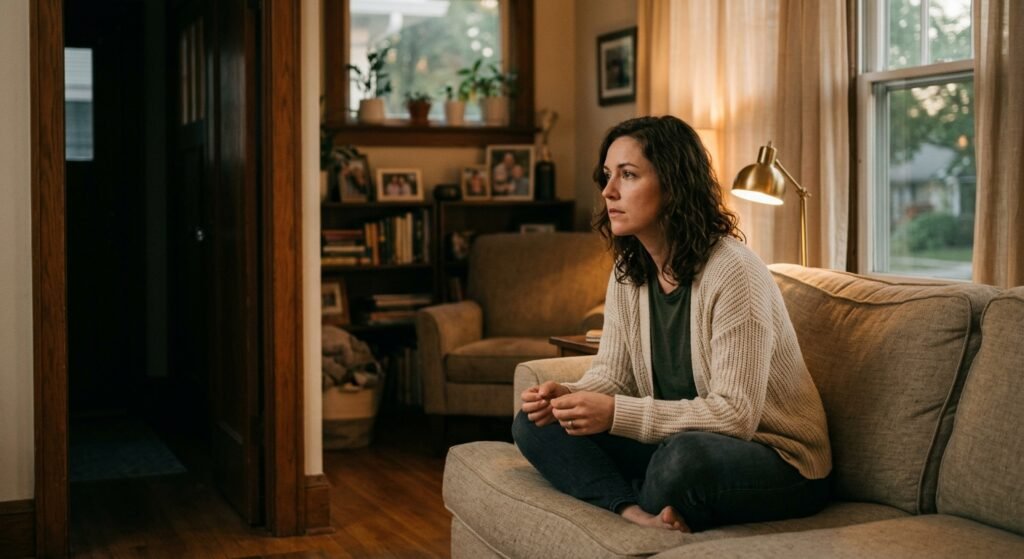
You are sitting in your car in the driveway, staring at the front door of your house. It is an ordinary evening, the kind where you should be looking forward to stepping inside, kicking off your shoes, and letting go of the day. Instead, you find yourself pausing. You take a slow, deep breath, and without quite realizing what you are doing, you try to read the air before you even open the door. You are listening for the volume of the television, the sound of footsteps, or the tone of a voice in the hallway. You are conducting a silent assessment, trying to determine what kind of evening you are about to have based entirely on the mood of the person waiting inside.
If you’ve ever lived this moment, you know it’s a quiet, exhausting way to exist. We don’t talk about it much because, on the surface, nothing seems wrong. There are no arguments happening, no loud disagreements, and no obvious crises. Yet, you feel a lingering sense of unease. You’ve become a master interpreter of tiny details. You can tell how a person is feeling by the way they close a cabinet door, the speed of their footsteps, or the brief pause before they answer a simple question. You’ve developed an exquisite sensitivity to their emotional state, not because you are overly curious, but because you’ve learned that your own peace is directly tied to theirs.
The Cost of Becoming an Emotional Translator
In close relationships, we naturally want to support the people we love. We want to be there for them when they’ve had a difficult day, and we want to share in their joy when things go well. That’s a beautiful part of sharing a life with someone. But a subtle line gets crossed when we stop simply supporting our partner and start managing them instead. It happens slowly, almost imperceptibly, until one day you realize your entire home environment is held hostage by their disposition.
When this happens, your home stops feeling like a sanctuary and starts feeling like a workspace where you are constantly on duty. If they are stressed, you quietly move around the kitchen, trying to minimize any extra disruption. If they are irritable, you choose your words with extreme caution, smoothing over potential friction points before they can turn into conflicts. You become the buffer between their mood and the rest of the household. It’s a role you never applied for, yet you find yourself working overtime to keep the peace.
The trouble with this arrangement is that it forces you to abandon your own emotional reality. You can’t truly relax when you’re always scanning the horizon for signs of trouble. You can’t share your own small victories if you feel their bad mood will overshadow them. Over time, this constant vigilance erodes your sense of security. You begin to realize that the atmosphere of your home is deeply fragile, and you are the one carrying the burden of keeping it put together.
Why We Learn to Walk on Eggshells
It’s easy to look at this pattern and wonder why we allow ourselves to fall into it. The answer usually lies in our deep desire for safety. For many of us, conflict feels deeply threatening, or we grew up in households where we had to stay highly attuned to the unpredictable moods of a parent. We learned early on that the best way to keep ourselves safe was to keep everyone else happy. We carried that survival skill into adulthood, believing it was just a sign of being empathetic and caring.
But there’s a significant difference between empathy and emotional caretaking. Empathy allows you to feel for someone while maintaining a clear boundary between their experience and yours. Emotional caretaking, on the other hand, makes you responsible for their feelings. It convinces you that if you just say the right thing, clean the house the right way, or keep things quiet enough, you can prevent them from feeling upset. It is a well-intentioned attempt to control the uncontrollable, and it always leads to exhaustion.
This dynamic also deprives your partner of the opportunity to manage their own inner world. When we constantly rush to soothe, fix, or accommodate someone else’s irritability, we don’t let them sit with their own feelings. We treat them as though they are too fragile to handle their own stress, and we treat ourselves as though we are strong enough to carry it for both of us. Neither of those assumptions is true, and they only keep the cycle moving forward.
Finding Peace in an Unsettled Room
Breaking this cycle doesn’t require a dramatic confrontation or a demand that your partner never have a bad day again. People are allowed to feel frustrated, tired, stressed, or sad. The real transition happens when you begin to decouple your own inner climate from theirs. It starts with the quiet realization that you can love someone deeply without letting their mood dictate your entire state of mind.
Imagine what it would feel like to walk into your home, notice that your partner is in a sour mood, and simply think, “They are having a hard evening,” rather than, “I need to fix this so I can feel safe.” That small distinction is where your freedom lives. It allows you to offer comfort if they want it, but it also allows you to make yourself a cup of tea, read a book, or go to sleep without feeling like you’ve failed because they aren’t smiling.
A truly peaceful home isn’t one where everyone is perfectly happy all the time. That’s an impossible standard that no relationship can sustain. Instead, a peaceful home is one where it is safe to have a bad day, and equally safe for everyone else to keep living their lives anyway. It’s a space where you don’t have to monitor the emotional temperature of the room just to feel like you have permission to breathe. Perhaps the greatest gift we can give ourselves, and the people we live with, is the permission to let them own their feelings while we gently, but firmly, hold onto our own.