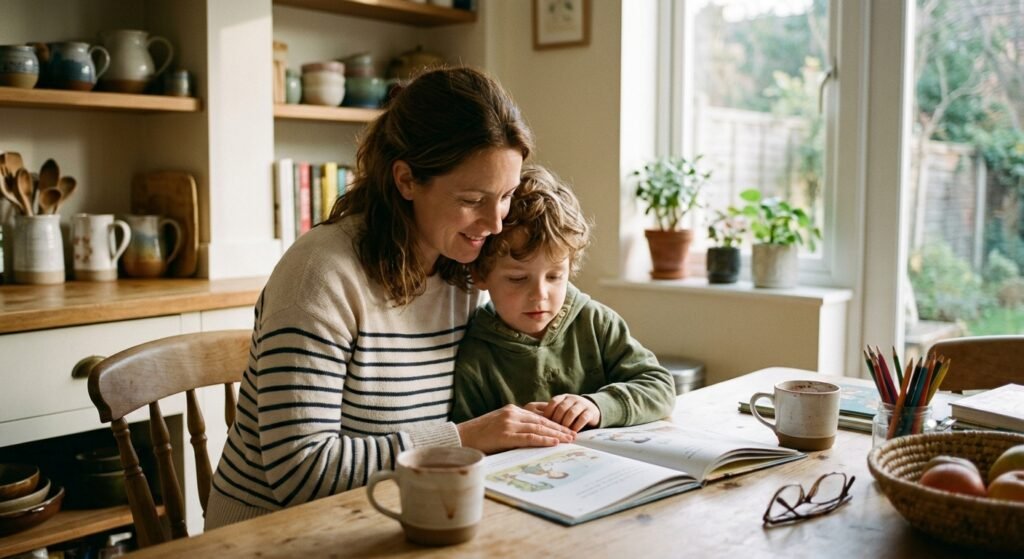
It usually happens on an ordinary Tuesday afternoon when you’re barely paying attention. Maybe you’re standing at the kitchen counter sorting through mail, or perhaps you’re staring into the refrigerator trying to remember what you needed to buy. Out of nowhere, your young child does something that stops you in your tracks. They mimic the exact, weary sigh you make when you’re trying to find your keys, or they repeat a phrase you didn’t even realize you used, adopting your precise tone of voice.
Or perhaps it’s a drawing brought home from school. There you are, rendered in bright purple crayon. Your child has drawn you with a massive grin, or maybe they’ve drawn you with lines on your forehead because, as they explain with complete innocence, that’s what your face does when you’re working. In that quiet, unexpected moment, a strange realization washes over you. You are being watched, not in a creepy way, but with the intense, devoted focus of a little person trying to figure out how to exist in the world.
We’ve spent so much of our time as parents trying to teach them. We lecture them about kindness, we remind them to be polite, and we carefully curate the lessons we think they need to grow into good people. But we rarely stop to think about what they are teaching themselves simply by studying us when we think they aren’t looking.
The Mirrors We Didn’t Ask For
It is easy to believe that parenting is about the big, deliberate decisions. We worry about choosing the right school, setting the perfect boundaries, and planning memorable family trips. We want them to remember the beautiful birthdays and the bedtime stories. Yet, if you ask adults what they remember most about their parents, they rarely focus on the grand gestures. They remember the small, unscripted habits: the way their father cleared his throat before making a phone call, or how their mother always played a specific song when she was happy.
This is because children are natural observers long before they are capable of analyzing what they see. They don’t just hear the words we say; they read our posture, our micro expressions, and the quiet tension we hold in our shoulders. When you react to a dropped glass of milk, they aren’t just watching the mess. They are watching how you handle a mistake. They are learning whether a small accident is a catastrophe or just something to be cleaned up with a towel.
Researchers who study family dynamics often observe that children use their parents as emotional compasses. When a toddler falls down, they don’t cry immediately. Instead, they look at their parent’s face first. If the parent looks terrified, the child cries. If the parent smiles and offers a calm word, the child often gets right back up. This deep emotional connection doesn’t stop when toddlers grow older. It simply becomes more subtle, shaping how they perceive security, stress, and love throughout their entire lives.
Seeing Our Vulnerability in High Definition
There is a unique vulnerability in realizing that your child has memorized your flaws. You might try to hide your anxiety behind a busy schedule, but they notice how quickly you walk when you are worried. You might think you’re hiding your sadness, but they see how long you stare out the window when the house gets quiet. It can feel exposed, almost like someone has pulled back a curtain on the parts of yourself you’d rather keep hidden.
But there is another side to this reflection that we often miss. When we look at ourselves, we tend to be our own harshest critics. We look in the mirror and see the tired lines around our eyes, the mistakes we made yesterday, or the things we wish we could change about our personalities. We carry a massive burden of guilt, constantly wondering if we are doing enough, being enough, or showing up the right way.
Yet, when our children look at us, they don’t see our self doubt. They don’t care that we didn’t get that promotion, or that the living room is untidy, or that we served cereal for dinner two nights in a row. They see the person who makes them feel safe when the storm gets loud. They see the hand that holds theirs when crossing the street. The very things we try to hide, like our tears or our exhaustion, are often the moments that show them we are real, feeling, and deeply connected to them.
The Realization That Changes Everything
Perhaps the real change in parenting comes when we stop trying to be perfect examples and start focusing on being present. When we accept that they see us clearly, flaws and all, we can stop wearing the exhausting mask of knowing all the answers. We can apologize when we lose our temper, showing them that grownups make mistakes too, and that relationships can be repaired. We can let them see us try, fail, and try again, which is a far more valuable lesson than witnessing effortless success.
And maybe that’s the ultimate comfort. We don’t have to be perfect to be exactly what they need. The drawing in purple crayon with the slightly crooked smile and the messy hair isn’t a critique of our parenting skills. It’s a love letter to the person who is simply there, day after day, doing their best. When we see ourselves through their eyes, we might just realize that the flawed, tired person we are so hard on is actually the hero of their story.