
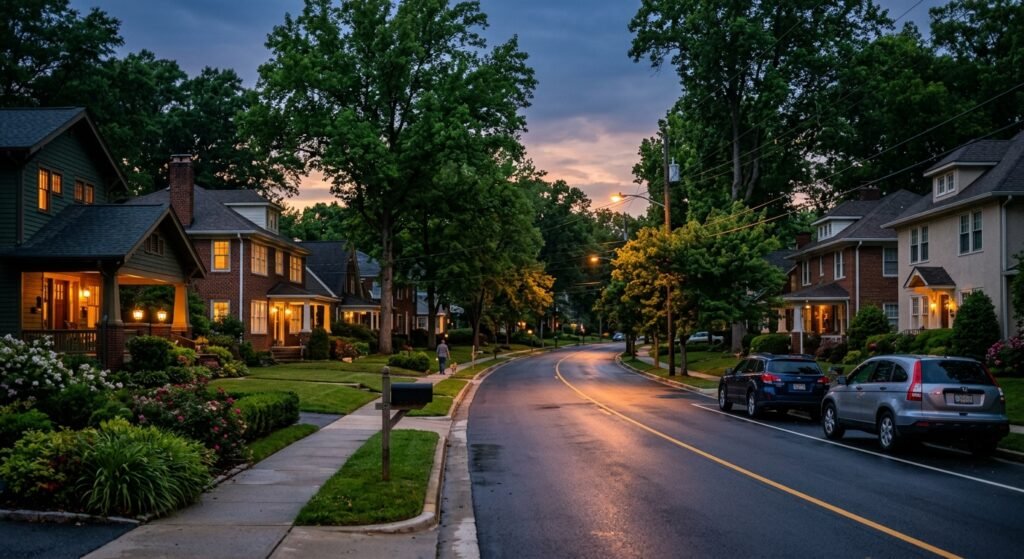
You pull into the driveway after a long day, hit the button on your visor, and watch the garage door yawn open. You pull inside, press the button again, and wait for the door to seal you off from the street before you even turn off the engine. It’s a seamless, efficient routine. You’re home, safe in your own space, completely insulated from the outside world. But as you step into the kitchen, there’s a quiet, barely noticeable ache that sometimes lingers. You realize you just spent the last twenty minutes navigating a street filled with people, yet you didn’t make eye contact with a single one of them.
Many of us can remember a time when the boundaries of our lives felt a little more porous. Maybe it was a childhood neighborhood where front yards functioned as shared parks, or an apartment building where you knew exactly which door to knock on if you ran out of milk. There was a time when the people living fifty feet away weren’t just background characters in your daily commute. They were witnesses to your life, and you to theirs. You knew their habits, their dogs, their gardens, and their names.
Today, we have more ways to connect than ever before, but our immediate surroundings have quietly become much quieter. We’ve swapped the casual front porch chat for the efficiency of the delivery app. We’ve traded the spontaneous driveway conversation for the curated neighborhood forum online, where we’re more likely to complain about a stray dog or a misplaced trash bin than we are to offer a warm hello. The physical spaces we inhabit have changed from places of active connection into places of peaceful isolation.
The Quiet Loss of Our Weak Ties
When we think about loneliness, we often focus on our deepest relationships. We worry about finding a partner, maintaining close friendships, or staying in touch with family. But researchers who study how we live have pointed out that our emotional well-being relies deeply on a different category of relationship altogether. They call these weak ties. These are the casual, low stakes connections we have with the people we see regularly but don’t know intimately. It’s the dry cleaner who remembers how you like your shirts, the neighbor who nods as you walk by, or the parent you always see at the school bus stop.
These brief, seemingly insignificant interactions do something vital for our psychology. They provide us with a sense of place. When the mail carrier asks about your weekend, or a neighbor comments on your new garden bed, your brain receives a subtle, powerful message: you exist, you’re seen, and you’re part of this landscape. Without these moments, our daily lives can begin to feel like we’re moving through a series of anonymous corridors, going from one private bubble to another without ever truly landing.
The beauty of the neighborhood community is that it historically forced us into these weak ties. You couldn’t help but run into people. You had to navigate the small awkwardness of small talk, the simple kindness of holding a gate, or the shared experience of a summer afternoon. These moments didn’t require deep emotional labor, but they built a foundation of trust. They made the physical world feel friendly and familiar.
The Convenience of Privacy
It’s easy to blame our modern isolation on technology or changing times, but the truth is often much closer to home. We chose this. We designed our lives for maximum privacy and convenience, and we got exactly what we asked for. We prefer the fence that’s six feet tall because it means we don’t have to talk to the family next door when we’re trying to read a book in the backyard. We prefer the grocery delivery because it saves us an hour on Sunday mornings. We prefer the quiet because we’re exhausted from our jobs, our screens, and the demands of modern life.
But convenience has a cost that we don’t always calculate up front. When we eliminate the small, slightly inconvenient interactions of neighborhood life, we also eliminate the opportunities for spontaneous belonging. We miss the chance to help someone carry a box, to share a laugh over a stubborn lawnmower, or to realize that the person living next door is navigating the exact same parenting struggles that keep us up at night.
By protecting ourselves from the minor discomfort of unpredictable social interactions, we’ve accidentally starved ourselves of the quiet comfort of being known. We’ve made our homes remarkably secure, but we’ve made our neighborhoods feel like collections of strangers who happen to share a zip code.
Reclaiming the Space Between Us
It’s not about turning back the clock or trying to recreate some idealized version of a midcentury suburb that may never have actually existed. We don’t need to start hosting weekly block parties or forcing ourselves into long, unwanted conversations when we’re just trying to take out the garbage. The solution is much smaller, and much more manageable, than that.
It starts with simply choosing to be slightly more visible in the places we already live. It’s the decision to sit on the front steps for fifteen minutes instead of the back deck. It’s the choice to take off your headphones when you’re walking the dog, leaving a little room for a passing greeting. It’s the willingness to wave at the person across the street, even if you’re not entirely sure what their name is yet.
These tiny gestures don’t solve the larger complexities of modern isolation, but they do something important. They signal to the people around us that the space between our houses isn’t a dead zone. They remind us that the street we live on is a shared space, filled with people who are also looking for a small sign that they aren’t alone.
Perhaps the realization we’re searching for is not that we need to find a perfect community to join. Perhaps it’s that community isn’t a finished place we find, but a slow, daily practice we build right where we are. When we choose to step out of our private bubbles, even for just a moment, we aren’t just greeting a neighbor. We’re quietly reclaiming our own sense of belonging in the world.