Can we talk about this for a second?
You’re sitting on your couch, happily messaging a complete stranger on the internet about a used coffee table. You’re negotiating prices, sharing friendly emojis, and coordinating a pickup time down to the exact minute. You feel like a master of social grace. Then, you hear the unmistakable sound of your next-door neighbor walking down their driveway. Instantly, your body freezes. You slowly lower your head below the window line. You hold your breath, waiting for the sound of their footsteps to fade away before you dare to move again.
Somehow this always happens.
We’ve all been there. We’ll spend forty-five minutes answering questions from strangers online, but the moment we see Dave from next door heading toward his mailbox, we’ll suddenly find ourselves intensely interested in our own shoelaces. We tell ourselves we’re just busy, or that we don’t want to bother them. For some reason this suddenly feels completely reasonable. We treat a neighborly greeting like a high-stakes stealth mission, holding our breath behind the curtains until the coast is clear.
The Art of the Driveway Detour
It isn’t that you dislike your neighbors. In fact, you probably think they’re perfectly nice people. If their house were ever in trouble, you’d be the first one there to help. But on a regular Tuesday afternoon, the prospect of an unscheduled chat feels like a mountain you simply aren’t prepared to climb. You convince yourself that you’re actually doing them a favor. You think, they probably don’t want to talk either, so by actively avoiding them, I’m being an exceptionally thoughtful neighbor. It’s a beautiful little delusion that allows us to feel wonderfully considerate while hiding in our own hallways.
So, we develop tactics. We look through the peephole before opening our front door. If the area is clear, we make a run for it. If we hear a door click open somewhere nearby, we suddenly remember we forgot something and retreat back inside. We’ve perfected the slow-motion mail retrieval, waiting until the street is empty before making our move. It’s a level of strategy that feels entirely natural in the moment, even though we’re just trying to avoid saying hello.
The Beautiful Simplicity of the Text Box
Compare that to the way we interact with strangers online. When you’re texting a person about buying a plant, or coordinating a food delivery, there are clear boundaries. The conversation has a beginning, a middle, and a very obvious end. You don’t have to ask about their weekend, their pets, or how their kitchen renovation is coming along. You just send a quick thumbs-up emoji and the interaction is officially complete.
At some point it stops being about the food or the plant, and starts being about control. With a text, you can read the message, put your phone down, eat a sandwich, and reply twenty minutes later when you actually feel like it. You can’t really do that in the middle of a driveway conversation. You can’t just freeze mid-sentence, stare blankly into space for fifteen minutes, and then resume talking like nothing happened. Real-life conversations are unpredictable. They require you to read facial expressions, figure out when to nod, and decide how long to keep making eye contact before it gets weird.
The Dread of the Open-Ended Chat
When you’re standing by the trash cans, there is no escape button. You’re fully committed to whatever direction the chat takes, whether that’s a detailed history of the local school board meetings or a deep dive into the neighbor’s garden soil. That’s the real issue. It’s the fear of the open-ended conversation. When you say hi to a neighbor, you’re opening a door with no clear exit strategy. We’ve all experienced that awkward moment where the main topic of conversation has clearly ended, but neither of you knows how to politely walk away. So you just stand there, adjusting your keys, commenting on the local trees, until one of you finally mutters something about having a pot on the stove.
We all know how this ends.
Five minutes later, you’re back inside, wondering why a simple hello felt like such a project. We want to connect, but we want to do it on our own terms, with a clear boundary and an easy out. Texting strangers gives us the feeling of community without any of the social obligations that come with actually knowing the people who live twenty feet away.
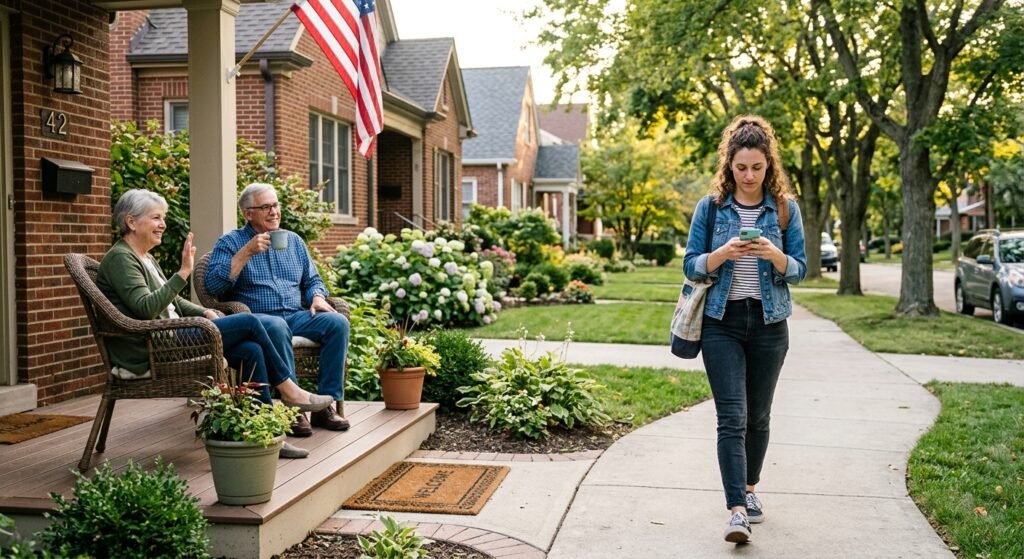
But maybe we’re overthinking it. Maybe our neighbors are doing the exact same mental gymnastics every time they see us. They’re probably looking through their window, seeing us walk to our car, and deciding to wait another five minutes before taking out their recycling just so they don’t have to navigate the driveway wave. There is something comforting about realizing we’re all playing the same quiet game of hide-and-seek. The next time you find yourself waiting inside your dark entryway until you hear your neighbor’s garage door close, don’t feel bad. You’re just practicing a very modern kind of neighborly respect.
You’ll probably do it again tomorrow.
And honestly, they’ll probably do it too.