
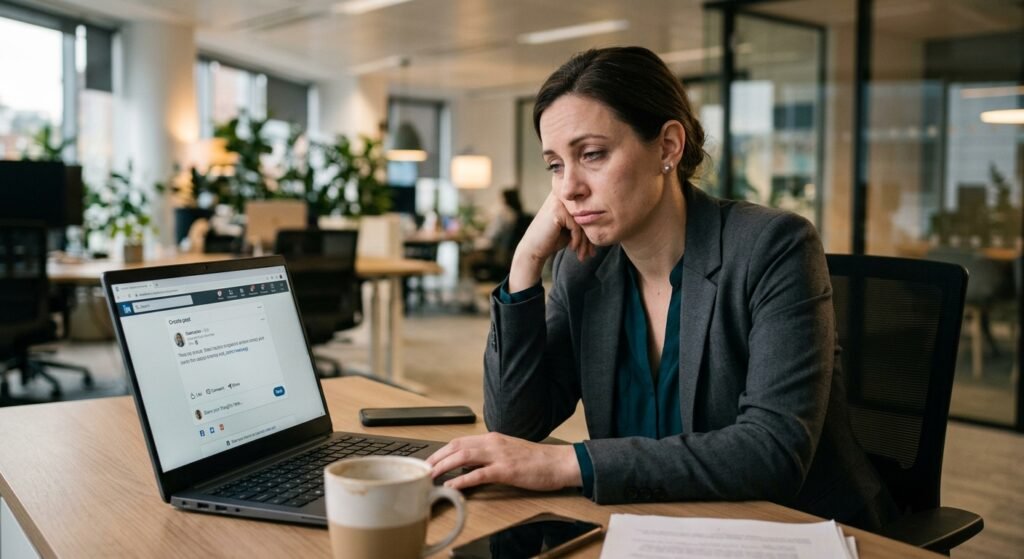
You open your laptop, intending to check a quick message, and find yourself scrolling through a professional social feed instead. Within seconds, you encounter a post from someone who managed to turn a minor traffic delay into a profound metaphor for leadership. A few scrolls down, someone else is celebrating a routine Tuesday meeting as if it were a life-altering victory. There is a polished picture, a carefully crafted paragraph, and a neat takeaway about growth. You look at it, feel a familiar flutter of fatigue in your chest, and wonder when simply doing our jobs became a spectator sport.
It is hard to pinpoint exactly when the nature of professional connection transformed into this constant public performance. Not long ago, networking meant having an honest conversation in a hallway or sharing a quick cup of coffee to talk about a project. Today, there is a quiet, persistent pressure to broadcast every achievement, lesson, and coffee meeting to a digital audience of hundreds, if not thousands, of strangers. We are told that visibility is currency, and that if we are not actively building our personal brand, we are somehow falling behind.
But this constant broadcasting takes a toll. It is exhausting to live in a state where every professional moment must be mined for content. When you spend your day translating your actual experiences into polished updates, you begin to view your working life through an external lens. You stop simply experiencing your workday and start editing it in real time. It is a subtle change, but it makes us feel like we are always on the clock, even when we are just trying to connect.
The Stage We Never Leave
Sociologists have long studied how people present themselves to others, noting that we naturally adjust our behavior depending on whether we are on a stage or behind the scenes. In a physical workspace, you might have a formal presentation where you perform, and then you step into the breakroom to drop the act and be yourself. The trouble with digital professional spaces is that the stage never closes. There is no breakroom. We are constantly expected to remain in character, presenting a version of ourselves that is endlessly optimistic, productive, and wise.
This continuous performance creates a strange kind of exhaustion that rest alone cannot fix. When we feel forced to put on a show just to remain relevant, we lose touch with the very authenticity we are trying to project. Research in organizational psychology suggests that when people feel compelled to engage in constant self-promotion, their actual satisfaction with their work drops. It turns out that convincing others we are successful is far less fulfilling than actually feeling connected to what we do.
The Loss of Quiet Connection
When every interaction is designed to be seen by an audience, we lose the safety of private spaces. Some of the most meaningful career guidance does not happen in public comment sections. It happens in the quiet moments when someone admits they do not know what they are doing, or when a colleague offers reassurance after a difficult meeting. These moments require vulnerability, and vulnerability cannot survive when there is a camera running or a like button waiting.
We have started prioritizing the appearance of connection over the substance of it. We collect digital connections like trophies, yet we often feel more isolated in our careers than ever before. It is easy to confuse a high number of views on a post with a genuine network of supportive colleagues, but the two have very little in common. One is a crowd watching a performance; the other is a group of people who would actually answer your call on a difficult day.
Finding Our Way Back to the Quiet Spaces
Perhaps the pressure to be constantly visible is based on a misunderstanding of how trust is built. Real trust is not created through a series of curated posts or clever commentary. It is built in the small, unseen interactions that happen daily. It is the colleague who helps you solve a problem without needing credit, the mentor who listens to your doubts without judgment, and the partner who reminds you that you are more than your output.
Maybe we do not need to turn our careers into public campaigns to be valued. Maybe professional relationships do not actually need an audience to be real. By stepping off the stage and focusing on the people directly in front of us, we can find a quieter, more sustainable way to work. We can reclaim our energy, protect our peace, and remember that our quiet contributions are often the ones that matter most.