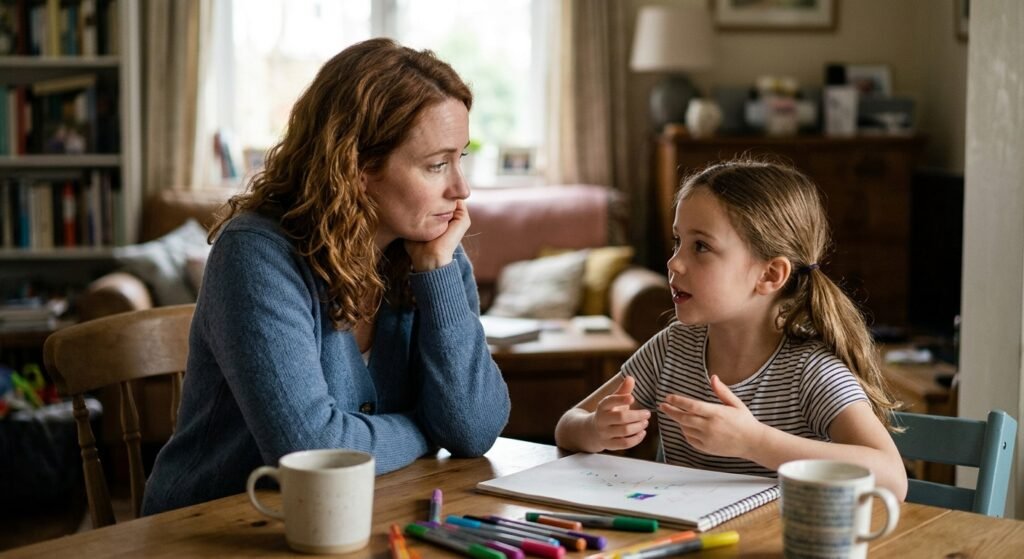
You’re sitting at the kitchen table on a quiet Tuesday afternoon, watching your child negotiate their way out of eating vegetables. Suddenly, they drop their head in a very specific way, crossing their arms and offering a stubborn, silent stare. It isn’t just a simple tantrum. It is a carbon copy of the exact look your spouse gives you when a budget discussion gets tense.
In that brief second, a wave of heat rises in your chest. It’s a familiar irritation, but this time it carries a sharp edge of panic. You aren’t just dealing with a difficult parenting moment anymore. You’re looking at a miniature version of the very trait that has tested your relationship for years. You find yourself wondering how this happened, and more importantly, how you’re supposed to handle a challenge when it’s packaged in a little person you love more than life itself.
This is one of those quiet, complicated corners of family life that people rarely talk about at social gatherings. We readily celebrate when a child inherits their parent’s bright smile, musical talent, or quick wit. But we’re completely unprepared for the day they inherit the defensive posture, the quiet avoidance, or the tendency to walk out of the room when things get uncomfortable.
The Double Echo of Irritation
When your partner retreats or reacts in these ways, you’ve built up ways to cope, even if they aren’t always perfect. You might speak up, walk away, or simply wait for the storm to pass. But when your child does it, those adult strategies fall apart. You can’t ignore them, and you certainly can’t treat them like an equal adversary. The irritation gets tangled up with a deep sense of responsibility, making the emotional temperature in the room rise much faster than it normally would.
It helps to understand why this feels so intense. Family researchers who spend years observing household interactions often note that children are exquisite observers. They don’t just watch how we speak to them; they absorb the subtle tension, the quiet withdrawals, and the unresolved dynamics between the adults in the house. Long before they understand the words we’re saying, they’re learning how the people in their world handle discomfort.
This means that when a child mirrors a partner’s difficult trait, they aren’t doing it to provoke you. They’ve simply noticed that this particular behavior is part of the family ecosystem. It’s a strategy they’ve seen used in their environment, and they’re testing it out to see how it works in their own lives. It’s a natural part of growing up, but for the parent watching it happen, it can feel like a direct challenge to their peace of mind.
The Shadow of the Future
There’s also a deeper, more personal layer to this frustration. When you struggle with a specific trait in your partner, you’ve likely spent years trying to resolve it, accept it, or negotiate around it. Seeing that same trait take root in your child can feel like a setback. It’s as if you’re destined to navigate this particular conflict forever, now on two different fronts.
But if you sit with that discomfort for a moment, a different perspective begins to emerge. Maybe your child isn’t acting as an extension of your partner’s flaws. Perhaps they’re offering you a unique opportunity to look at those flaws with a different kind of lens.
It’s remarkably easier to practice patience with a child than it is with an adult. When your child shuts down or reacts with anger, you know instinctively that they’re still learning, that their brain is developing, and that they need safety rather than judgment. You don’t take their behavior as a personal insult because you understand they don’t have the tools to do any better yet.
Finding the Origin of the Defense
What if that same softness could quietly extend backward? When you see your child struggle with the exact same emotional roadblock as your partner, you’re getting a rare, unfiltered look at the origin of that behavior. You’re seeing that this defense mechanism isn’t a weapon designed to hurt you. It’s simply a fragile way of coping that someone else learned a long time ago, when they were just as small and just as overwhelmed as your child is today.
This realization doesn’t mean you have to accept poor behavior from anyone in your house, big or small. You still need to set boundary lines, teach emotional regulation, and guide your child toward healthier ways of communicating. But it changes the spirit in which you do that work. The frustration begins to ease, replaced by a quiet understanding that everyone in your home is still trying to figure out how to navigate the hard moments.
In the end, the traits we struggle with in our partners don’t have to become a generational cycle we’re doomed to fight forever. Sometimes, our children become the unexpected teachers who show us how to heal those old frustrations. By learning to meet your child’s difficult moments with patience and curiosity, you might find yourself discovering a little more grace for the adult who is still growing up right alongside them.