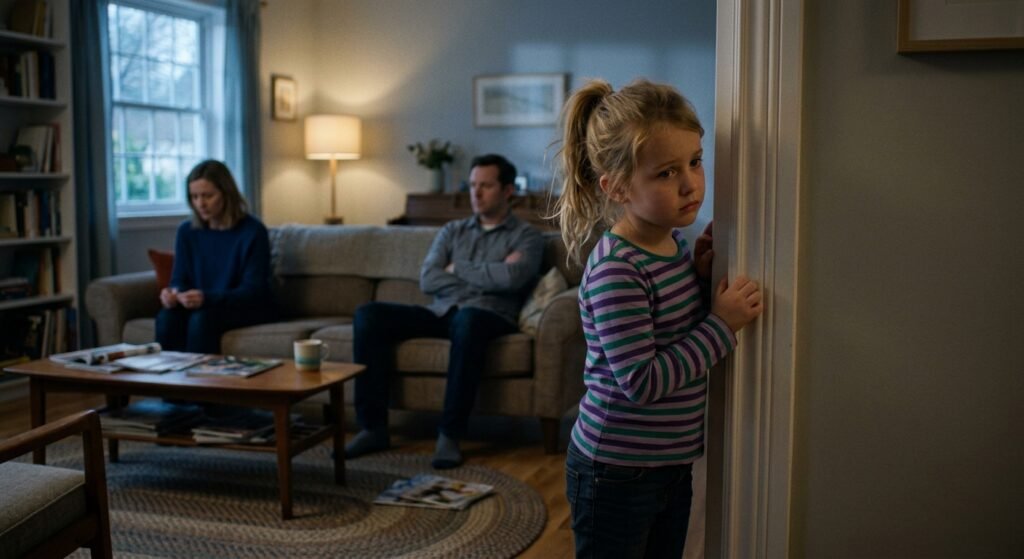
If you grew up in a house where the adults simply stopped loving each other, your memories probably aren’t filled with slammed doors or shattered plates. Instead, you might remember the quiet. You might remember the way your parents sat on opposite ends of the sofa, watching television together without ever exchanging a glance. You remember the polite, almost businesslike tone they used when discussing who would pick you up from soccer practice or what was needed from the grocery store. It wasn’t a battlefield. It was a museum of a relationship that had quietly ended long before anyone admitted it.
As a child, you didn’t have the words for this, but you certainly had the feelings. You became an expert at reading the temperature of a room the moment you walked through the door. You knew when a silence was peaceful and when it was charged with years of unspoken resentment. You watched two people live like polite roommates, passing the salt at dinner with a quiet thank you, while an ocean of distance stretched out between them. Without anyone ever telling you, you learned that love doesn’t always end with a loud explosion. Sometimes, it just slowly evaporates.
The Lessons We Learn in the Silence
Those quiet rooms of childhood become the blueprints for our adult lives. When we grow up watching love go cold, we absorb a very specific set of expectations about what happens when two people build a life together. We don’t realize we’re doing it, of course. We simply watch the adults who raise us and think that this must be where every road eventually leads. We begin to believe that closeness is temporary, that distance is inevitable, and that the natural trajectory of any long-term relationship is a slow, polite descent into emotional exile.
This early observation shapes the way we navigate our own adult lives. When you start building your own relationships, that old childhood temperature can feel strangely familiar, even comforting in a distorted way. You might find yourself drawn to partners who are emotionally unavailable, because their distance feels like home. Or, conversely, you might become hyper-vigilant. The moment your partner is a little quiet after a long day at work, you feel a surge of panic. You assume the silence means the end has begun, because you’ve seen that unfold before, and you know exactly how it ends.
The Silent Classroom of Childhood
Researchers who study family life often point out that we learn how to be in relationships through a process of observational learning. Long before we ever have our first relationship, we spend thousands of hours watching how our caregivers treat each other. Studies show that the emotional climate of a home is one of the most powerful predictors of how we manage conflict and vulnerability in our own lives. When that climate is cold, we don’t learn how to bridge the gap between ourselves and another person. We only learn how to tolerate the freezing weather.
This means that as adults, we often struggle to trust warmth. When someone loves us consistently, when they show up and stay close, it can feel unsettling. You might find yourself waiting for things to go wrong, convinced that this warmth is just a temporary phase before the inevitable freeze sets in. You might even find yourself creating minor conflicts or pulling away first, simply to gain some control over a rejection you feel is guaranteed to happen anyway.
Protecting Ourselves from the Freeze
It’s a strange thing to realize that you might be protecting yourself from a danger that isn’t actually there. When you grow up in a quiet home, you learn to build defenses. You learn to be self-reliant, to never ask for too much, and to keep a small part of yourself packed and ready to leave. You become highly sensitive to the slightest change in your partner’s mood, interpreting every sigh or moment of distraction as proof that they are pulling away from you forever.
But the real challenge of this emotional history is that it can make us miss the beauty of quiet moments that actually are safe. In a healthy relationship, silence isn’t a threat. It’s a soft place to rest. There is a profound difference between the silence of two people who are comfortable enough to exist without words, and the silence of two people who have run out of things to say. When you’ve only experienced the latter, it takes a long time to learn how to enjoy the former without looking for an escape route.
We often carry this unspoken anxiety into our adult partnerships, trying desperately to keep the fire burning because we’re terrified of what happens when the embers start to cool. We mistake ordinary, healthy periods of independence for emotional abandonment. We exhaust ourselves trying to entertain, appease, or fix our partners, believing that if we stop moving for even a second, the cold will creep back in and claim us too.
The Quiet Realization of Safe Warmth
If you’re still carrying the chill of that childhood living room, it’s worth taking a step back and looking at the life you’ve built today. You aren’t a child anymore, and you aren’t a helpless observer of someone else’s unraveling. You have a voice now, and you have choices. You can choose to talk about the silence instead of just surviving it. You can tell your partner when you’re feeling anxious, and you can let them reassure you that their quietness is just tiredness, not a sign of fading love.
It takes time to warm up after a childhood spent in a cold climate. You have to learn how to let people see you, how to ask for reassurance when you need it, and how to believe someone when they tell you they aren’t going anywhere. It requires you to slowly dismantle the protective barriers you built when you were young, trusting that you are strong enough to handle whatever comes next without needing to freeze your own heart in advance.
Maybe the ultimate realization isn’t that you have to find a perfect, conflict-free relationship to feel safe. Maybe it’s realizing that you don’t have to keep yourself cold just because the room you grew up in never learned how to stay warm. You’re allowed to let the warmth in, even if it feels unfamiliar at first. And you’re allowed to believe that the love you build can be entirely different from the love you watched.