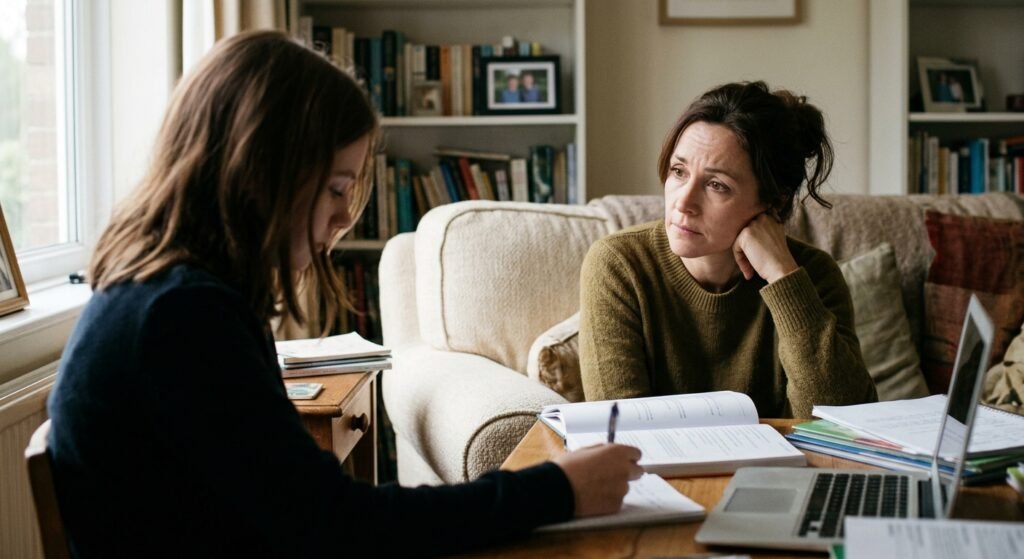
You’re standing in the doorway of your child’s bedroom, looking at a space that feels increasingly unfamiliar. Perhaps there are posters of musicians you’ve never heard of, or maybe the room is simply quiet, filled with books, hobbies, or digital worlds that you don’t know how to navigate. You remember when this same room was filled with toys you bought together, back when you knew every single thing they loved and why they loved it.
Now, you find yourself sitting at the dinner table listening to them talk about their plans, their beliefs, or their view of the world, and you feel a strange, quiet distance. You love them with an intensity that can make your throat ache, but you don’t always understand the person they’re choosing to become. It’s a soft, complicated kind of grief that parents rarely talk about because it feels almost like a betrayal to admit it.
The Silent Space Between Expectation and Reality
When you first hold a child, it’s easy to quietly project a future for them. You don’t do this out of selfishness, but out of love. You imagine sharing your favorite movies, teaching them your favorite hobbies, and watching them navigate the world with the same values that have kept you safe. You build a lovely, comforting picture of who they’ll be and how you’ll fit into their life as they grow.
But children aren’t blank pages waiting for us to write their stories. They arrive as their own complete, mysterious packages, and as they grow, they begin to unpack themselves in ways that can surprise us. Sometimes, the person who emerges is someone whose quietness puzzles you, whose ambition scares you, or whose complete lack of interest in the things you cherish feels like a quiet rejection of your lifestyle.
It’s deeply unsettling to realize that you can know someone’s entire history, every scrape on their knee and every childhood fear, and still feel like you’re speaking different languages. You want to bridge the gap, but the harder you try to pull them back toward the version of them you understand, the more you feel them pulling away to protect their own space.
The Science of Letting Them Be Different
Psychologists who study family dynamics often talk about a process called differentiation, which is simply the psychological term for learning where you end and your child begins. It’s one of the most challenging developmental hurdles for any parent. Research shows that healthy emotional development actually requires children to push against the family mold, testing out different identities, values, and worldviews to see which ones actually fit them.
When a child chooses a path that diverges from yours, it’s often a sign of deep emotional safety rather than rebellion. They trust your love enough to show you who they really are, even when they suspect it might disappoint you. They’re betting on the stability of your connection to hold them, even while they test the limits of their own independence.
But knowing this academically doesn’t make the dinner table conversations any easier. It doesn’t stop the quiet ache of wishing they loved the things you love, or the deep worry that the path they’re choosing might lead them toward struggles you can’t protect them from.
Redefining What It Means to Connect
Perhaps the hardest part of this transition is realizing that your role as a parent has to change. You’re no longer the author of their story; you’re now the audience. That change in perspective requires a profound amount of grace, both for your child and for yourself.
You might find yourself mourning the relationship you thought you’d have, and that’s entirely natural. It’s okay to feel sad that they didn’t inherit your love for the outdoors, or that their career choices feel foreign to your own experience. Giving yourself permission to feel that loss actually frees up the emotional space you need to see the person who’s actually standing in front of you.
Connection doesn’t always require shared interests or identical beliefs. It can exist in the simple willingness to show up, to listen with curiosity instead of judgment, and to let them teach you about their world even if you never fully feel at home in it.
Loving the Mystery Rather Than the Plan
In the end, maybe we’ve been looking at parenthood backward. We often treat it as a task of guiding someone toward a destination we’ve already visited, rather than a journey of accompanying someone into a place we’ve never been.
Your child’s life isn’t a test of your parenting, nor is it a continuation of your own life story. It’s theirs alone. When you let go of the need to fully understand every choice they make, you might find that a different kind of closeness becomes possible, one that’s built on acceptance rather than agreement.
You don’t need to understand their world to be the person who welcomes them home from it. Perhaps the ultimate gift of love isn’t fully understanding the person they’re becoming, but simply letting them know that whoever they turn out to be, they’ll always have a place at your table.