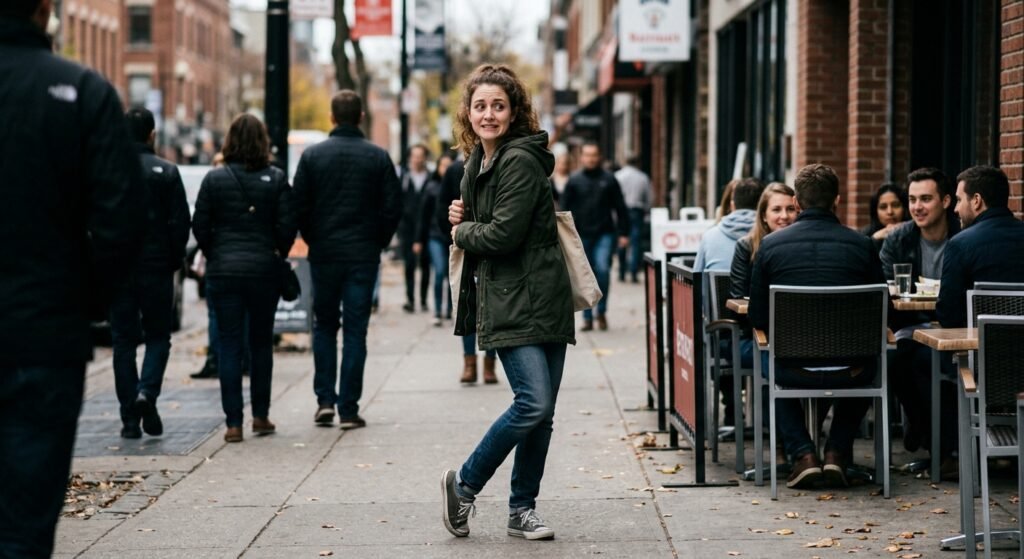
Can we talk about this for a second?
You’re walking down a quiet sidewalk, completely lost in your own thoughts, when you realize you have to cross the street. There is a car waiting at the stop sign. The driver has stopped, looked right at you, and waved you across.
This is a perfectly normal, polite interaction.
But the moment your foot leaves the curb, everything changes.
Suddenly, you are acutely aware that you are being watched. And in that exact millisecond, your brain apparently forgets a skill you mastered when you were a toddler.
You forget how to walk.
The Sudden Manual Override
It isn’t a gradual transition. It is an instant, complete leap from autopilot to manual control.
Normally, you don’t think about walking. Your legs just move, your arms swing, and you get from point A to point B without any conscious effort. But now, under the gaze of a stranger behind a windshield, walking becomes a complex, detailed engineering project.
You start asking yourself questions that should never be asked.
Am I bending my knees enough?
Are my feet pointing straight ahead, or am I doing some sort of strange waddle?
And, most importantly, what are my arms doing?
Normally, your arms naturally swing in opposition to your legs. It is a beautiful, efficient system. But when you are conscious of being watched, that natural rhythm disappears. You suddenly feel like you have to make a choice. If you let them hang limp, you look like a toy that has run out of batteries. If you swing them, you worry you are swinging them too much, like a soldier marching in a parade.
So you compromise. You decide to put one hand in your pocket.
Now you’ve solved the arm problem for one side, but the other arm is still dangling there, looking surprisingly useless.
The Art of the Quick Shuffle
Then there is the speed issue.
Because the driver was nice enough to stop, you feel a social obligation to move a little faster. You don’t want to run, because running is a commitment, and you aren’t wearing the right shoes for it.
So you perform the universal gesture of polite haste.
It is that half jog, half shuffle where you bounce your shoulders up and down to look like you’re moving quickly, while actually covering ground at almost exactly the same pace as your normal walk.
You’re putting in twice the effort for zero extra speed, all to show the driver you care about their time.
In your mind, you look like an athletic, considerate citizen of the world.
To the driver, you look like someone who is trying to walk on hot asphalt while wearing invisible flippers.
But you make it to the other side of the street. You step onto the sidewalk, the car drives away, and instantly, the spell is broken. Your brain hands control back to your autopilot, your legs behave normally again, and you continue your journey as if nothing happened.
The Office Hallway Challenge
This doesn’t just happen at crosswalks.
Think about walking past a busy outdoor cafe patio.
You’re just trying to get to the grocery store, but now you have thirty people sitting at tables with nothing to do but look in your general direction.
Suddenly, the simple act of putting one foot in front of the other feels like a high wire act.
You convince yourself that everyone on that patio is a professional judge of walking technique. You tell yourself that if you trip, even slightly, on a tiny crack in the concrete, the entire patio will rise to their feet and hold up scorecards.
So you stiffen up. You look straight ahead. You try to look like a person who is very busy and has very important places to go, which ironically makes you look like you’re being operated by strings from above.
Or think about walking down a long, narrow office hallway toward a coworker who is walking toward you.
You see each other from fifty yards away.
That is too far to say hello. It is too far to even wave.
So you have to survive the fifty yard walk of mutual observation.
You look at your phone. You look at the floor. You look at a poster on the wall that you’ve seen three hundred times before. And with every step, your gait becomes just a little more rigid. By the time you finally reach each other and say your brief, polite hello, you feel like you’ve just completed a marathon of self restraint.
Why Our Brains Overcomplicate the Simple Stuff
Why do we do this to ourselves?
It is a funny little quirk of how our minds handle routine.
Our brains are remarkably efficient at outsourcing repetitive tasks to our subconscious. We don’t have to think about breathing, blinking, or walking. It is all taken care of in the background.
But the moment we feel observed, we shine a bright spotlight on that background process. We take a task that is designed to run automatically and try to control it manually.
It is like trying to think about every single key you press while typing. The moment you start focusing on where your fingers are going, your typing speed plummets, and you start making typos in words you’ve known how to spell since grade school.
The spotlight of attention doesn’t make the task easier. It just gets in the way.
We convince ourselves that being watched requires us to perform walking correctly, as if there is a perfect, standardized version of it we need to show the world. But the truth is, nobody is judging your stride. The driver at the crosswalk is just waiting for their turn to go. The people on the patio are thinking about their sandwiches. The coworker in the hallway is having the exact same internal debate about their own arms.
We’re all just trying our best to navigate these small, shared moments of self consciousness.
So the next time you find yourself crossing the street and your legs suddenly feel like they’re made of wood, don’t worry.
You aren’t the only one trying to figure out what to do with your left elbow.
We’ve all been there, bouncing our way across the pavement, just waiting for the relief of the opposite sidewalk.
And honestly… we’ll probably do it again tomorrow.