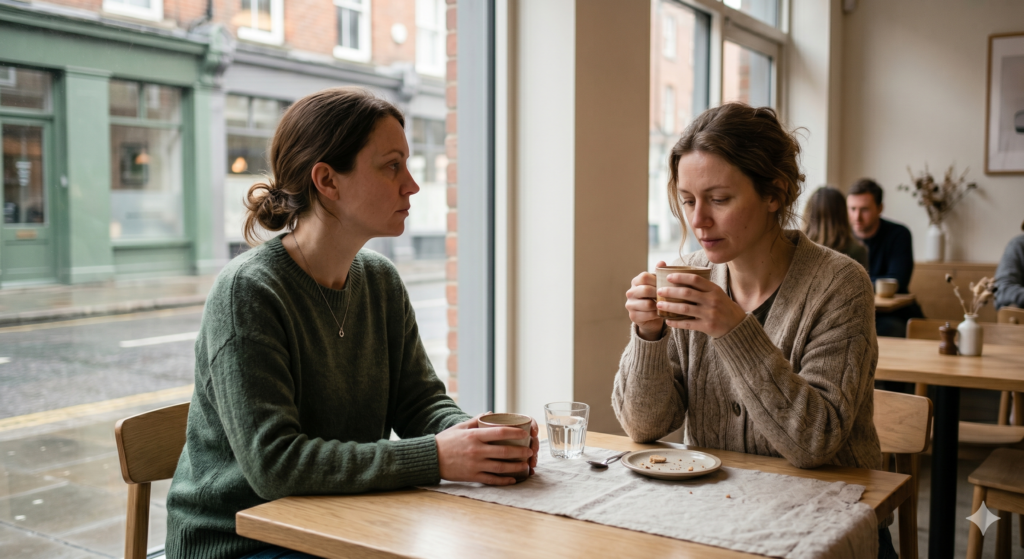
You are sitting at your kitchen island, and a friend walks in. They don’t wait for you to offer them a glass of water; they simply open the cupboard, grab a mug, and pour themselves some coffee. There is no polite dance of hosting, no performance of being the perfect guest. They just exist in your space, and you exist in theirs. It’s a quiet scene, completely ordinary, yet it holds a depth that we rarely take the time to name.
It’s easy to miss the moment this transition happens. We spend so much time celebrating the major milestones in life, like weddings or promotions, that we ignore the quiet magic of a friendship slipping into something deeper. It’s the friend who knows exactly which floorboard creaks in your hallway, or the one who has a permanent spot on your couch where they always sit with their feet tucked under them. These people become woven into the fabric of our daily routines so gently that we can’t quite remember when they weren’t there.
The Unmarked Threshold of Belonging
This kind of closeness isn’t built on grand declarations. It’s constructed out of a thousand tiny, unremarkable interactions. It’s the text sent from the grocery store asking if you need milk, the shared glance across a crowded room when someone says something ridiculous, and the willingness to sit in silence together on a Sunday afternoon when neither of you has the energy to speak. In these quiet spaces, we stop pretending to have everything figured out. We let down our defenses because we know we are safe.
Sociologists who study social connections often look at how we form these deep bonds, sometimes referring to them as voluntary kin. They point out that these relationships carry the same psychological benefits as healthy biological family ties, offering profound emotional stability. But the research only confirms what our hearts already know. Having someone who chooses to show up for you, day after day, without the obligation of shared DNA, provides a unique kind of emotional security that is hard to find anywhere else.
How We Build Chosen Sanctuaries
Think about the last time you felt truly overwhelmed. Maybe it wasn’t a major crisis, but simply one of those weeks where the pressure of life felt like too much to manage. You didn’t need a motivational speech or a list of solutions. You just needed someone to sit with you on the living room floor and eat takeout while you complained about your day.
That’s where these friendships show their true value. They don’t ask you to perform or be the best version of yourself. They offer a space where you can simply land. When we are with the people who feel like family, we don’t have to explain our reactions or justify our feelings. They already know the backstory. They remember the difficult seasons you’ve survived, and they understand the context behind your quiet moments.
This level of safety changes how we move through the world. It acts as an emotional safety net, allowing us to take risks and face challenges because we know we have a soft place to fall. We don’t have to navigate the world alone when we have built a sanctuary with others. In many ways, choosing your family is an act of quiet courage. It requires us to trust that we are worthy of being loved for exactly who we are, not just because we share a last name or a family tree.
Belonging Is Something We Create
Many of us grow up believing that family is a fixed concept, something decided for us at birth. We are taught to place all our expectations of belonging, safety, and unconditional love onto our biological relatives. And while those biological connections can be deeply beautiful, they can also be complicated, distant, or sometimes entirely absent. When we expect one source to provide all our emotional connection, we often end up feeling disappointed or lonely.
When we realize that family can be chosen, it changes how we see our lives. It means that belonging isn’t a passive inheritance, but an active creation. We are not limited to the circles we were born into. We have the freedom to build our own circles, to invite people in, and to create the kind of home we’ve always wanted. It changes our perspective from waiting to be accepted to actively building a life filled with people who truly see us.
Perhaps the most comforting realization of all is that we don’t need a biological bond to experience deep, lasting devotion. The people who know your coffee order, who remember your childhood stories, and who show up on your doorstep when life gets complicated are not just your friends. They are the family you chose, the ones who remind you that you are never truly alone in this world. And maybe family was never about sharing the same bloodline. Maybe it’s about sharing the same quiet commitment to never letting each other walk alone.