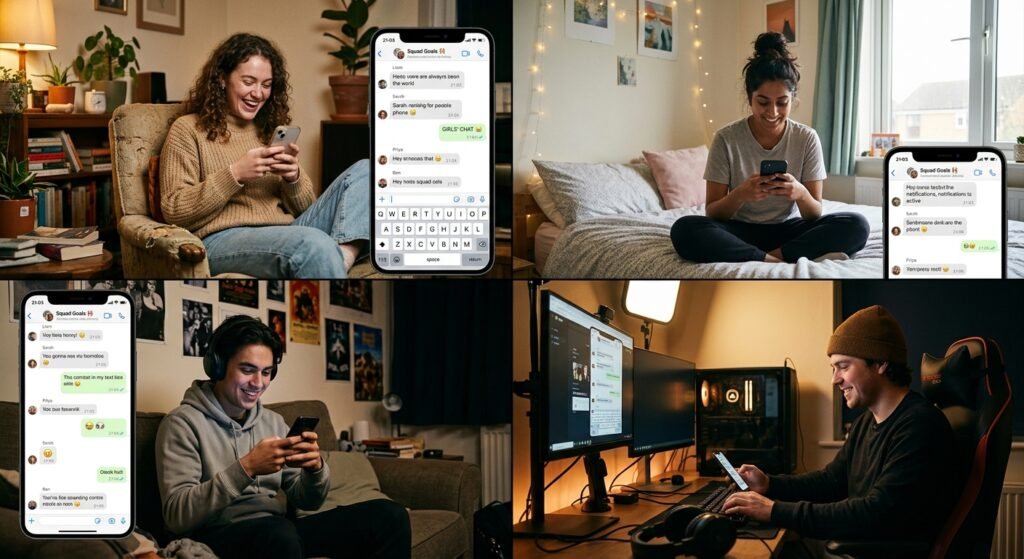
You probably remember a time when hanging out with a friend didn’t require a calendar invite. You didn’t plan it weeks in advance, and you certainly didn’t need to coordinate across multiple messaging apps just to find a two hour window where neither of you was too exhausted to speak. Instead, you just showed up. You sat on the hood of a car, or lingered on their living room floor, doing absolutely nothing together for hours.
Now, those unstructured afternoons feel like echoes from another life. Today, a lot of our closest friendships exist in the quiet spaces of our phones. We send quick texts during our morning commutes, double tap photos of their weekend trips, and exchange funny videos late at night when we should be sleeping. It feels like connection, and in some ways, it’s exactly that. But if you’ve ever closed your apps and felt a strange, lingering sense of loneliness, you aren’t the only one.
The Illusion of Keeping Up
There’s a subtle comfort in modern technology. It keeps us in the loop. You know that your old roommate just got a puppy, that your childhood friend is renovating their kitchen, and that your coworker from three jobs ago is vacationing in Italy. We receive constant updates about the people we love, which creates a cozy blanket of familiarity. We feel like we’re keeping up, so we don’t feel the urgency to reach out and actually talk.
But there’s a difference between knowing about someone’s life and actually sharing it. Social researchers often point out that this passive observation doesn’t satisfy our deep need for belonging. When we scroll through someone’s life, our brains process the information, but our emotional core misses out on the connection. We’re consuming their highlight reel, but we’re missing the quiet, unedited moments that make people who they are. We don’t hear the sigh before they start speaking, or see the way their eyes light up when they’re genuinely excited.
What’s happening isn’t that we’ve stopped caring. It’s that we’ve quietly traded presence for convenience. It’s much easier to leave a supportive comment on a post than it is to carve out an evening for a phone call. Over time, this convenience changes the very nature of our bonds. We become audiences for one another rather than active participants in each other’s daily lives.
Why the Green Dot Isn’t Enough
Our biology is wired for physical presence. For generations, bonding happened through shared environments, shared meals, and the simple rhythm of being near one another. When we are physically in the same room, our bodies respond. We naturally mirror each other’s posture, we catch each other’s laughter, and we share a silent understanding of the room we’re in. That shared reality is what builds trust and deepens comfort.
Studies on social interaction suggest that when we communicate purely through screens, we lose a vast amount of emotional data. We don’t get the comforting presence of someone sitting next to us when we’re having a difficult day. Instead, we get a glowing green dot next to their name, indicating they’re online, but emotionally miles away. The text message that says “I’m so sorry” is kind, but it doesn’t carry the same warmth as a friend simply sitting on the couch with you in silence while you process a loss.
The Grief of Growing Older Together
It’s easy to blame technology for this distance, but the truth is usually more complicated. Life gets busier. We take on more responsibilities, our energy levels change, and our circles naturally shrink as we prioritize family, careers, or simply surviving the day to day. The unstructured time we used to take for granted disappears, replaced by grocery shopping, laundry, and the profound fatigue that seems to arrive with adulthood.
Sometimes, the nostalgia we feel when we look at old photos of real life hangouts isn’t just about missing our friends. It’s about missing the version of ourselves who had the time and space to wander. We miss the freedom of a Tuesday night with no expectations. When we grieve the drift of our friendships into the digital world, we’re also grieving a simpler chapter of our lives.
And because we’re tired, the phone becomes a lifeline. It’s a way to keep our favorite people close without demanding more energy than we have left to give. It’s an act of love, even if it feels a little diluted compared to what we used to share.
Finding Our Way Back to Each Other
We don’t need to throw away our phones or pretend we can go back to the infinite free time of our youth. Life has changed, and our friendships have to change with it. But maybe the realization we’re looking for is that a friendship doesn’t have to be loud, constant, or perfectly scheduled to be real. Perhaps we’ve just spent too much time trying to maintain dozens of distant connections online when what we actually need are two or three people who really know us.
Maybe the way we close the distance isn’t by trying to schedule the perfect dinner date that both of you will probably want to cancel anyway. Maybe it’s by sending a voice note instead of a text, letting your friend hear the real tiredness in your voice, or the genuine laugh that a keyboard emoji can never quite capture. It’s about letting the messiness back in.
When we stop trying to keep up with everyone’s curated lives and instead focus on being present for just one person in a small, real way, the digital world starts to feel a little less cold. We realize that the warmth we’ve been missing hasn’t disappeared. It’s just waiting for us to pick up the phone, ignore the feed, and say, “Tell me how you really are.” And in that moment, the distance we’ve built quietly melts away, reminding us that we’re still here, and we’re still connected, even if the shape of our together looks a little different than it used to.