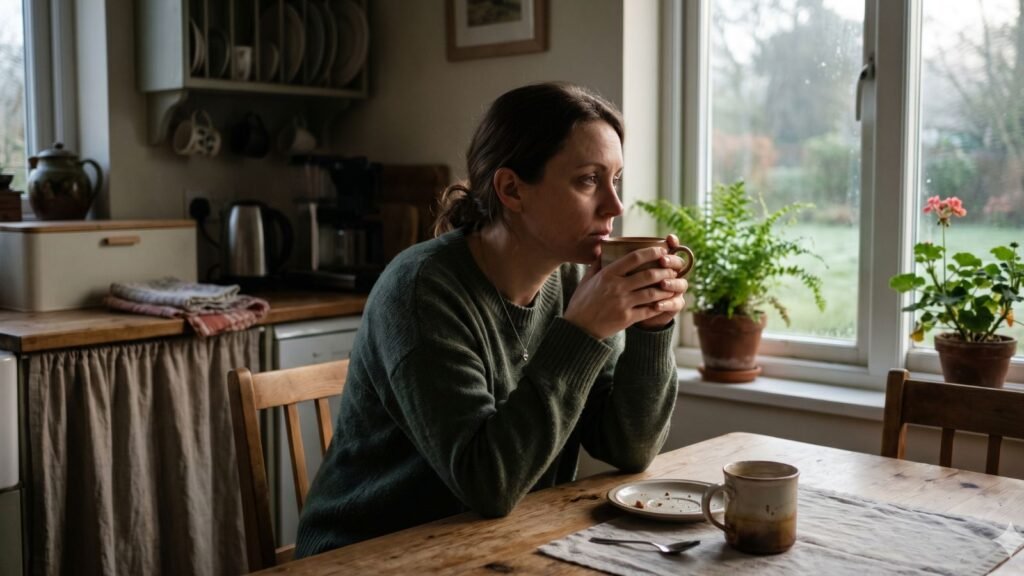

Imagine sitting at a crowded dinner table where the food is warm, the laughter is loud, and the people around you genuinely want you there. Someone reaches over to pour you another glass of water, and someone else laughs at a joke you made just a few minutes ago. On paper, this is exactly what a happy life is supposed to look like. Yet, right in the middle of the chatter, a strange, quiet chill creeps in. You look at the smiling faces of your friends or family, and instead of feeling connected, you feel like you’re watching them through a thick pane of glass. You’re physically in the room, but emotionally, you’re a million miles away.
It’s a deeply unsettling feeling, and it’s one we rarely talk about because it feels almost ungrateful to admit. When you’re alone in an empty apartment on a rainy evening, feeling lonely makes perfect sense. It’s a natural reaction to silence. But when you feel completely isolated while sitting next to your partner or celebrating with your closest friends, it feels like a personal failure. You start to wonder if something is wrong with your heart, or if you’ve somehow lost the ability to receive the love that’s being freely offered to you.
The Difference Between Proximity and Presence
We often treat closeness as a simple matter of geography. We assume that if we fill our calendars with social gatherings, say yes to invitations, and live alongside people who care about our well-being, we’ll naturally feel anchored. But intimacy doesn’t work that way. You can share a kitchen, a bed, or a lifetime of Sunday lunches with some people and still feel like they’re looking right past you. That’s because being surrounded by people isn’t the same thing as being perceived by them.
Relationship researchers who study social bonds have found that the quality of our connections is determined far more by what they call emotional responsiveness than by how much time we spend together. It’s the feeling that when you speak, your words actually land somewhere. When you share a small worry, the other person doesn’t just offer a quick solution or change the subject; they pause, they look you in the eyes, and they validate that your internal landscape matters. Without that mutual recognition, our interactions can quickly start to feel like a series of scripts we’re reading to one another just to keep the quiet at bay.
When those scripts become our primary way of interacting, we start to feel like we’re playing a role rather than living our lives. You become the cheerful sibling who always has things under control, the funny friend who keeps everyone entertained, or the dependable coworker who never complains. It’s easy to get trapped in these roles because the people around us appreciate them. They make us easy to love, and they make our relationships feel smooth on the surface. But the problem is that when people love the character you’re playing, it doesn’t actually feed your soul. Deep down, you know that the affection you’re receiving is addressed to the performance, not to the real you.
The Cost of Keeping the Peace
Many of us have learned to hide our truest selves as a way to protect our relationships. We don’t want to bring down the mood, we don’t want to seem needy, and we don’t want to disrupt the comfortable routine we’ve built with the people we love. So, we pack away our disappointments, our anxieties, and our secret griefs, keeping them safely out of sight. We show up to the party with a smile, fully prepared to ask others about their lives while keeping our own doors firmly shut.
But there’s a steep price to pay for being the easy one in the room. When you constantly filter your thoughts and edit your feelings to keep things light, you’re quietly telling yourself that your true inner state is too messy or too difficult for others to handle. Over time, that self-imposed silence turns into a massive barrier. You start to feel lonely not because the people around you don’t care, but because you aren’t actually letting them see what’s happening inside you. You’re protecting them from your reality, but in doing so, you’re also locking yourself out of the connection you crave.
It’s helpful to remember that people can only meet us as deeply as we’re willing to meet ourselves. If we’re constantly running away from our own vulnerabilities, we can’t expect anyone else to find them and soothe them for us. Sometimes, the isolation we feel in a crowd isn’t a sign that our relationships are broken. It’s simply a sign that the bridge between our inner world and our outer life has been neglected for a little too long.
The Small Steps Toward Being Known
Reclaiming that sense of connection doesn’t require a dramatic, soul-baring confession at the next family dinner. It doesn’t mean you have to suddenly start sharing your deepest secrets with everyone you meet. Real intimacy is built in tiny, quiet increments. It happens in the moments when we choose to be just a little bit more honest than we comfortably feel, or when we take a small risk and let someone see us without our usual guard up.
It might look like answering, “It’s been a really tough week, actually,” when a close friend asks how you’re doing, instead of offering your standard, cheerful reply. It might look like letting your partner see you cry when you’re overwhelmed, rather than slipping into the bathroom to dry your eyes in private. These small moments can feel deeply risky because they require us to step out of our comfortable roles and face the possibility of being misunderstood. But they are also the only doorways to genuine belonging.
When we allow ourselves to be seen in our imperfection, something beautiful happens. We give the people who care about us the chance to show up for us. We give them permission to put down their own guards and meet us in a space of shared reality. And in that shared space, the chill of isolation begins to fade, replaced by the quiet comfort of knowing that we don’t have to be perfect to be loved.
A Different Way of Seeing Our Isolation
Perhaps we’ve been looking at loneliness all wrong. We tend to view it as a painful defect, a sign that we’re failing at our relationships or that we’re somehow unlovable. We treat it like a problem to be solved with more plans, more friends, or more conversations. But maybe that quiet, empty feeling we get in a crowded room isn’t an enemy at all. Maybe it’s a messenger.
Maybe that persistent ache of disconnection is actually our inner self quietly telling us that we deserve to be known, not just noticed. It’s a sign that our souls are tired of pretending, tired of playing roles, and ready to be received for who we actually are. When we look at it that way, loneliness ceases to be a source of shame. Instead, it becomes a compass, pointing us toward the places where we need to find the courage to show up as our true selves.
Ultimately, feeling seen matters just as much as feeling surrounded. We don’t need a stadium of people cheering for us; we just need a few people who are willing to sit with us in the quiet and look at us with eyes that truly understand. And sometimes, the first step to finding that connection isn’t searching for better people, but simply finding the bravery to let the people who are already standing right in front of us see who we really are.