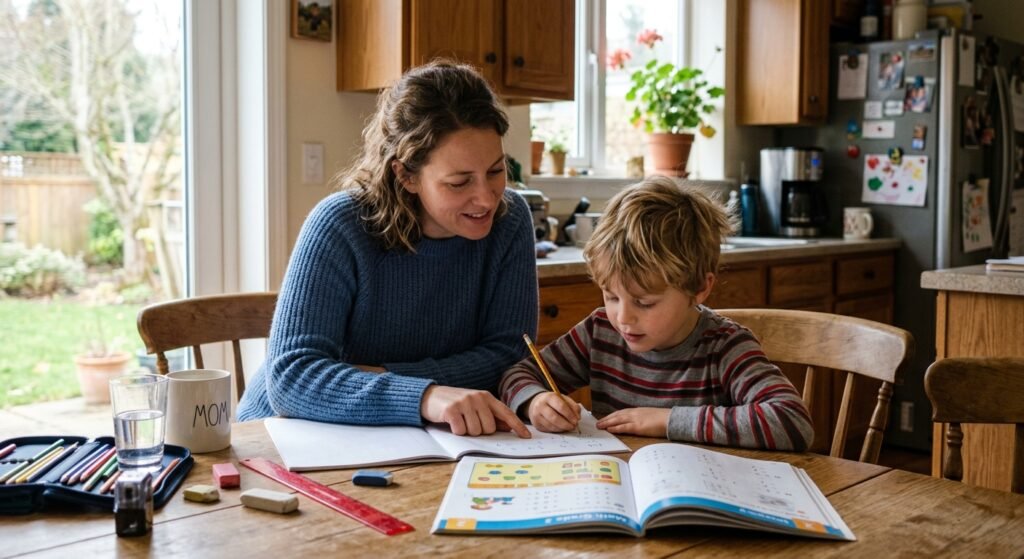
It’s a scene that plays out quietly in living rooms and at kitchen tables every single afternoon. There’s an open textbook, a pencil with a worn eraser, and a math assignment that has somehow turned into a small, domestic battlefield. You started the afternoon with the best intentions, ready to support, encourage, and guide. But as the minutes stretch into an hour, you feel a familiar tightening in your chest. The encouraging praise turns into structured instruction, then into irritation, and finally into a tone of voice you barely recognize as your own.
In those moments, your child isn’t looking at a loving protector who offers safety after a long school day. They’re looking at an evaluator. They’re looking at a teacher who is suddenly measuring their progress, correcting their mistakes, and pushing them to meet a standard. You can see the exact moment their shoulders drop and their eyes look away. You aren’t just helping them with schoolwork anymore; you’ve stepped into a completely different role, and the home you’ve built together suddenly feels like a classroom under constant inspection.
The Quiet Collision of Two Different Worlds
Wearing multiple hats is a common struggle of parenthood, but combining the role of educator and parent is uniquely exhausting. When you teach your own child, whether you homeschool them full-time or simply spend hours acting as the homework supervisor, you’re attempting to bridge two fundamentally different spaces. A teacher’s job is to evaluate, correct, and prepare a child for the external world. A parent’s job, at its core, is to provide unconditional acceptance, a soft place to rest, and a sanctuary from the demands of that very same world.
When these two roles collide, the boundaries get messy. It’s difficult to be the person who demands discipline and accuracy at two o’clock in the afternoon, and then seamlessly transition back into the gentle, understanding protector at six o’clock. Your child begins to wonder which version of you is sitting across from them. Are you the one who is proud of who they are, or are you the one who is disappointed by how many spelling words they missed today?
The Search for a Performance-Free Zone
Children are remarkably sensitive to our expectations. They can sense when our love feels tied to their achievements, even when we try our absolute best to hide it. Experts who study family dynamics often point out that children thrive when they have at least one environment where they do not have to perform to be valued. They need a place where their mistakes are just mistakes, not metrics of development.
When we step too deeply into the role of the instructor, we accidentally turn our homes into another place where they are constantly being evaluated. Every conversation can start to feel like a quiz. A simple walk outside becomes a lesson about nature; a baking session becomes a math experiment. While these moments can be wonderful opportunities for learning, they can also leave a child feeling like they are always on display, always being measured, and always expected to improve.
The Exhaustion of the Dual Role
The fatigue you feel isn’t just physical; it’s emotional. It comes from the constant internal negotiations you have to make throughout the day. You find yourself asking whether you should correct their language during a personal story, or simply listen to how excited they are about a new game. You worry that if you don’t push them to finish their reading list, you are failing them as an educator. But if you push too hard, you worry you are damaging the connection that matters most.
This constant tension leaves many parents feeling isolated and depleted. Studies on parental burnout often highlight the strain of role overload, which is the feeling of having to be everything to someone all at once. When we try to be the academic guide, the character builder, the nurturer, and the disciplinarian, we run out of the emotional resources required to simply enjoy our children. We become so focused on their future success that we lose our ability to be present with them today.
Finding the Way Back to Just Being Parent and Child
Reclaiming the role of parent doesn’t mean abandoning your child’s education. It means recognizing that your relationship with them is the ultimate classroom. The lessons they learn from how you treat them when they make mistakes, how you handle frustration, and how you show up when they are struggling are far more permanent than any math worksheet or history unit.
Sometimes, the most educational thing we can do is close the book early and choose connection over correction. It is letting the misspelled word go unnoticed for an evening so you can focus on the story they are trying to share. It is allowing yourself to say that you don’t care about the assignment right now because you just want to hear about their day.
The True Safe Harbor
Perhaps our children don’t actually need us to be their perfect instructors. The world is full of people who will evaluate them, grade them, and tell them where they fall short. They will have teachers, coaches, employers, and peers who will constantly measure their value against a set of standards.
Maybe they only get one or two people in their entire lives whose love is entirely detached from their performance. When we let go of the pressure to teach them every lesson, we make room for the quiet realization that our most vital job isn’t to make sure they get every answer right. It’s to ensure that when they get everything wrong, they still know exactly where they belong.