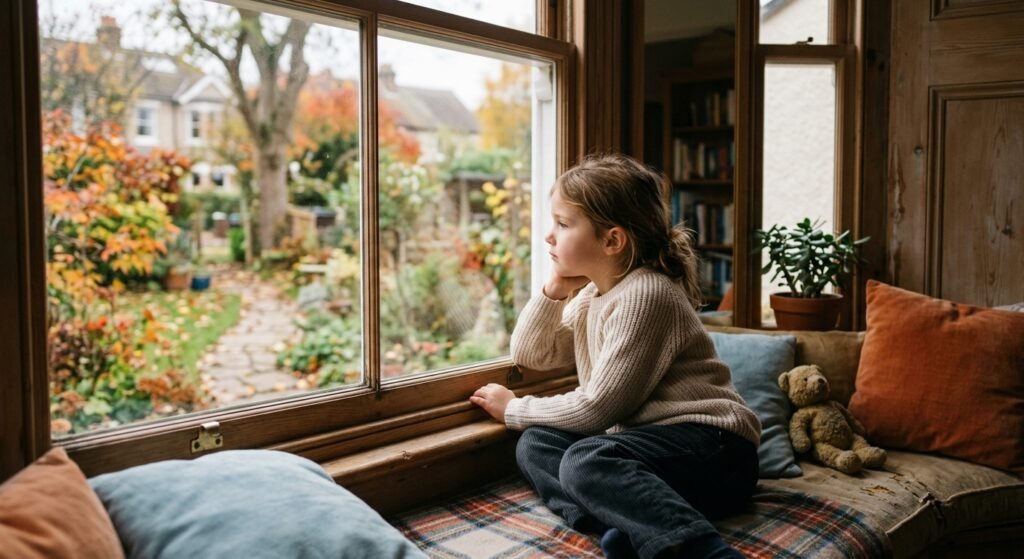
You’re sitting in the kitchen, listening to the familiar sounds of your home. The refrigerator hums, a dog barks down the street, and from the living room, you hear the rest of your family chatting. But from the corner of the room, or from the hallway upstairs, there’s a distinct lack of sound. Your child has retreated again. They’ve slipped away into their own space, leaving you with a familiar, lingering worry.
When a child goes quiet, it can feel like a sudden drop in air pressure. As parents, we’re wired to associate silence with trouble. We wonder if they’re hurting, if someone was unkind to them at school, or if they’re keeping a secret that’s too massive for them to carry. Our instinct is to knock on the door, to ask questions, to pull them back into our world where we can see them and keep them safe.
Yet, if you look closely, this quietness doesn’t always look like sadness. Sometimes, it looks like a deep, concentrated relief. It’s the face of someone who has finally found a moment to catch their breath after a long sprint. Their silence isn’t a lack of feeling; it’s how they hold onto themselves when everything else feels too loud.
The Commotion of Being Small
Modern childhood is a remarkably loud experience. From the moment kids step onto the school bus, they’re thrust into a world of constant stimulation. There are bright classrooms, crowded hallways, group projects, and the endless social negotiation of the playground. Even after school, their schedules are often filled with activities, sports, and screens that constantly demand their attention.
For a child who processes life deeply, this constant stream of input can feel like standing too close to a speaker. They don’t have the words to explain that their senses are full. They can’t always tell you that they’ve run out of the energy required to participate in the conversation. Instead, they do the only thing that makes sense: they turn down the volume by stepping away.
This isn’t necessarily a sign of distress. It’s a natural reaction to a world that rarely values stillness. When they retreat to their room, build a fort out of blankets, or simply stare out the window for half an hour, they aren’t shutting you out. They’re rebuilding the boundaries that the day slowly wore away.
A Loud Mind in a Quiet Space
It helps to realize that quiet children often have the loudest inner worlds. Researchers who study childhood temperament have found that kids who tend to retreat inward often possess minds that notice everything. They pick up on details that others miss, from the tone of a teacher’s voice to the subtle tension in a room. Because they absorb so much more of their environment, they require much more time to sort through it all.
Think of their minds like a busy sorting office. Every interaction, every lesson, and every feeling from the day is a package that needs to be opened, organized, and filed away. If they don’t get the quiet space to do this work, the packages pile up until the room feels cluttered and overwhelming. Their silence is the time they spend sorting.
When we push them to speak before they’re ready, we’re essentially asking them to explain a story that they’re still busy writing. We want answers, but they’re still trying to understand the questions. Giving them space isn’t neglect; it’s respecting the work their minds are doing in the dark.
Protecting the Inner Sanctum
There’s a beautiful realization that comes when we stop viewing our child’s silence as a problem to solve. We begin to see it as a form of wisdom. In a culture that constantly urges us to speak up, stand out, and share every thought, a quiet child has already figured out how to protect their own peace.
They’ve realized that they don’t have to participate in every conversation to be a part of the family. They don’t have to fill every empty moment with words to feel secure. They’re content to simply exist, letting their thoughts wander where they will, trustful that they’re allowed to have a world that is entirely their own.
So the next time you see your child staring quietly into space or retreating to their room, you don’t have to knock with a list of questions. You can choose to sit near them in the stillness, showing them that their silence doesn’t frighten you. Perhaps the most reassuring thing we can offer a quiet child isn’t an invitation to talk, but the comfort of knowing they don’t have to say a word to be completely understood.