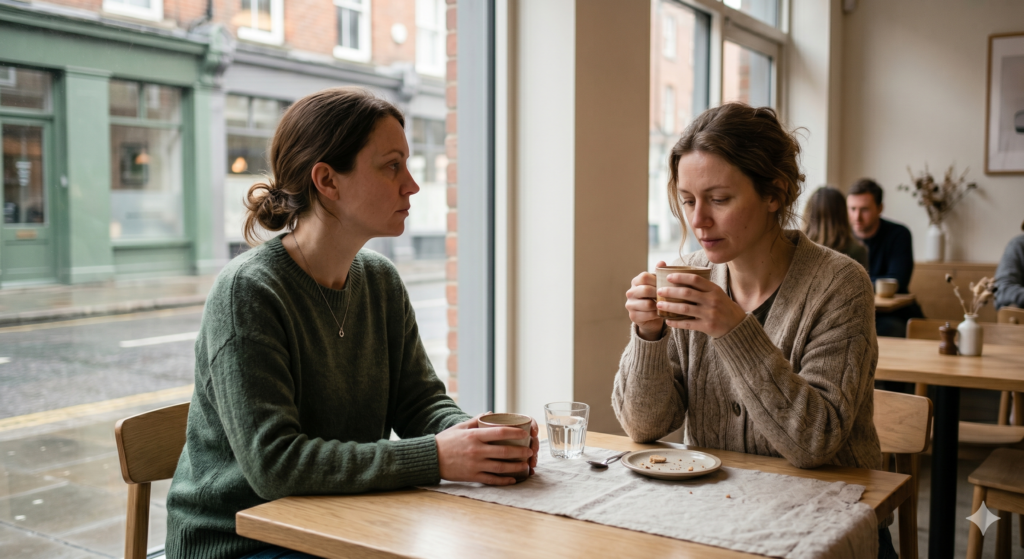

Imagine sitting around a living room with your favorite people, surrounded by half-empty mugs and notebooks. You started gathering because you all shared a love for creating things. In the beginning, those nights felt like magic. You cheered for each other’s messy drafts, celebrated tiny victories, and felt a little less alone in your creative pursuits.
But lately, something has started to feel different.
You notice it in the split-second pause before someone congratulates a friend on a new opportunity. You feel it in the way a casual conversation about projects starts to feel like a quiet roll call of accomplishments. Someone shares a win, and instead of a wave of genuine celebration, the room fills with an unspoken tension. Suddenly, you aren’t just sharing your work anymore; you’re measuring it.
It’s a subtle transformation, and that’s what makes it so disorienting. Nobody is openly hostile. In fact, everyone is still saying all the right things. But when you leave these gatherings, you no longer feel inspired or energized. Instead, you go home with a quiet ache in your chest, wondering why your own progress feels so small, and why your friends’ successes suddenly feel like a mirror reflecting your own stagnation.
We rarely admit to this feeling because it feels deeply embarrassing. It makes us feel petty, small, and ungenerous. We want to be the kind of person who is unconditionally happy for the people we care about. So when we feel that tiny pinch of resentment or panic when a friend succeeds, we tuck it away, cover it with a performative cheer, and feel guilty for having felt it at all.
The Subtle Slip into the Scoreboard
There is a reason this happens so easily in groups of creative people. Psychologists often point to social comparison theory, which suggests that we naturally determine our own social and personal worth based on how we stack up against others. When we compare ourselves to strangers, the distance is too vast to feel personal. But when we compare ourselves to our peers, the people who share our interests, our age group, or our social circle, the comparison hits much closer to home.
In a creative circle, this dynamic becomes amplified because creative work is deeply tied to our sense of identity. When you share something you’ve made, you’re sharing a piece of your inner life. If a peer receives recognition or achieves a milestone you’ve been working toward, your brain can easily misinterpret their success as a scarcity problem. It starts to feel like there is only a limited amount of achievement to go around, and if they took a piece, there is less left for you.
This scarcity mindset turns a collaborative space into an arena. You stop looking at your friend’s work with curiosity and start looking at it with calculation. You begin tracking who is ahead, who is behind, and where you stand on the invisible ladder. The tragedy of this is that it robs you of the very thing you joined the group to find: a safe harbor where your vulnerability could be witnessed without judgment.
The Cost of the Creative Scorecard
Studies on group dynamics suggest that while healthy competition can sometimes spark motivation, it only works when the goals are completely independent. When people feel that their personal value or belonging within a group is tied to their performance relative to others, trust quickly erodes. Researchers have found that in highly competitive peer groups, people begin to self-censor. They stop sharing their unfinished ideas or admitting to their struggles because they fear showing any vulnerability that might be perceived as weakness or failure.
This means the very conversations that make creative relationships so rich begin to dry up. You stop talking about the struggle of the process and start only sharing the polished, successful outcomes. The friendship group essentially becomes a curated feed, a physical version of social media where everyone is presenting their best selves while quietly feeling isolated behind their accomplishments.
Reclaiming the Space Between Us
It’s worth asking ourselves what we are actually looking for when we gather with other creative souls. Most of us didn’t start writing, painting, designing, or building because we wanted to win a race. We started because we had something inside us that wanted to speak, and we looked for a circle because we wanted to know that our voice mattered to someone else.
When we let comparison dominate the room, we forget that creativity isn’t a finite resource. One person’s breakthrough doesn’t diminish your potential; if anything, it proves that the path you are on is real and navigable. But remembering this is surprisingly difficult when you are sitting in the room, feeling the quiet pressure to match someone else’s pace.
Sometimes, the most loving thing you can do for your friendships, and for your own creative spirit, is to step away from the scoreboard. This doesn’t mean ending the friendship or declaring a dramatic break. It might simply mean choosing to talk about things other than your projects for a while. It might mean finding a hobby that you have absolutely no intention of showing to anyone, just to remember what it feels like to make something without needing it to be successful.
A Different Way to Stand Together
Perhaps the realization we are searching for isn’t that we need to stop being competitive, but that our friends were never our competitors in the first place. The people in your circle are just travelers on a similar road, experiencing the same self-doubt, the same long nights, and the same quiet hopes that you do. Their victories aren’t a sign that you are being left behind, nor are your quiet seasons a sign that you have failed.
If we can learn to look at each other’s success not as a critique of our own progress, but as a shared victory for the creative life itself, the room begins to change. The tension starts to soften. And eventually, you might find yourself sitting around that same living room, looking at your friends, and realizing that the most beautiful thing you ever created together wasn’t your work, but the safe space you made for each other to try.