
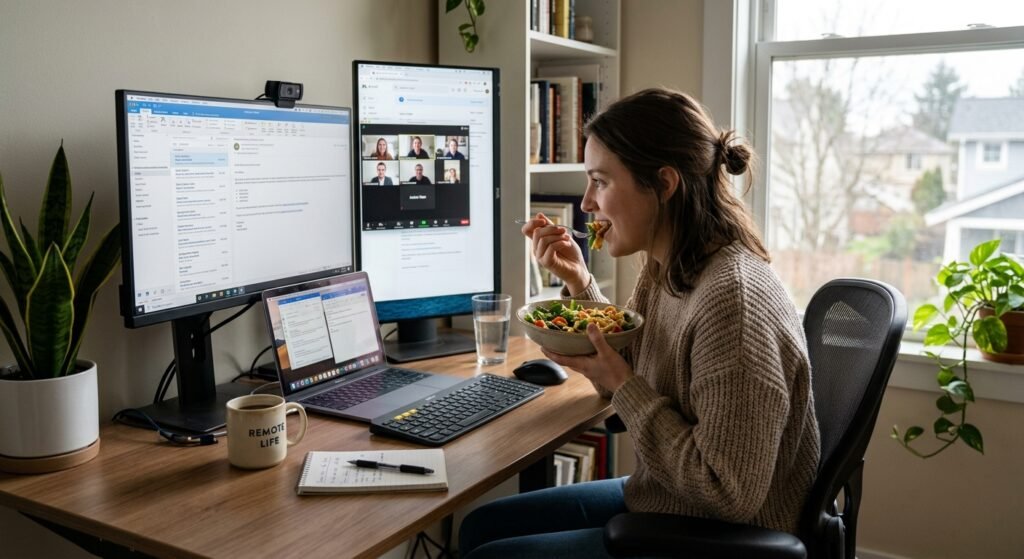
You finish your last video call of the afternoon, click the red button to leave, and instantly the room goes silent. There’s no walking out of a conference room alongside someone else. There’s no lingering by the doorway to talk about how strange that meeting was. You simply close your laptop, stand up in your quiet kitchen, and realize your workday has ended without a single person witnessing it.
In the beginning, working from home felt like a quiet victory. You gained back hours of your morning, skipped the exhausting commute, and traded rigid office attire for complete comfort. It seemed like the perfect balance. You were getting your work done, enjoying your personal space, and moving through your tasks with clean efficiency.
Then, somewhere along the line, a subtle feeling started settling in around the middle of the afternoon. It wasn’t total exhaustion, and it wasn’t a desire to return to fluorescent lights or crowded elevators. It was something far quieter. A strange sense of isolation that stayed with you long after you closed your laptop for the evening.
The Unscripted Moments We Didn’t Notice
When you think back to working in a shared environment, the things you miss are rarely the formal meetings or the actual tasks. What you miss are the unplanned moments that happened around the work. It was the quick smile from a coworker in the hallway, the shared look of confusion during a long presentation, or the brief chat while waiting for the coffee pot to brew.
Those moments were small, almost unnoticeable while they were happening. Nobody scheduled them on a calendar, and nobody included them in a weekly agenda. Yet those tiny, low pressure interactions were quietly doing something vital. They were reminding you that you were part of a team, sharing an experience with people who understood the exact context of your day.
Without those casual touchpoints, working life becomes purely transactional. Every interaction requires a calendar invite, a link, and a reason to speak. You don’t call a colleague just to say that an email sounded funny. You don’t jump on a call just to express frustration about a confusing software update for thirty seconds. So instead, you hold onto those tiny thoughts by yourself, sitting alone at your desk.
When Every Interaction Has A Purpose
Psychological research often highlights the value of what experts call weak ties, which are those secondary social connections with acquaintances, neighbors, and casual colleagues. While close relationships give us deep emotional support, these lighter connections provide something equally important: a grounding sense of belonging within a wider community. They offer gentle validation and remind us that we exist in a shared world.
When you work remotely, those casual connections are usually the first thing to disappear. Video calls are designed for efficiency. People log on, discuss the project, check off the action items, and log off. Even when teams try to schedule virtual social hours, they often feel artificial because forced fun through a camera rarely creates the same warmth as sharing physical space.
In a traditional office, you could gauge the atmosphere of a room just by walking through it. You could tell if a manager was stressed, if a teammate was having a difficult morning, or if the energy was light and relaxed. Online, that context disappears. You’re left reading into every short message, every delayed reply, and every ambiguous punctuation mark, turning simple communications into puzzles you have to solve alone.
Sitting Alone With Your Thoughts
If you’ve spent hours overthinking a single message from your manager, you already know how lonely remote work can feel. In a physical office, you could turn around and ask the person next to you if you were overreacting. They would give you a reassuring nod or a quick laugh, and the worry would dissolve in seconds.
At home, that small worry stays in your head. It grows bigger because there’s no immediate, casual perspective to shrink it back down to size. You carry it with you while you prepare dinner, clean up the living room, or try to unwind for the evening. The boundary between work troubles and personal peace grows blurry, not because you’re working too many hours, but because you’re carrying the mental effort entirely on your own.
Studies show that social isolation at work affects overall job satisfaction far more than workload or compensation. When social support drops, small frustrations feel much more significant, and ordinary daily stressors begin to feel far more lingering. You aren’t losing your ability to focus, and you aren’t failing at managing your time. You’re simply missing the natural comfort that comes from being alongside others.
It Isn’t About The Office Space
It’s easy to confuse this feeling with a desire to go back to how things used to be. But most people don’t actually miss long commutes, rigid schedules, or the lack of personal flexibility. What people miss is the effortless presence of others who are living through the same daily moments.
There’s comfort in knowing someone else knows how difficult a project was, or how funny a particular moment turned out to be. Connection doesn’t always require deep, personal conversations. Sometimes, it just requires knowing you aren’t the only one sitting in the room, working through the day.
If you’ve been feeling a strange sense of disconnection lately, it doesn’t mean you’re ungrateful for the freedom of working from home. It doesn’t mean you aren’t built for remote flexibility. It simply means you’re noticing a quiet truth that modern work often forgets: flexibility is wonderful, but connection is essential. And feeling a little lonely in a quiet room isn’t a personal flaw; it’s just a sign that you were always meant to share your days with others.