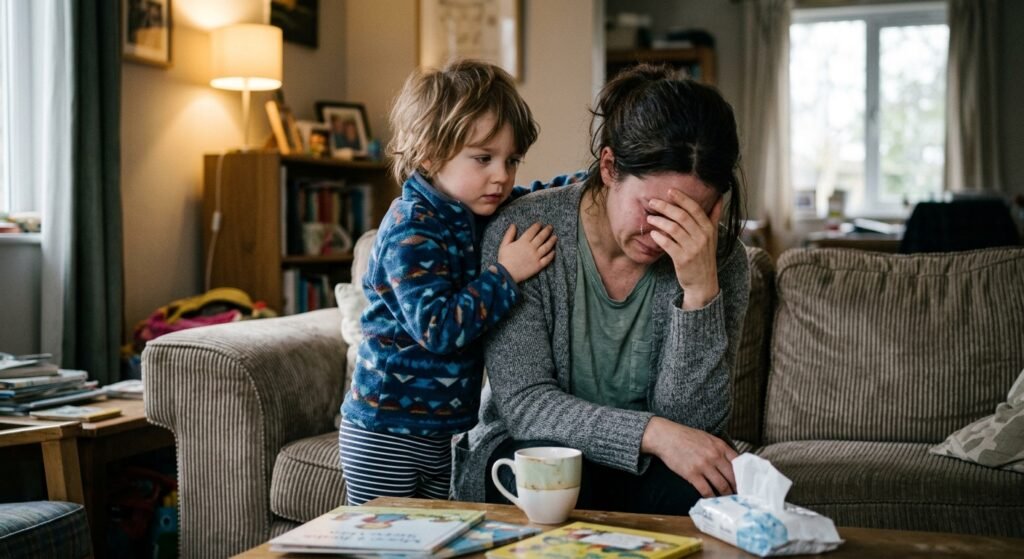
You might remember standing in the kitchen as a ten or eleven year old, listening to an adult talk about things you couldn’t fully understand. Maybe your mother was crying at the table over unpaid bills, or your father was venting about his marriage after a long day. You stood there quietly, holding a glass of water, trying to figure out how to make the room feel safe again.
In that small moment, something subtle happened. You didn’t just listen. You took on the role of the person who fixes things.
It usually starts without anyone planning it. Most parents don’t set out to turn their children into emotional anchors or sounding boards. Life simply gets complicated, stress overflows, and an observant child happens to be standing nearby with open ears and a caring heart.
When a home feels unstable, kids naturally look for ways to restore order. Some act out, while others quiet down. But a specific group of children learns that the fastest way to feel secure is to keep the adults around them calm. They become the good listener, the steady presence, the wise little adult who always knows the right thing to say.
On the surface, people praise these kids. Relatives talk about how mature they are for their age. Teachers compliment their calm demeanor and empathy. It looks like a gift, and in many ways it is. But beneath that maturity lies a heartbreaking truth: a child usually grows up fast because staying small didn’t feel safe enough.
The Silent Role You Didn’t Choose
When you become your parent’s confidant, the entire family dynamic quietly changes place. Instead of relying on an adult to help you process your fears, you become the one managing theirs. You learn to read the room the second you walk through the front door, scanning for tight jaws, sharp tones, or tense silence before deciding how to act.
You figure out quickly that your own bad days need to wait in line. If your mother is overwhelmed, you pack away your school stress because adding to her trouble feels unfair. If your father is lonely, you stay home to keep him company, quietly trading your own social life for his peace of mind.
Psychology experts who study family roles often point out that when emotional boundaries blur like this, children end up absorbing adult worries long before their brains possess the tools to process them. Research shows that young people in these positions develop remarkably high empathy, but they also learn to suppress their own emotional needs. They learn that being loved means being useful.
And that mindset doesn’t just disappear when you turn eighteen and pack up your room.
How Childhood Roles Follow You Into Adulthood
If you were the emotional rock growing up, you’ve probably noticed that same dynamic showing up in your life today. You might find yourself drawn to friends or partners who always seem to be in crisis. You naturally step into the role of the caretaker, the problem solver, the one who stays steady while everyone else unravels.
It feels natural because it’s familiar, but it can also be exhausting. Asking for help might feel nearly impossible, almost like you’re breaking an unwritten rule. When you’re going through a difficult season, your first instinct is probably to handle it alone, hiding your struggle so you don’t burden anyone else.
That’s the quiet heartbreak of early responsibility. You spend so much of your life paying attention to what everyone else needs that you lose touch with what you need. When someone asks you how you’re feeling, you might give a polished answer about how everything is fine, even when you’re privately struggling to keep things going.
You grew so used to protecting your parents’ feelings that having your own feelings started to feel selfish.
Learning to Belong to Yourself First
Undoing this pattern doesn’t mean you stop loving your family or caring for the people in your life. It simply means recognizing that you were never meant to carry the emotional well-being of the adults who raised you. That was their responsibility, even if they weren’t equipped to handle it themselves.
Allowing yourself to step down from the role of the family anchor can feel terrifying at first. You might worry that if you stop holding everything together, the connections in your life will fall apart. Or worse, that people won’t need you anymore if you aren’t fixing their problems.
Sometimes, the gentlest realization is that being loved shouldn’t require you to be a buffer for everyone else’s storm.
Maybe you weren’t a mature child simply because it was your natural personality. Maybe you were just a young person doing your best to keep a peaceful home from disappearing. And maybe now, as an adult, you’re finally allowed to put down the job you were given before you were old enough to choose it.