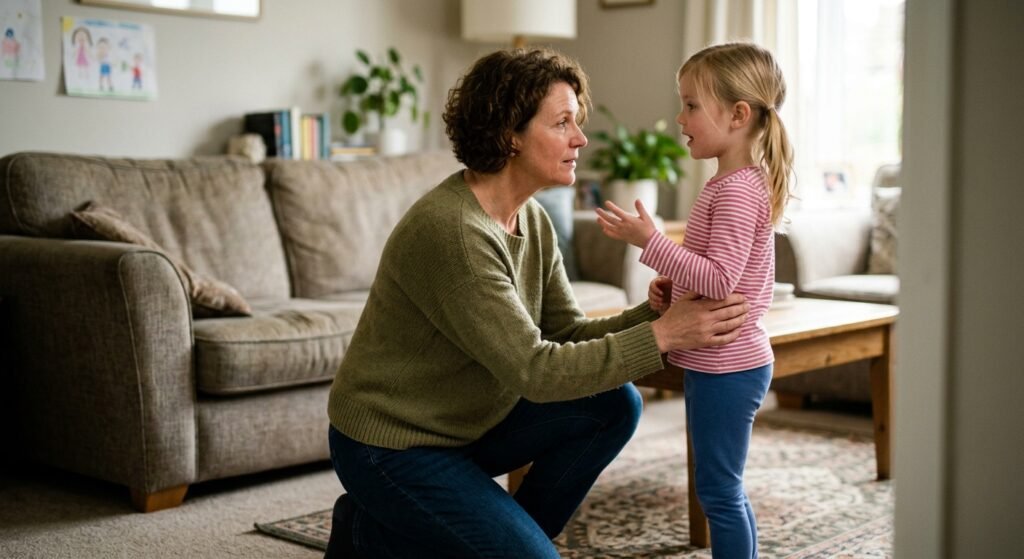
If you’ve ever watched a toddler fall down on a soft rug, you know there is always a tiny delay before the reaction comes. They don’t cry right away. Instead, they pause, freeze for a second, and look up to find your eyes.
In that brief quiet moment, they aren’t checking whether their knee hurts. They’re checking to see how you respond. They’re asking a question without saying a word, wanting to know if they’re safe, if you saw what happened, and if everything is going to be okay.
That quick search for your gaze happens dozens of times a day. It happens when a five-year-old holds up a crooked drawing, when a ten-year-old lingers near the kitchen island while you’re cooking dinner, or when a teenager suddenly gets quiet in the car on the ride home from practice. Life is full of these small, unspoken invitations, and how you respond to them quietly shapes how a child experiences the world.
The Quiet Calls For Connection
It’s easy to assume that parenting is defined by the big moments. We spend so much energy worrying about having the right talk about big life decisions, choosing the right school, or managing major behavioral challenges. Yet most of what builds a child’s internal foundation happens during moments that feel so ordinary you might miss them entirely.
Psychologists refer to these interactions as bids for attention, but in daily life, they simply look like small attempts to share space. A child might point at a bird out the window, tell you a long story about a game that makes very little sense, or complain about a broken crayon. On the surface, these moments seem minor, almost trivial when you’re trying to manage a busy household.
When you pause, look up from your phone, and acknowledge what they’re showing you, something subtle happens. You send a message that their world matters to you. You let them know that their feelings, curiosity, and small daily discoveries are worth your time. Over time, those small exchanges stack up like tiny building blocks, laying down a deep, quiet certainty that they belong.
Security Isn’t Built In A Single Speech
Back in the mid-twentieth century, researchers studying child development began looking closely at why some children move through life with a steady sense of confidence while others seem perpetually anxious. What they discovered changed our understanding of childhood. Security didn’t depend on how many toys a child had or how strictly rules were enforced. It came down to parental responsiveness.
When a primary caregiver consistently notices a child’s signals and responds with warmth and predictability, the child develops what experts call a secure attachment. The nervous system learns that the world is a manageable place because someone is in their corner. They learn that distress isn’t a permanent state, because whenever feeling overwhelmed shows up, a comforting presence isn’t far away.
What’s fascinating is that responsiveness doesn’t mean solving every problem or taking away every unpleasant feeling. In fact, trying to fix everything often backfires. True responsiveness is simply emotional availability. It’s the willingness to sit next to a child who is upset without demanding that they hurry up and feel better. It’s letting them know that their emotional world isn’t too vast or scary for you to handle alongside them.
The Fear Of Getting It Perfect
Of course, reading about emotional availability can easily trigger a wave of worry for any parent. You think about the afternoons when you were exhausted and snapped over a spilled drink, or the times you were so wrapped up in an email that you barely heard what your child was saying. It’s easy to wonder if those imperfect moments are undoing all your hard work.
Fortunately, long-term observational studies offer some profound comfort here. Researchers found that parents don’t need to be perfectly attuned all the time to raise secure, resilient children. In fact, even the most responsive parents are only fully in sync with their children about thirty to forty percent of the time. What matters far more than flawless attention is repair.
When you get distracted or lose your patience and later come back to say you’re sorry, you teach your child something deeply valuable. You show them that relationships can experience a bump and still be restored. You teach them that missteps aren’t the end of connection, but rather an opportunity to rebuild it. That knowledge stays with a child long after they leave home.
What Staying Present Really Teaches
When a child grows up with a parent who regularly tunes into their emotional world, they absorb a set of quiet truths about themselves. They learn that their feelings make sense, that it’s safe to be vulnerable, and that asking for help isn’t a sign of weakness. They don’t have to put on a show or perform to earn care; they simply receive it because they exist.
That kind of internal security becomes a powerful compass as they grow into adults. It affects the friends they choose, the partners they trust, and how they treat themselves when life gets difficult. Someone who was met with warmth as a child is much more likely to show up for themselves with patience when things go wrong later in life.
Maybe the point of being a responsive parent was never about making sure a child never experiences sadness, frustration, or fear. Maybe it’s about showing them that no emotion is too big to hold, and that no matter how strange or confusing the world gets, they’ll never have to figure it out entirely on their own.