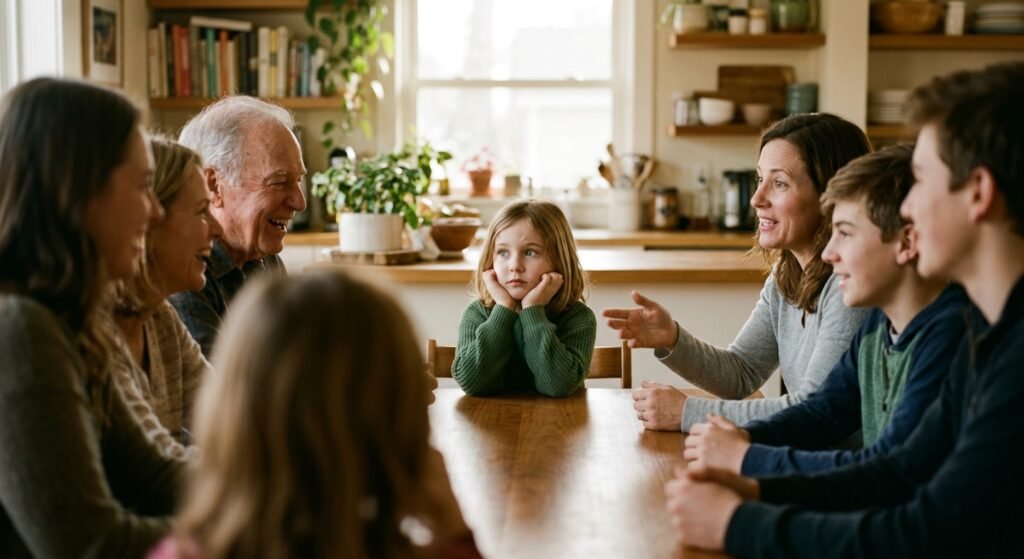
If you’ve ever spent time around a quiet child, you’ve probably caught them staring at you during an ordinary moment. Maybe you were stirring a pot of soup on the stove, folding laundry, or pausing just a second too long before answering a phone call. You thought you were completely unobserved, but when you turned around, there they were, watching you with a calm, steady gaze that felt surprisingly perceptive.
It’s easy to assume children only pay attention when you’re directly speaking to them. We spend so much energy trying to give instructions, explain rules, and guide their behavior that we forget how much learning happens in the quiet space between our words. But certain kids possess a deep instinct for observation. They don’t just hear what adults say. They feel the atmosphere in the kitchen when someone comes home tired after a long day.
They notice the subtle turn in your voice when a conversation becomes tense. They pick up on the quick look exchanged between parents across a crowded living room. Long before they have the words to name an emotion, they’ve already understood the truth of it.
They Read the Room Before Anyone Speaks
Psychologists who study family dynamics often talk about emotional sensitivity in children, but in everyday life, it looks much simpler than any technical explanation. It looks like a five-year-old quietly bringing you their favorite stuffed animal on a Tuesday evening, not because you said you had a hard day, but because you walked through the front door a little slower than usual.
These observant children are constantly gathering details about the world around them. Where an adult sees an ordinary evening routine, a sensitive child notices the slight tight feeling in the air. They notice when laughter sounds easy and when it sounds forced. They notice when someone is truly present and when someone’s mind is somewhere else entirely.
Research into developmental awareness suggests that young minds absorb nonverbal signals long before they master complex language. Long before a child can explain why a room feels tense, their internal system has already processed the subtle clues. They are taking mental notes on how adults navigate stress, disappointment, and quiet joy, saving those moments for later.
The Language They Aren’t Ready to Use Yet
The trickiest part for a child who notices everything is that their ability to observe usually develops faster than their ability to express themselves. Imagine understanding that a situation feels off, but having only the vocabulary of an eight-year-old to describe it. It can leave a young person sitting with big, complex realizations while possessing very few ways to speak about them.
That’s often why these kids stay so quiet. Their silence isn’t a lack of thought or a sign that they’re distracted. It’s often the opposite. It’s the sound of a young mind trying to organize a world that moves very fast and carries a lot of implied meaning. They’re translating adult emotions into something that makes sense in their own world.
When a child stays quiet during a busy family gathering or retreats to their bedroom while adults talk downstairs, it’s rarely because they’re ignoring what’s happening. More often, they’re simply taking in more information than they can sort through at once. They need space to unpack everything they’ve seen and felt.
Holding Space for the Quiet Ones
Sometimes, as parents or relatives, we feel an urge to pull these observant children out of their shell. We want them to speak up, join in, and share their thoughts with the rest of the room. We worry that being quiet means they’re feeling left out or shy.
Yet there’s a unique beauty in the way these children move through life. They teach us that presence doesn’t always require loudness. They remind us that watching and listening are active choices, ways of caring for the people around them. When a quiet child finally does choose to speak, their words often land with surprising clarity, offering a perspective that catches everyone off guard.
They aren’t missing out on the moment by staying silent. They’re experiencing it deeply, taking in the details that everyone else was too busy to notice.
A Quiet Realization
Perhaps children aren’t simply waiting for adults to teach them how the world works. Perhaps they’re quietly watching us to see if we’ve forgotten what truly matters. And maybe their silence isn’t something to fix, but an invitation to slow down, look closer, and notice the soft truths hanging right there in the air.