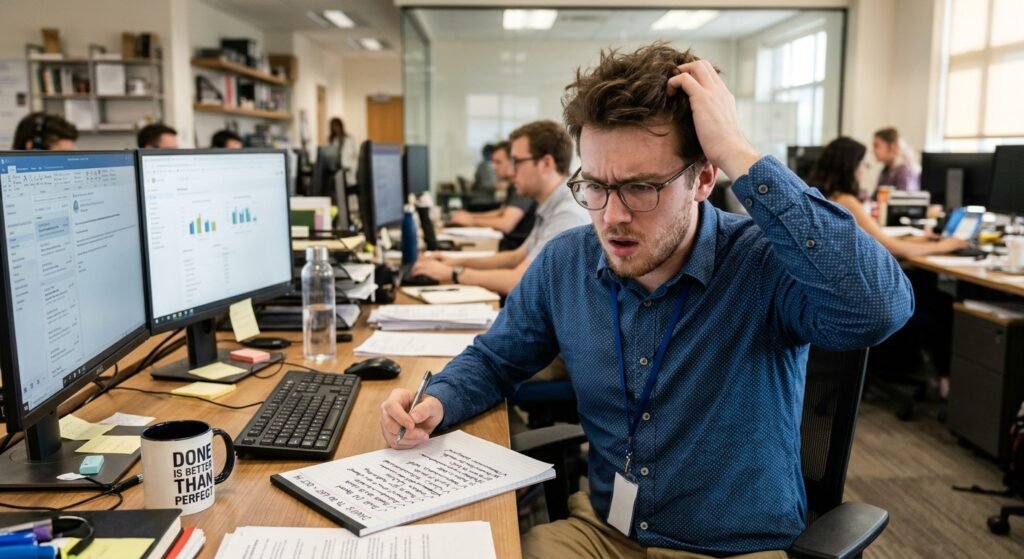
Can we talk about this for a second?
You sit down at your desk in the morning, look at your to do list, and see one tiny task. Just one. It is something simple like replying to a two sentence email, attaching a file to a folder, or changing the date on a presentation slide. It is the kind of job that technically takes about forty five seconds. You even smile a little because you think to yourself that you will just knock this out real quick and move on with your day.
Five minutes later, you haven’t started.
Three hours later, you’ve reorganized your entire inbox, refilled your water glass twice, checked the temperature in three different rooms, and quietly convinced yourself that you cannot possibly send that short reply until you find the exact right phrasing.
By four o’clock in the afternoon, that tiny forty five second task is still sitting there, staring at you from your screen, somehow taking up your entire day.
The Art of the Pre Task Warm Up
Somehow this always happens.
We all like to pretend that work is a straightforward equation. If a task takes two minutes, you do it for two minutes, and then you have seven hours and fifty eight minutes left to handle everything else. But deep down, we all know that is not how our brains actually operate. The smaller a task looks on paper, the more room it seems to create for micro distractions, weird mental negotiations, and sudden urges to clean things that haven’t been cleaned in months.
It usually starts with the warm up period.
Before tackling the tiny task, you decide you need the proper environment. You cannot just type out a quick response with an empty mug sitting on your desk, right? So you head to the kitchen. While waiting for your coffee to brew, you notice a stray dish in the sink. You rinse it. Then you notice a tiny spot on the counter, so you wipe the counter. Suddenly, you’re wiping down the microwave door like an off duty restaurant inspector. For some reason this suddenly feels completely reasonable.
You walk back to your desk feeling strangely productive. You sit down, open the document, and highlight the single sentence you need to change.
Then your brain intervenes again.
Why Tiny Tasks Feel So Defeatable
Your brain looks at this tiny task and makes a surprisingly persuasive point. It whispers that because this job is so fast, you can literally do it at any moment. Which means, by modern logic, you do not actually have to do it right now.
That’s the trap.
When a project is massive and intimidating, you feel a clear sense of urgency. You pull up your sleeves and dig in because you know it requires real effort. But when a task is tiny, it carries zero urgency. It is so small that it feels completely light and manageable. And because it feels so manageable, you convince yourself that deferring it for ten minutes carries no consequence at all.
So you check a quick news article. Then you check your calendar for next month. Then you decide it’s a great time to unsubscribe from store newsletters you haven’t opened in years.
At some point it stops being about the task itself.
It becomes about the bizarre internal story you tell yourself to protect the feeling of being busy. If you finish that forty five second job right away, the task is gone, and you are suddenly faced with the bigger, scarier projects of the day. But as long as that tiny item stays on your list, you get to feel like you are actively in the middle of something achievable.
The Hidden Complexity of Simple Choices
Then comes the drafting process for things that shouldn’t require a draft.
You finally type out the short email. It reads: “Thanks for sending this over. Looks good to me!”
You stop. You read it back. You edit it.
You change it to: “Thanks for sending this over! Looks great to me!”
You read it again. Now it feels too enthusiastic. Are you an exclamation point person today? Should you tone it down so people don’t think you are trying too hard? You delete the second exclamation mark. Now it sounds cold. Is the recipient going to think you are upset with them? You spend seven minutes debating the emotional tone of punctuation for a routine budget sheet.
You rewrite it a third time, step away from your desk to grab a snack, and return ten minutes later to finally hit send.
The relief is immediate, followed quickly by the realization that you just spent three hours on something that required less effort than tying your shoes.
Giving Yourself Room to Breathe
We’ve all done this, and honestly, there is no point in feeling bad about it. The truth is that work rarely matches the clean, efficient schedules we build in our heads. Small tasks don’t take all day because we are bad at managing our time. They take all day because small responsibilities leave wide open spaces for our minds to wander, adjust, and reset.
Sometimes that forty five second task isn’t just an item on a list. It’s the small boundary between getting down to serious business and giving yourself a little breathing room before the rest of the afternoon kicks off.
So if you’re currently staring at a five word message that’s been sitting open on your screen since lunch, don’t worry too much about it.
We all know how this ends. Take a deep breath, hit send, and go easy on yourself. You’ll probably do the exact same thing tomorrow, and that’s perfectly okay.