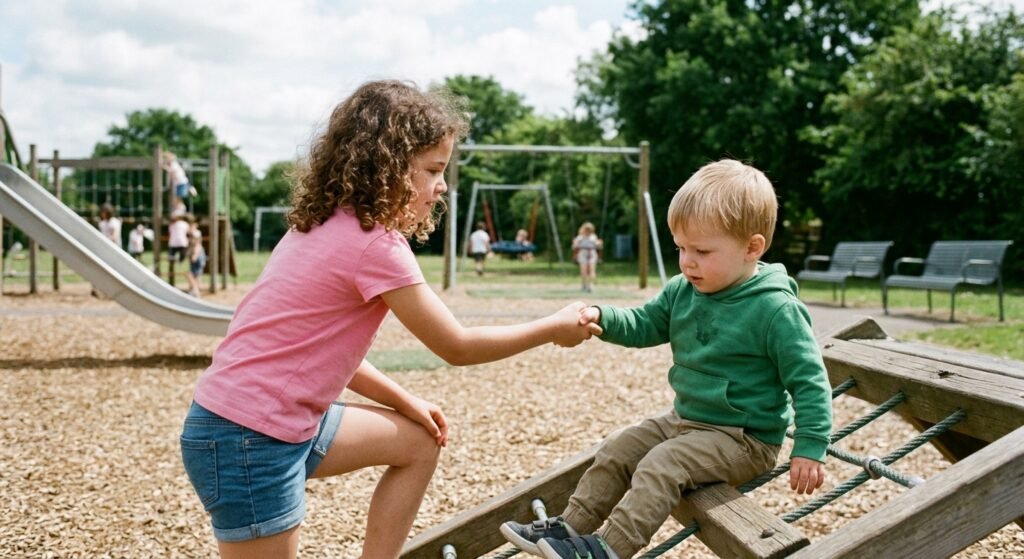
If you watch closely from across a crowded room, or through the kitchen window on a quiet afternoon, you might catch a moment you weren’t supposed to see. Your child is standing near a classmate who just dropped their books. No teacher is directing traffic, and no adult is offering praise. Your child simply kneels down, gathers the papers, and hands them back with a quick, reassuring smile before walking away.
It happens in an instant, so fast that if you blinked, you would have missed it entirely. Yet, somehow, that tiny moment stays with you long after the rest of the afternoon fades. You might find yourself thinking about it while doing the dishes, or standing by the stove later that evening, feeling a strange and quiet warmth settling into your chest.
That feeling isn’t the loud excitement that comes with winning a trophy or bringing home a perfect report card. It is something far softer and much deeper. It is the realization that the person you’re raising possesses a genuinely good heart when nobody is asking them to perform.
The Quiet Moments You Weren’t Meant to Notice
Parenting often feels like an endless series of instructions. You spend years repeating the same phrases over and over. You tell them to share their toys, to say thank you, to hold doors open, and to be polite to neighbors. After a while, those reminders start to feel like background music in your household, and you begin to wonder if any of it is actually sinking in.
Politeness, after all, can be taught as a habit. Children learn early on that saying certain words keeps the adults happy and keeps daily life moving smoothly. But kindness is entirely different. Politeness is following a set of social rules, while kindness requires someone to actually step outside of themselves and notice how another person feels.
When a young person offers comfort to a friend who missed a goal, or stays behind to help clean up a mess they didn’t make, they aren’t relying on a script. They’re making an active choice to care. And seeing that choice happen naturally, without any prompting from you, provides a kind of joy that catches you completely off guard.
Achievement Tells You What They Can Do, Decency Tells You Who They Are
The world around us loves to measure progress through visible milestones. We keep track of growth charts, athletic scores, musical achievements, and academic honors. It is easy to get caught up in those numbers because they offer clear, tangible proof that your child is growing up and moving forward.
Psychologists who study family dynamics often point out that while children absorb explicit rules through direct instruction, their core empathy is shaped far more by observing everyday interactions. They pick up on how adults treat servers, how family members speak to each other after a long day, and how compassion is offered when things go wrong. Over time, those observed behaviors stop being things they copy and start becoming part of their internal moral identity.
That is why seeing your values reflected back to you feels so moving. It isn’t because it reflects well on your parenting skills, though it certainly brings a sense of relief. It feels moving because you realize that the goodness you tried to foster in your home has taken root inside of them, turning into something that belongs entirely to them.
The Reassurance Every Parent Secretly Longs For
Most parents carry a quiet stream of self doubt. You worry about the times you lost your patience, the hectic evenings when you were too tired to listen properly, or the moments you wish you had handled differently. It is easy to wonder if your mistakes are building the foundation of who they will become.
Seeing your child act with genuine decency offers a quiet answer to those worries. It reminds you that children don’t need perfection from you to grow into caring people. They simply need enough love, consistency, and warmth to understand that other people matter, too.
In those quiet moments of unscripted goodness, the stress of daily routines briefly lifts. You stop worrying so much about whether you’re doing everything right, and you simply appreciate the person sitting across from you at the dinner table.
A Different Way to Measure Growth
As children grow older, the nature of parenting changes. You gradually move from protecting them from the world to watching how they move through it on their own. You won’t always be there to guide their decisions, offer advice, or smooth out the rough edges of their days.
That transition can feel bittersweet, but watching their character develop makes the letting go a little easier. When you know they carry empathy into their friendships, their classrooms, and their daily interactions, you feel a deep sense of trust in their future.
Maybe we spend so much time watching for milestones because we want to make sure our children are ready to face the world. But when you see them treat others with quiet decency, you realize something even better. You realize that the world around them is going to be a little better off because they are in it.