Staring Into the Kitchen Light Again
Can we talk about this for a second?
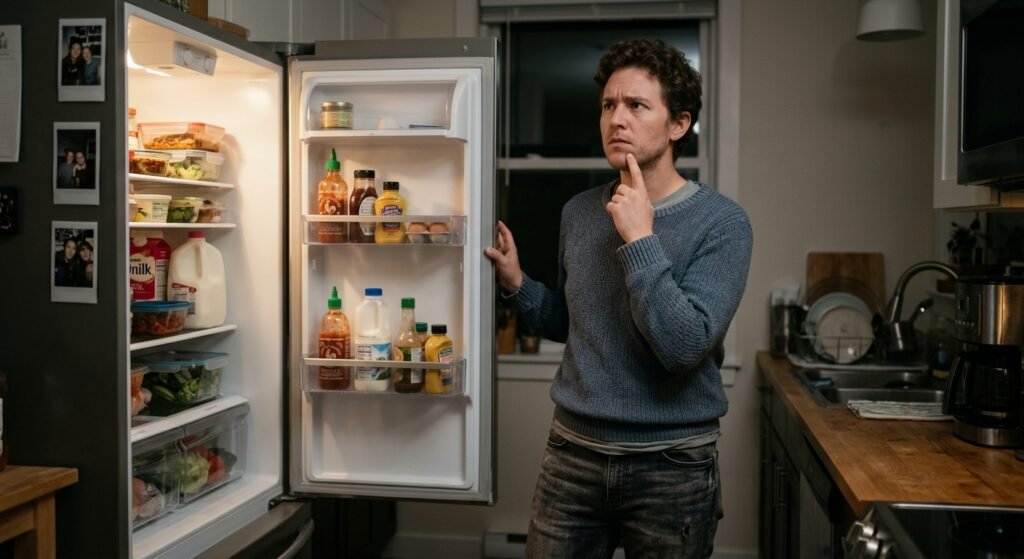
You walk into the kitchen, open the refrigerator door, and stand there in silence while cold air drifts around your ankles. You stare at the shelves. There’s a half-empty jar of mayonnaise, a box of baking soda that’s been working hard since last summer, a leftover container of rice from three nights ago, and a solitary lime that’s slowly turning rock hard. You look at everything for ten full seconds, decide there’s nothing in there you want, and gently swing the door shut.
Five minutes later, you walk right back into the kitchen and open the exact same door.
Somehow this always happens. Nothing has changed. A fully catered buffet hasn’t magically materialized on the middle shelf in the last three hundred seconds. Nobody snuck into your house to restock the snack drawer while you were sitting on the couch. Yet there you are, glowing in the soft light of the refrigerator bulb once again, looking at the exact same jar of mayonnaise like maybe it’s evolved into a gourmet meal while your back was turned.
We all know how this ends. You didn’t suddenly become hungry in those five minutes. You were never hungry in the first place. You were just looking for something to happen.
The Refreshed Expectation
At some point, it stops being about the food entirely. The refrigerator door has quietly become the home’s primary physical refresh button. When work gets tedious, when a movie gets slow, or when you’re supposed to be folding laundry, your feet just start moving toward the kitchen. It’s almost automatic. You step away from whatever you were doing, pull open the door, and pause.
There’s something wonderfully optimistic about the second and third visit to an empty fridge. On the first visit, you’re looking for prime choices. You want an ice-cold drink, a slice of leftover pizza, or maybe some leftover Chinese takeout. When those aren’t there, you close the door in slight disappointment.
By the third visit, your standards have adjusted dramatically. You’re no longer looking for dinner. You’re looking for possibilities. For some reason, two pickle spears wrapped in a slice of deli turkey suddenly feels completely reasonable. You stare at a block of cheddar cheese and a jar of mustard and convince yourself that with enough creativity, this could actually be a pretty solid snack.
You haven’t lowered your food standards because you’re starving. You’ve lowered them because you really, really don’t want to go back to what you were doing before you walked into the kitchen.
Searching for a Moment of Surprise
The funny thing is how quiet and deliberate the whole routine is. People don’t sprint to the fridge when they’re bored. They wander. They open the door with the slow, thoughtful posture of someone browsing a museum exhibit. You rest one hand on top of the door frame, lean forward slightly, and scan the top shelf as if you’re expecting a tiny surprise to appear behind the salad dressing.
If someone asked you right then what you were doing, you’d probably say you were getting a snack. But deep down, you know that isn’t true. If someone handed you an apple, you might not even want it. The apple requires commitment. What you actually wanted was the mystery of opening the door and seeing what was inside.
In a way, the refrigerator is the ultimate offline scroll feed. A bright light turns on the moment you open it. Cold air gives you an instant sensory reset. And every shelf offers a small collection of items you’ve seen a hundred times, but somehow still hope might deliver a brief spark of interest. It’s a low-stakes search for standard novelty in a quiet afternoon.
The Lowering of Expectations
As the evening goes on, the trip back to the kitchen turns into a regular route. You might check the pantry first, realize it’s just baking ingredients and old canned soup, and then head straight back to the cold light of the main appliance. It’s a two-stop circuit that feels strangely comforting.
You convince yourself that maybe you missed something tucked behind the orange juice. You lift a carton. You peer into the crisper drawer with deep seriousness, as if a bag of potato chips might be hiding beneath three heads of celery. It isn’t, of course, but the act of checking gives your brain a tiny pause from whatever quiet moment you’re living through.
Eventually, you grab a single grape or one almond, close the door, and walk back to the living room feeling like the mission was somehow a success. You didn’t find anything amazing, but you completed the loop.
Curiosity in Everyday Moments
It’s easy to laugh at ourselves for doing this, but there’s something sweet about it too. We’re endlessly curious creatures, even when we’re just pacing around our own hallways on a quiet Tuesday evening. We don’t always need big grand adventures to satisfy that tiny itch for something new; sometimes we just need to pull open a magnetic door and see if anything interesting has shown up since seven o’clock.
So the next time you find yourself standing in front of the open fridge for the fourth time in an hour, staring at a jar of pickles like it holds the secrets of the universe, don’t worry about it. You aren’t losing your mind, and you aren’t even really hungry.
You’re just taking a little breather, enjoying the cool light, and hoping for a tiny surprise. And honestly, you’ll probably walk right back out there and do it again twenty minutes from now.