
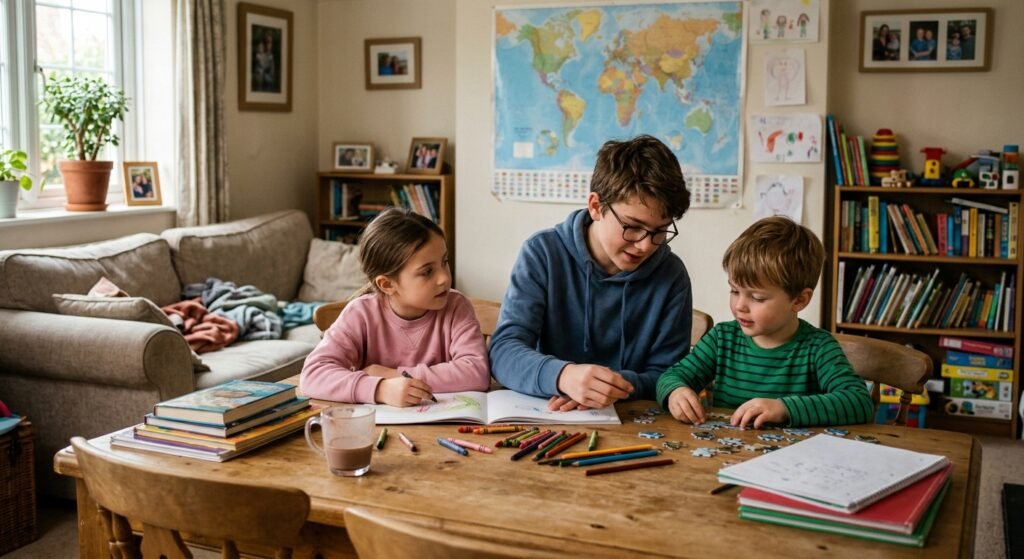
You are in the kitchen, dinner is bubbling on the stove, and the living room is a chaotic blur of toys, scattered shoes, and a younger sibling crying about a lost crayon. In the middle of this storm sits your oldest child. They are quietly packing their school bag for the next morning, placing their completed math worksheet inside a neat folder without being asked. You look at them and feel a wave of gratitude. They are capable. They are independent. They are the one person in the house you don’t have to worry about right now.
It’s a scene that plays out in millions of homes every single day. When a child seems to have everything under control, we naturally step back to focus on the fires that need immediate attention. We stop double-checking their backpack. We ask them to keep an eye on their sibling while we take a quick phone call. We praise them for being so grown-up, so mature, so helpful. It seems like a beautiful partnership, a quiet agreement between parent and child that makes a busy life feel a little more manageable.
The Silent Agreement of the Easy One
But if you look closely at that quiet agreement, you might notice something else happening beneath the surface. When a child learns that they are appreciated most for their competence, they begin to build their entire sense of safety around never needing help. The praise we give them for being the easy one can quietly turn into a rule they think they must follow at all costs. They start to believe that their role in the family is to be the one who doesn’t have problems, the one who doesn’t make demands, and the one who always has the answers.
People who study family dynamics often talk about how easily children adopt roles to keep their family system running smoothly. When a family is busy or stressed, the oldest child often steps into the role of the helper because it is the most useful space available. It isn’t a conscious choice they make; it’s a natural response to the world around them. Over time, this pattern shapes how they interact with everyone. They become highly skilled at reading the room, anticipating needs, and tucking their own feelings away to avoid adding to the stress of the household.
The challenge is that competence is a very convincing disguise. A child who gets good grades, remembers their jacket, and handles disappointments with a quiet shrug doesn’t look like someone who is struggling. In fact, they look like a parenting success story. It is easy to forget that a ten-year-old who acts like a fifteen-year-old is still, at their core, only ten. They might have the intellectual capacity to organize their schedule, but they don’t yet have the emotional maturity to carry the substantial load of always being the strong one.
The Standard of Perfection
Think about how this shows up in your own routines. When your oldest has a bad day, do they get the same space to cry and scream as their younger sibling, or do you find yourself gently asking them to set a better example? When they make a mistake, does it feel like a normal part of childhood, or does it feel like a sudden breakdown of the system you rely on? It is easy to hold our oldest children to an unspoken standard of perfection simply because they have shown us they can reach it.
Some of the most revealing research in developmental psychology looks at how adults who were capable children look back on their youth. Many of them express a quiet sadness, not because they were mistreated, but because they felt they had to grow up too quickly. They recall feeling a constant pressure to keep the peace and remain low-maintenance. The tragedy isn’t that they learned to be responsible; it’s that they learned their worth was directly tied to how little they needed from the people who loved them.
This realization isn’t meant to make you feel guilty. Parenting is an exhausting balancing act, and relying on a capable child is a highly understandable survival strategy. But perhaps the realization we need to sit with is that strength in a child isn’t always a sign of resilience. Sometimes, it is simply a coping mechanism. A child who never asks for help may not be perfectly fine; they might just be afraid of what will happen if they let themselves fall apart.
Every child, no matter how competent, needs to know that they are allowed to be messy, confused, and utterly helpless. They need to know that they don’t have to earn their place at the table by being useful. Sometimes, the greatest gift we can give our oldest child is to step in and take care of them before they have to ask for it. It’s about looking past their competence, pulling them into a hug, and letting them know that they don’t have to hold everything together. They are allowed to just be a kid, and you’ve got the rest covered.