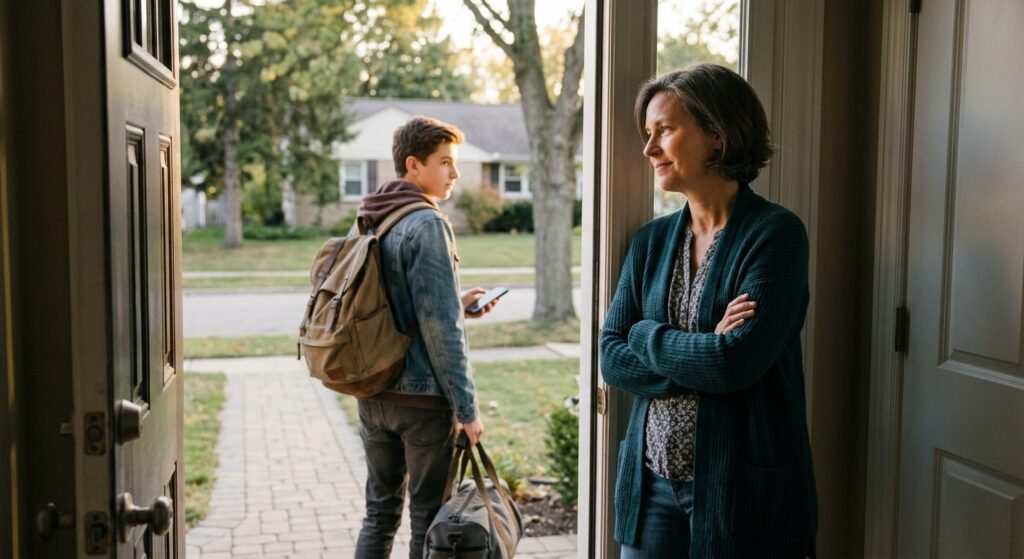
Think about that moment you see your teenager walk out the door in the middle of a freezing morning without their coat. You call out to them, but they shrug, offer a quick wave, and keep walking. Your first instinct is to grab the jacket, run down the driveway, and hand it to them. You want to shield them from the discomfort, just like you’ve shielded them from every scraped knee and bumpy road since they were small.
But then you stop. You realize that if you run out there, they will stay warm today, but they might never learn how it feels to freeze because of their own choice.
It’s a small moment, almost silly in its simplicity, but it represents one of the most quiet, challenging transitions of parenting.
The Urge to Fix Everything
When our children are small, our job is beautifully clear. We’re the protectors, the fixers of broken toys, the finders of lost socks, and the builders of safety nets. If they fall, we’re right there to catch them. If they make a mistake, we can usually smooth it over with a quick apology or a band-aid. We get used to this role because it makes us feel useful, and frankly, because it keeps our children safe.
Then, almost overnight, the world gets bigger and the stakes get higher.
Suddenly, the mistakes aren’t about spilled milk; they’re about forgotten homework, missed practices, broken promises to friends, or the sting of a bad grade they didn’t study for. Our immediate reaction is still the same old instinct: we want to step in. We want to email the teacher, write the excuse note, or make the phone call that fixes the problem before our teenager has to feel the sting of it. We tell ourselves we’re helping, but deep down, we’re often just trying to manage our own discomfort.
The Hidden Value of the Stumble
There is a quiet beauty in allowing people to experience the natural outcome of their choices. Psychologists who study development often point out that self-reliance isn’t something we can teach through lectures or advice. It’s something that must be earned through direct experience. When we constantly step in to rescue our teenagers from minor disasters, we might be keeping their lives smooth in the short term, but we’re also quietly sending them a message that we don’t think they’re capable of handling the rough spots.
Think of the last time you learned a really valuable life lesson. It probably didn’t happen because someone gave you a piece of advice. It happened because you made a mistake, felt the discomfort of it, and had to figure out how to clean up your own mess.
By stepping out of the way, we allow our teenagers to develop their own sense of capability. They learn that a bad grade isn’t the end of the world, but rather a sign that they need to change how they study. They learn that forgetting their practice gear means sitting on the bench, which teaches them to pack their bag the night before. These are lessons that cannot be learned secondhand, no matter how much we love them.
Learning to Let Go of the Safety Net
It takes a profound amount of courage to watch someone you love walk into a storm, even a very small one. When we see our teenagers struggling with a choice or facing a difficult day, our hearts ache to rescue them. It feels like we’re failing if we don’t fix it.
But perhaps the real growth in parenting isn’t about how well we protect them from the world. Maybe it’s about how well we can sit with our own anxiety while they learn how to navigate it.
We worry that if they fail, it means they’re failing. Or worse, that we’re failing. But failure isn’t a destination; it’s just information. It’s the way we all learn where the edges are. When we let them experience the cold of the morning without their coat, we aren’t being unkind. We’re offering them the respect of believing they can handle the cold, and more importantly, that they can figure out how to warm themselves up.
The Gift of Their Own Story
In the end, our teenagers aren’t looking for perfect parents who can prevent every mistake. They’re looking for a steady presence who believes in their ability to survive those mistakes. They need to know that when they stumble, the world doesn’t fall apart, and neither does our love for them.
Maybe growing up isn’t about avoiding the hard lessons. Maybe it’s about discovering that you’re strong enough to learn them, survive them, and keep going anyway.
And perhaps our job isn’t to write a story where they never get hurt, but to stand quietly nearby, ready to listen when they’re ready to talk about how they found their way back to the warmth.