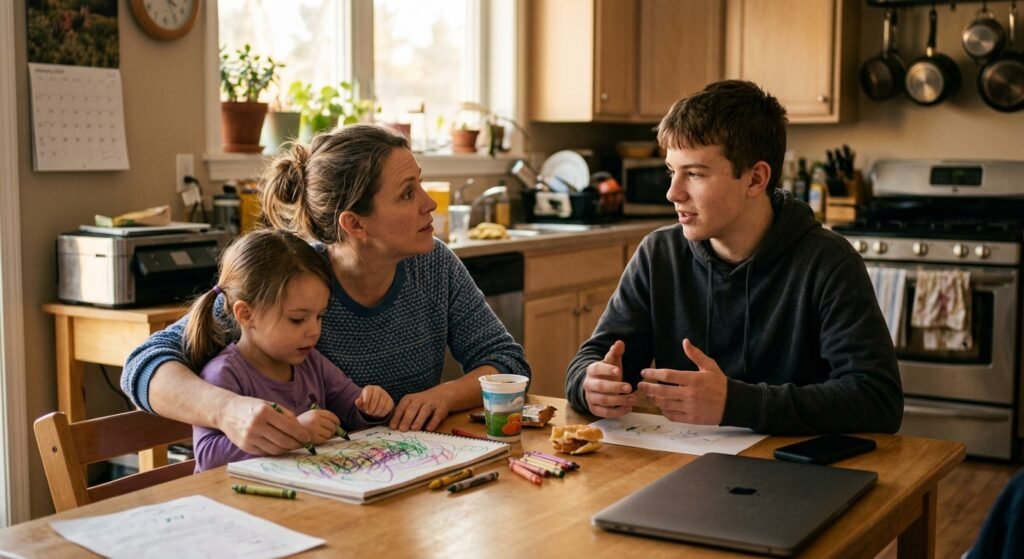
You are standing in the middle of the kitchen, trying to wipe mashed sweet potato off the cabinet handles while simultaneously responding to a text message from your oldest child about college financial aid forms. In your left hand is a half empty baby bottle, and on the counter next to you is a brochure for a university three states away. It’s a bizarre kind of emotional whiplash that nobody really prepares you for. One minute you’re singing a silly song about washing hands, and the next you’re trying to offer sage, profound advice about career paths and independent living.
We often talk about parenting as a series of neat, predictable stages. There is the baby stage, the toddler stage, the elementary school years, and finally, the teenage launch pad. We assume we’ll get to master one level before graduating to the next, like a game where the rules remain consistent until you level up. But for many families, the timeline doesn’t work that way. When you find yourself raising a toddler and a young adult at the very same time, those supposedly distinct eras of life crash into each other in the very same afternoon.
The Daily Art of Emotional Gear Switching
The sheer velocity of the transition is what catches most people off guard. In the span of twenty minutes, you might go from negotiating with a three year old who refuses to wear pants to discussing student loans with an eighteen year old who is terrified of failing their first adult milestone. Each child requires a completely different version of you. The toddler needs physical presence, boundaries, and absolute certainty. The teenager needs space, subtle guidance, and a soft place to land when they make mistakes. Your mind is forced to pivot constantly, adjusting its vocabulary, its expectations, and its level of patience on a dime.
This continuous mental jumping around takes a quiet toll that is hard to explain to those who haven’t lived it. Psychologists who study family dynamics sometimes refer to this as a form of developmental collision. It’s the experience of trying to meet the needs of people who are at completely opposite ends of the emotional spectrum. While one child is learning how to share a toy, the other is trying to figure out who they are in the world. You are acting as both the primary physical caretaker and an conversational life coach, often within the same hour, and it can feel like your brain is being pulled in two different directions.
The Contrast of Neediness
There’s a strange realization that comes when you look at these two stages side by side. The toddler’s demands are loud, immediate, and impossible to ignore. They want their cup refilled right now, they’ve spilled something on the rug, or they need help putting on their shoes. It’s exhausting, but it’s also wonderfully concrete. You know exactly what they need, and you can usually fix it in a matter of seconds. The older child’s needs, however, are quiet, complex, and often hidden behind doors or monosyllabic grunts. They don’t scream for your attention; instead, they sit silently in the kitchen at midnight, waiting to see if you’ll notice their anxiety about the future.
It’s easy to feel like you’re failing both of them. You worry that the physical demands of early childhood are stealing the mental energy you need to guide your teenager through their most critical decisions. Or, conversely, you worry that your focus on the looming college tuition bills is making you miss the fleeting sweetness of the toddler years. The constant comparison can make you feel profoundly scattered, as if you are living in two entirely different movies at the same time, unsure which plotline deserves your full attention.
The Beauty of the Messy Middle
Yet, if you look closely, there is a rare kind of beauty in this chaos. When your teenager watches the baby learn to walk, you see a glimpse of their own early days reflected back at you. When your older child holds the little one’s hand, you are reminded that the exhausting work of those early years actually pays off. It’s a living timeline of your own growth as a parent. You get to see the beginning of the story and the middle of the story playing out simultaneously on your living room floor, and it gives you a perspective that is hard to find any other way.
We spend so much time trying to organize our lives into neat compartments, hoping that if we just plan well enough, we can manage the flow of time. But parenting isn’t a factory assembly line. It’s a wild, unpredictable landscape where seasons overlap and boundaries blur. Maybe the goal isn’t to balance these competing demands perfectly, but simply to accept that they are meant to exist together. Perhaps the comfort comes from realizing that you don’t have to be a perfect guide for every stage simultaneously; you just have to be willing to sit in the messy, beautiful middle with them.