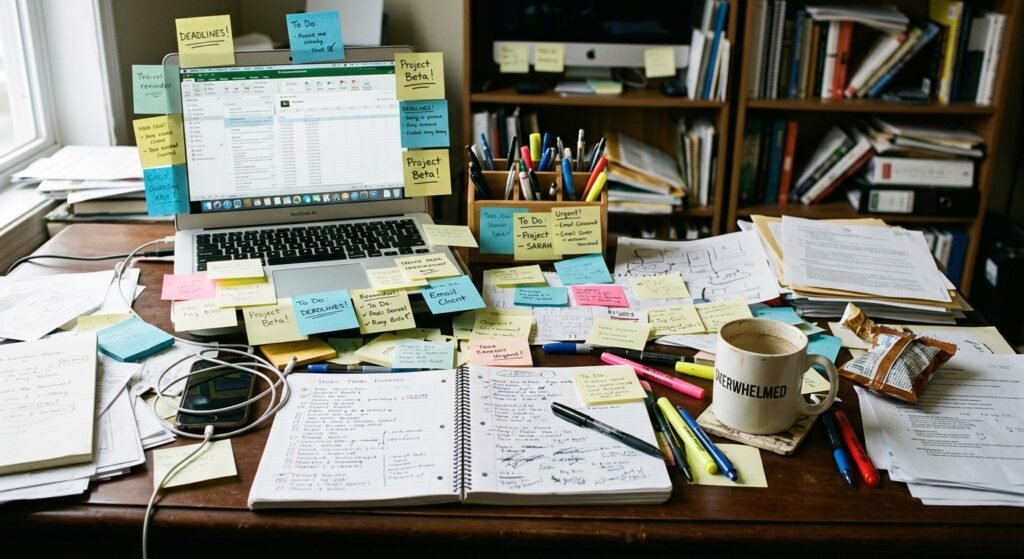
You sit down at your kitchen table with a fresh cup of coffee, determined that today is going to be different. You find a clean notebook, click your favorite pen, and start writing. You write down the urgent emails, the lingering laundry, the phone call to the doctor, and that project at work you’ve been putting off for a week. At first, it feels like a relief to get everything out of your head and onto the page.
But then, something strange happens. The list keeps growing. You remember the cluttered hallway closet, the oil change your car needs, and the birthday gift you still need to buy for your sister. Before you know it, you’ve written down twenty-two separate tasks, each one demanding a different version of your attention. You look at the page, feel an instant wave of exhaustion, and quietly close the notebook to go look at your phone.
It’s a pattern so many of us recognize. We spend twenty minutes crafting the perfect, color-coded plan for our day, only to spend the rest of the afternoon doing absolutely none of it. We tell ourselves we’re just disorganized, or that we lack the discipline to get things done. But if you look a little closer, this habit of making lists we have no intention of starting has very little to do with laziness. It’s actually about how we handle the pressure of feeling overwhelmed.
The Comfort of Planning
When life starts feeling too loud, writing things down can feel like a safety valve. The act of listing your responsibilities gives you a brief, satisfying sense of control over a world that feels increasingly disorganized. For a few minutes, as you write down each task, you aren’t actually doing the hard work of living your life; you are simply designing a perfect version of it. On paper, your day is clean, structured, and entirely manageable.
Psychologists who study productivity have pointed out that our brains can be surprisingly easy to fool when it comes to planning. When you write down a task, your brain often treats the plan as a small victory, releasing a tiny spark of satisfaction before you’ve even lifted a finger to begin. This is why listing your chores feels so therapeutic in the moment. It relieves the immediate anxiety of having too much to do, offering the feeling of progress without requiring any of the actual effort.
The trouble is that this relief is fleeting. Once the pen is put away, the reality of the list returns, and it suddenly looks less like a helpful guide and more like a pile of evidence showing how far behind you are. What started as an exercise in organization quietly turns into a source of guilt. You look at the page and realize that completing even half of those items will require more energy than you currently have to give.
Running From the Finish Line
Sometimes, we build these massive lists because we are unconsciously trying to avoid the feeling of being finished. It sounds counterintuitive, but for people who are used to working constantly, the idea of a blank space can feel deeply uncomfortable. If you actually finish your to-do list, you are left with yourself, your thoughts, and the quiet pressure of what you should be doing next. A long list ensures that you never have to face that quietness because there is always something else waiting for your attention.
We also tend to use planning as a way to negotiate with our own exhaustion. When you’re tired down to your bones, you can’t easily admit to yourself that you simply need to rest. Instead, you make a list. You promise yourself that tomorrow you will wake up early, exercise, answer forty emails, cook a healthy meal, and clean the baseboards. You use the promise of future productivity to justify your current need to do nothing, setting up an impossible standard that you’ll inevitably fail to meet.
This cycle is remarkably common among people who tie their self-worth to how much they accomplish. When you feel like you’re only as good as your last checked box, a shorter, more realistic list can feel like an admission of weakness. So, you write down everything, creating a monument of expectations that no person could ever realistically finish in a single day. You set yourself up for failure because, deep down, failing to meet an impossible standard feels safer than succeeding at a modest one.
The Hidden Costs of the Never-Ending List
When you live your life by a list that never ends, you stop experiencing your days and start managing them. Every interaction becomes a transaction. A conversation with a friend is just a distraction from your timeline. A quiet evening reading a book carries a subtle background hum of guilt because you aren’t folding the laundry or preparing for tomorrow’s meeting. You aren’t present in your own life because you’re constantly evaluating how well you are performing it.
Studies in cognitive science show that carrying a long list of uncompleted tasks actually drains our mental energy. Our brains naturally want to finish what we start, so every unfinished item on your list stays alive in the back of your mind, quietly pulling at your focus even when you’re trying to relax. It’s why you can’t fully enjoy a movie or a dinner with loved ones; your brain is still trying to figure out when you’re going to clean out the garage.
This mental clutter is what makes us feel so tired even on days when we haven’t actually accomplished much. You aren’t exhausted from the work you did; you’re exhausted from the mental energy required to keep carrying all the work you didn’t do. The list is constantly running in the background, consuming your peace of mind and leaving you with very little energy to actually start the tasks you’ve written down.
Learning to Let the List Breathe
Finding a healthier relationship with your responsibilities doesn’t mean you stop writing things down. It means changing what you expect the list to do for you. A list can be a wonderful tool for remembering details, but it is a terrible measure of your value as a person. When we stop using our planners to prove that we are busy enough to deserve space in the world, we can start using them to help us live more mindfully.
Perhaps the realization we need isn’t how to become more efficient, but how to be kinder to our own limitations. Maybe we make these long lists not because we have so much to do, but because we are trying to prove to ourselves that we are trying. We want to show that we care, that we are responsible, and that we are doing our best to keep up with everything the world asks of us.
Next time you find yourself writing down a list that feels too long to face, it might be worth taking a breath and looking at the page with a bit of perspective. Some of those tasks can wait. Some of them probably don’t need to be done at all. And sometimes, the most productive thing you can do for yourself isn’t crossing off another item, but having the courage to set the pen down, close the notebook, and let yourself simply exist in the quiet space of an unfinished afternoon.