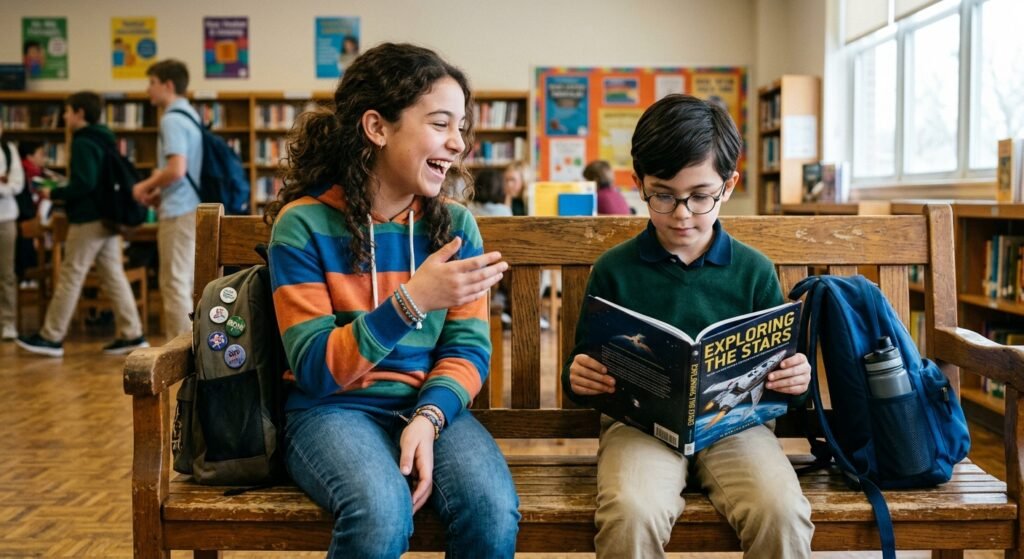
If you’ve ever sat in your living room and watched your children interact, you might have experienced a strange, quiet realization. One of them is sprawled on the rug, meticulously sorting physical trading cards or reading a dog-eared paperback, seemingly content with the quiet pace of a bygone era. Two feet away, your other child is effortlessly navigating a multi-screen digital landscape, speaking in a shorthand dialect that feels entirely foreign to you. They share the same last name, eat at the same table, and sleep under the same roof, yet they somehow seem to have arrived from completely different historical eras.
It’s a common story in modern households, though we rarely talk about how disorienting it can feel. We often enter parenting believing we’ll develop a signature style, a reliable way of guiding our family through the years. We assume that the lessons we learned with the first child will naturally carry over to the second, creating a sense of continuity. Instead, we quickly discover that what worked beautifully for one child feels like trying to fit a square peg into a round hole with another.
One child might need hours of quiet, face-to-face conversation to process a minor setback at school, requiring you to slow down, soften your voice, and set aside your own agenda. The other might process things in rapid-fire bursts, needing you to match their quick energy and meet them on their own fast-paced terms. It’s as if you’re constantly tuning a radio, trying to find the right frequency for two entirely different stations that are playing at the same time.
The Illusion of the Shared Starting Line
We like to think that siblings start from the exact same place, but the reality is much more complex. Even when raised by the same people in the same house, siblings never actually experience the same parents or the same childhood. The family structure changes with every new addition. A firstborn experiences parents who are cautious, perhaps a bit anxious, and entirely focused on every milestone. A younger sibling meets parents who are more tired, certainly more relaxed, and far less surprised by the ordinary challenges of growing up.
Beyond the family structure, our world moves at a dizzying pace. A gap of just a few years can mean children are socialized in entirely different cultural climates. A child who entered middle school before the widespread adoption of certain technologies has a fundamentally different relationship with friendship and privacy than a younger sibling who has known a highly connected world since preschool. They aren’t just different personalities; they’re navigating different cultural landscapes altogether.
This disparity can leave parents feeling like they’re living in a constant state of translation. You find yourself adjusting your expectations, your language, and even your body language depending on which room you walk into. It can feel exhausting, and at times, you might worry that your inconsistency makes you a less effective parent. You wonder if you’re being unfair by treating them so differently, or if you’re somehow failing to provide a stable, unified foundation.
The Burden of Consistency
We’ve been taught to value consistency more than almost everything else in parenting. We’re told that rules should be identical, expectations should be uniform, and our reactions should be predictable. But anyone who has managed a busy household knows that rigid consistency is often an illusion. When we try to treat entirely different children exactly the same way, we usually end up missing the unique needs of both.
Those who study family dynamics often point out that children don’t actually need us to treat them identically. What they actually need is to feel seen for who they are as individuals. When we force a child who thrives on quiet reflection to participate in the same high-energy discussions as their sibling, we aren’t being fair; we’re simply being stubborn. True fairness isn’t about giving everyone the exact same thing; it’s about trying to offer each person what they actually need to feel secure.
Once we let go of the pressure to be perfectly consistent, we can begin to look at our children with a sense of genuine curiosity. Instead of viewing their differences as a problem to be solved, we can start to see them as a landscape to be explored. We stop trying to pull them into the same era and instead learn to travel back and forth between their worlds.
Learning to Speak Two Languages
Adjusting to these different worlds requires us to develop a sort of emotional flexibility. It means recognizing that the quiet, sensitive child who seems to belong to a simpler time isn’t being difficult when they withdraw from a busy room. It means understanding that the high-energy, forward-looking child who seems to live in the future isn’t being disrespectful when they crave constant stimulation. They’re simply trying to make sense of their environment using the tools they have.
This flexibility also asks us to look closely at our own preferences. Most of us naturally align more easily with the pace of one child over another. If you’re a naturally quiet person who appreciates structure, you might find yourself feeling much more comfortable with the sibling who shares those traits. Navigating the world of your more energetic, unpredictable child might feel like a stretch, requiring more patience and energy than you feel you have to give.
But there’s a quiet beauty in that stretch. When we step outside our comfort zones to meet a child on their own terms, we often rediscover parts of ourselves we’ve ignored for years. The child who lives in a world of quiet imagination might invite us to slow down and appreciate the small details of our lives. The child who lives in a fast-paced, digital future might challenge us to stay open to new ideas and embrace change with a bit more courage.
Every Child Invents a New Parent
Perhaps the most reassuring thing to remember is that you don’t have to be a perfect, unchanging monument of authority. Parenting isn’t a performance where we deliver the same monologue to different audiences. It’s a continuous, evolving conversation. It’s a relationship that changes us just as much as it shapes our children.
When we look back on our parenting journey years from now, we likely won’t remember the moments of perfect consistency. We’ll remember the quiet, unexpected moments of connection that happened because we were willing to adapt. We’ll remember the times we sat on the floor and tried to understand a game we didn’t quite get, or the times we sat in silence with a child who simply needed us to be there without any words at all.
Maybe the goal was never to find one single way to parent our children. Maybe the real beauty of family life lies in the realization that every child asks us to become a slightly different parent, and in doing so, they help us expand into a more complete version of ourselves.