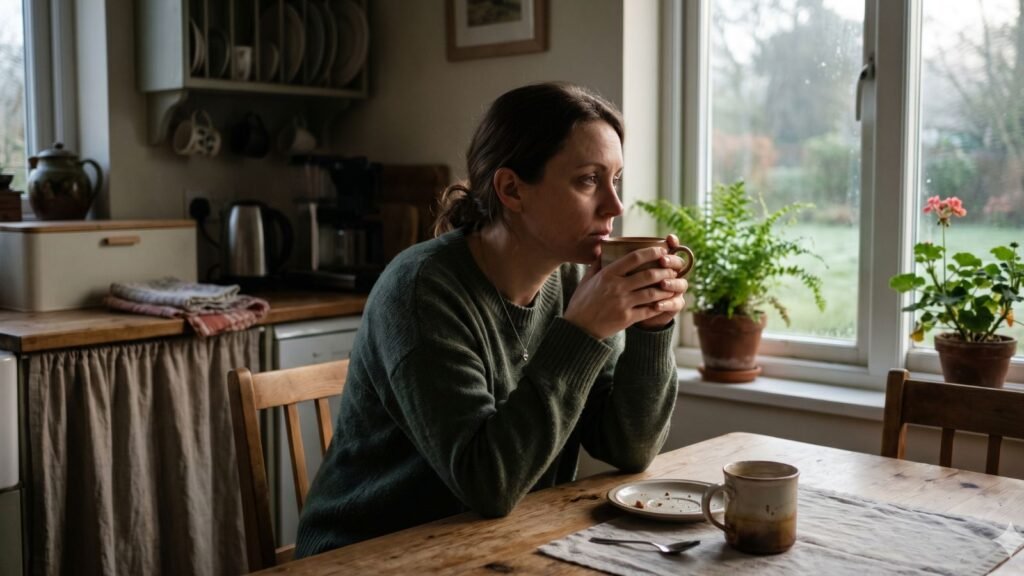

If you’ve ever found yourself standing near the edge of a crowded room, holding a half-empty drink and watching the laughter unfold from a comfortable distance, you know the quiet relief of the sidelines. You aren’t necessarily unhappy. In fact, you’re probably having a decent time just tracking the dynamics of the room. You notice who laughs a little too loudly to cover up their nervousness, who quietly checks their phone every three minutes, and who is holding court in the center of the kitchen. You’re there, but you aren’t entirely in it.
It’s a familiar position for many of us, and it extends far beyond parties. Maybe you’re the person at work who sits back during brainstorming sessions, keeping your best ideas to yourself because the risk of having them dismissed feels too high. Or perhaps you’re the friend who knows everyone else’s secrets but rarely shares your own, preferring to keep your personal life locked behind a polite, supportive smile. There’s a distinct comfort in being the observer, a sense that as long as you’re watching the game, you can’t actually lose it.
The Cozy Comfort of Staying Unseen
For a long time, you might tell yourself that you simply prefer the peace. And there’s real truth to that. Being a spectator is less exhausting than being a participant. You don’t have to worry about stumbling over your words, saying the wrong thing, or feeling the sudden, cold sting of a joke that didn’t land. The sidelines offer a perfect vantage point where you can enjoy the warmth of social energy without actually having to risk your own comfort to get it.
This approach isn’t an accident. It’s a highly organized system of caution that we build over years of living. When we’re younger, we learn that putting ourselves out there can sometimes lead to unexpected bumps. A friend moves away, a partner changes their mind, or a group we wanted to join makes it clear we don’t quite fit. Each of these moments leaves a small mark, a quiet warning that participating in life always comes with a price. Slowly, we realize that if we stay just a few steps back, we can enjoy the scenery without having to pay the entry fee.
What the Mind Tells Us About Safety
There’s a fascinating reason why our minds lean so comfortably into this observer role. People who study social behavior have found that our brains process the threat of emotional vulnerability in ways that look remarkably similar to how we react to physical safety concerns. When we feel exposed or at risk of being judged, our natural response is to look for cover. Staying on the sidelines isn’t a sign of weakness; it’s a highly functional survival strategy. It’s your mind’s way of keeping you safe from the unpredictable nature of other people.
When you sit back and watch, you’re essentially gathering data. You’re measuring the room, evaluating the risks, and deciding whether the environment is supportive enough to justify letting your guard down. The trouble is that this intelligence-gathering phase can easily become a permanent lifestyle. We get so good at predicting how things might go wrong that we convince ourselves it’s always better to stay exactly where we are, sheltered by our own careful distance.
The Silent Toll of Looking In from the Outside
But while the sidelines offer safety, they also carry a quiet, persistent loneliness. There’s a specific kind of ache that comes from being surrounded by people and yet feeling entirely separate from them. You watch others form inside jokes, share spontaneous hugs, and build deep bonds, all while you remain behind your protective glass. You want to join in, but the longer you stay on the edge, the higher the barrier to entry feels.
You might find yourself waiting for someone to notice your absence from the center of things. You hope a friend will reach out, pull you into the circle, and make the choice for you. But because you’ve become so skilled at looking calm, independent, and perfectly content on your own, other people usually take you at face value. They assume you’re quiet because you want to be. They don’t see the desire for connection hiding beneath your composure because you’ve built such an effective shield to cover it up.
It’s a difficult cycle to break because your protective habits work so well. They do exactly what you designed them to do: they keep you from getting hurt. But in doing so, they also prevent you from being truly known. We can’t let the good stuff in through the same walls we use to keep the bad stuff out.
A Different Way to See the Sidelines
Maybe the goal isn’t to suddenly force yourself into the absolute center of every room or to become the loudest voice in the conversation. That kind of pressure usually just makes us want to retreat even further into our shells. Instead, perhaps the realization we need is that the sidelines were never meant to be a permanent home. They’re just a resting place.
It’s completely okay to take your time, to watch, and to protect your energy when you need to. But sometimes, true safety doesn’t come from avoiding the world; it comes from finding the few people who make the world feel safe enough to step into. When we stop viewing participation as a test we might fail, and start seeing it as a series of small, imperfect invitations to connect, the distance between the edge of the room and the center doesn’t seem quite so vast. You don’t have to jump all at once. Sometimes, just taking one step forward is enough to let someone know you’re ready to be found.