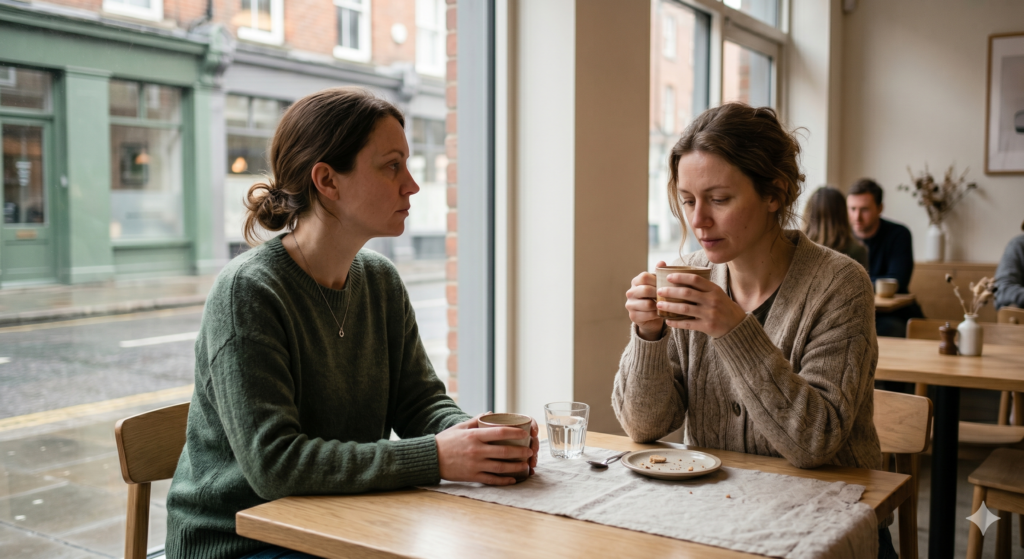
You’re sitting in your living room on a quiet Tuesday evening, looking at your phone, and you realize it’s been weeks since you had a conversation that didn’t involve a status update, a transaction, or a work deadline. It isn’t that you don’t have people in your life. Your contacts list is full, your messages are active, and you might even have plans on the calendar for next weekend. Yet, as you stare at the screen, there’s a distinct, quiet distance that feels hard to explain. It’s the feeling of being surrounded by life while somehow standing just outside of it, watching the warmth of others through a glass pane.
We’ve all had those seasons where we feel out of practice at being known. Maybe you moved to a new city, or maybe the old friendships you relied on slowly drifted into different life stages while you weren’t looking. Or perhaps life simply got busy, and the small, daily interactions that used to keep you anchored slowly faded away until you woke up one morning and realized you felt entirely on your own. It’s a strange kind of isolation because it doesn’t always look like loneliness. You can go to work, buy groceries, talk to colleagues, and exchange pleasantries with neighbors, all while carrying a quiet longing to belong to something real.
The Quiet Threshold of Stepping Back Out
The hardest part of feeling disconnected isn’t the absence of people. It’s the quiet belief that everyone else has already found their circle, and that you’re the only one standing on the outside trying to figure out how to walk back in. When we’ve been isolated for a while, we tend to tell ourselves that we need to wait until we feel confident, secure, and completely ready before we try to connect again. We think we need to have our lives perfectly sorted out, our social energy fully restored, and our self-doubt entirely cleared away before we can open the door.
But the truth is, connection rarely waits for us to feel ready. If you wait until you feel completely confident before you reach out to an old acquaintance or attend a local gathering, you’ll probably find yourself waiting forever. True belonging doesn’t require us to be perfectly polished or filled with social courage. Often, the small, awkward steps we take when we feel entirely unprepared are the very moments that begin to bring us back into the warmth of community.
The Myth of the Natural Joiner
It’s easy to look at people who seem to make friends effortlessly and assume they possess a secret gift we lack. We watch them strike up conversations at a local coffee shop or easily integrate into a new group, and we assume their confidence came first. We tell ourselves that once we feel as outgoing or secure as they do, we’ll finally start rebuilding our own circles. This keeps us waiting in the wings, hoping that some internal change will occur and suddenly make the process feel easy.
What we’re missing is that confidence is almost always a byproduct of action, not the cause of it. Those who seem to navigate social spaces with ease aren’t necessarily free from doubt; they’ve simply decided that the potential for connection is worth the discomfort of a slightly awkward start. When we redefine our expectations and realize that everyone feels a little uncertain when entering a new space, the pressure to perform begins to lift. We can show up as we are, with all our hesitation and quiet energy, and still find a place where we fit.
Small Ripples in the Neighborhood
Rebuilding a sense of belonging doesn’t require grand gestures or overnight transformations of your social calendar. It starts with the tiny, almost unnoticeable choices we make in our daily routines. It’s choosing to linger for an extra moment to speak with the person who delivers your mail, or nodding hello to the neighbor you usually pass in silence. These micro-connections might seem insignificant at first, but they form the quiet foundation of how we feel anchored in our environments.
Over time, these brief moments accumulate. They create a familiar landscape where you are recognized, and where your presence is noted. Psychologists often point to the idea of the mere exposure effect, which suggests that we naturally grow fonder of people and places simply by seeing them regularly. By showing up in the same spaces, whether it’s a local library, a park, or a weekly class, you are quietly signaling to the world and to yourself that you are ready to be seen again.
The Courage to Ask a Second Question
When we do find ourselves in conversations, our instinct is often to keep things safe and brief. We ask how someone is doing, we receive the standard polite answer, and we let the conversation drift to a close. We protect ourselves from rejection by keeping our distance, convincing ourselves that we are simply respecting the other person’s boundaries. But true community is built in the spaces where we dare to go a little deeper.
Asking a second question, moving past the standard pleasantries to something slightly more personal, changes the dynamic. It shows that you are paying attention, and that you are genuinely interested in the answer. This doesn’t mean we have to share our deepest secrets right away. It simply means we offer a small pocket of curiosity that allows the other person to share a bit more of who they are. In doing so, we create an invitation for them to do the same for us.
Belonging Is a Shared Practice
Perhaps the most comforting realization about community is that everyone is looking for it. The person sitting across from you at the community table, the parent standing alone at the school gate, the colleague who eats lunch at their desk, most of them are carrying the exact same quiet hope for connection that you are. They are waiting for someone to make the first move, to offer a smile, or to bridge the gap between strangers.
When you take a small step toward connection, even when your hands are shaking and your voice feels a little thin, you aren’t just helping yourself. We’re quietly offering a lifeline to someone else who was hoping they wouldn’t have to navigate the day entirely alone. Connection doesn’t start when you finally feel brave enough to command a room. It starts when you realize that your presence, exactly as it is right now, is enough to help someone else feel a little less lonely.
Maybe we don’t need to wait until we feel ready to seek connection. Maybe showing up in all our quiet uncertainty is exactly what gives someone else the permission to do the same. And perhaps, on the other side of that shared hesitation, we’ll find that we were never as truly alone as we thought.