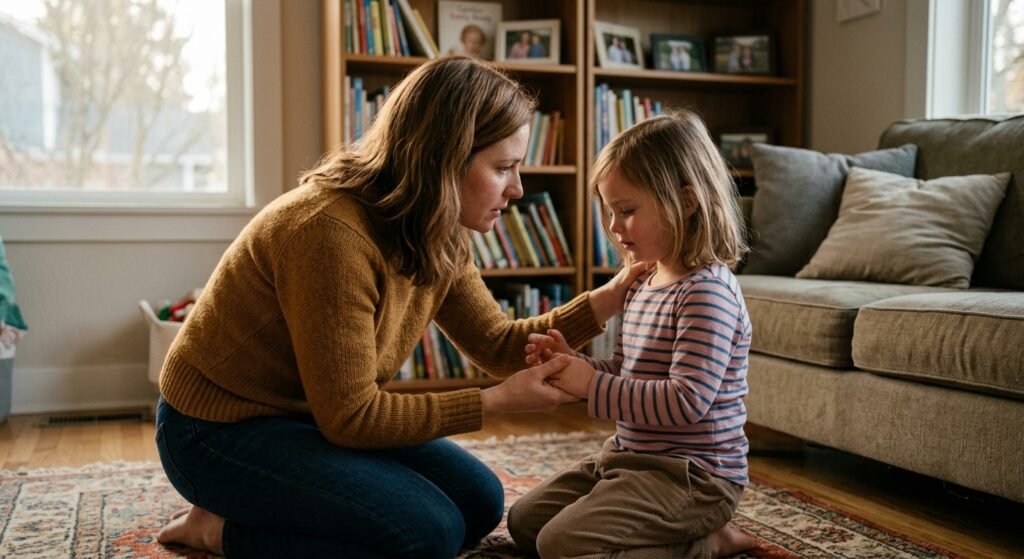
You’re standing in the kitchen, and your child is crying because their toast is cut into rectangles instead of triangles. It’s a classic, silly toddler moment that should be easy to dismiss. Yet, somewhere inside your chest, a familiar tightening begins. Your immediate instinct isn’t to comfort them, but to quiet them. You feel a sudden, urgent desire to make the crying stop, to sweep the disappointment away, or perhaps to tell them they’re making a big deal out of nothing. That reaction isn’t actually about the toast, and it isn’t even about your child’s behavior. It’s the quiet echo of a rule you learned decades ago, long before you had a kitchen of your own.
Most of us grew up in homes where emotions had very specific, unwritten boundaries. Maybe anger was treated like a household emergency, sadness was something you only did behind closed doors, and fear was met with a firm reassurance to just be brave. You learned early on that the easiest way to keep the peace was to keep your inner world small and tidy. You learned to pack away the messy parts of yourself, tucking them into neat little corners where they wouldn’t bother anyone else. It was an effective strategy for navigating childhood, but it left you with a very limited vocabulary for your own feelings.
Learning a Language You Do Not Speak
Now, as a parent, you’ve made a quiet promise to do things differently. You want your kids to know that their anger is valid, their sadness is welcome, and their fears are safe with you. You buy the colorful books about feelings, you memorize the phrases about validating emotions, and you prepare yourself to be the calm, supportive harbor your parents couldn’t quite manage to be. But then the storm actually hits. Your child throws a tantrum, or shuts down in quiet isolation, or looks at you with eyes full of deep, confusing grief over a lost toy. And suddenly, you realize you’re trying to teach a language you don’t actually speak fluently.
It’s a deeply disorienting feeling. You want to offer comfort, but your body is screaming that something is wrong. When your child cries, you react as if there’s an active threat in the room. This isn’t because you lack empathy, but because your childhood training is fighting against your adult intentions. Those who study childhood development often discuss how we absorb emotional patterns before we even have the words to describe them. When our parents consistently pulled away from our distress, we quietly registered that certain emotions are dangerous. We learned to suppress those feelings to preserve our connections with the people we needed most.
Decades later, trying to welcome your child’s big emotions can feel like trying to walk through a doorway you still believe is locked. You find yourself stumbling over your words, sounding stiff and rehearsed. You say “I hear that you’re angry,” but your voice is tight, and your shoulders are up around your ears. You’re trying to perform emotional openness, but underneath the words, you’re still that kid who was taught to hide.
The Hidden Burden of the Good Parent
There is a unique kind of exhaustion that comes from trying to break a generational pattern. It’s not just the physical tiredness of parenting; it’s the mental friction of constantly monitoring your own reactions. Every time your child pushes a boundary or falls apart, you have to intercept your natural, hardwired response and replace it with something completely new. You’re trying to run a marathon on a path you’re paving while you run. It’s easy to feel like you’re failing because the process feels so clumsy and artificial.
We often look at parenting advice and see families who seem to handle every meltdown with serene, effortless grace. They speak in soft, melodic tones, always knowing exactly what to say to make things better. When we compare our own internal panic to their outward calm, we feel like imposters. We worry that our hidden tension is somehow damaging our children, or that we’re passing down the exact same patterns we’re trying so hard to break.
But maybe the goal was never to become a perfect, unflappable guide. Research into family dynamics suggests that children don’t actually need flawless parents to develop healthy emotional resilience. They don’t need us to be Zen masters who never feel overwhelmed. What they actually need is to see us handle our own discomfort with honesty. They need to see that it’s okay to feel messy, and that relationship repair is always possible, even after we’ve lost our temper or closed ourselves off.
The Power of Being Clumsy Together
Some of the most profound moments of connection happen when we stop trying to sound like a textbook and simply admit how hard this is. It might mean sitting on the floor next to your crying child and saying, “I’m not sure how to fix this, but I’m here with you.” It might mean going to them after you’ve reacted too harshly and saying, “I got scared when you were shouting, and I’m sorry I raised my voice. Let’s try that again.”
These conversations feel deeply vulnerable because they require us to show our kids the very parts of ourselves we were taught to hide. We have to let them see our uncertainty, our mistakes, and our efforts to grow. In doing so, we show them something far more valuable than a perfect parent. We show them a real person who is willing to do hard, uncomfortable things for the sake of love.
When you sit with your child in their sadness, even when your own chest feels tight and you’re counting the seconds until it’s over, you are doing beautiful work. You are rewriting a script that has been passed down through generations. You are teaching your child that their feelings won’t destroy the relationship, and that they don’t have to choose between being authentic and being loved. You are learning to tolerate the discomfort of your own past so they can have a different future.
Maybe the realization that changes everything is that you don’t have to be a finished product to be a good parent. You don’t need to have all your own emotional struggles completely sorted out before you can offer your child a safe space. Breaking generational patterns doesn’t mean you’ll never feel that old urge to hide or quiet the room. It simply means that when that urge arises, you choose to stay in the room anyway, learning to breathe through the discomfort, one clumsy, courageous conversation at a time.