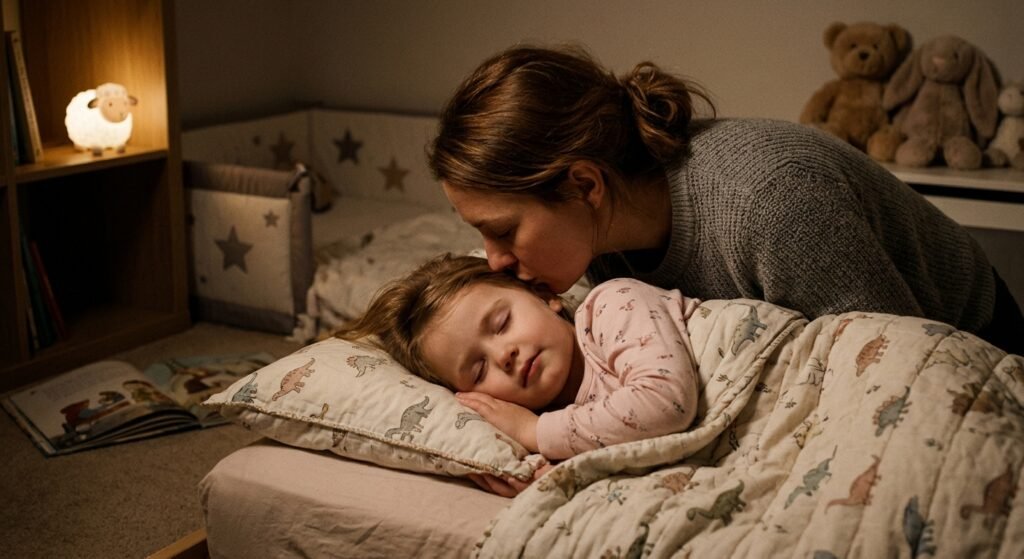
If you’ve ever stepped into your child’s bedroom late at night, long after the toys have been cleared away and the house has finally settled into quiet, you probably know a very specific kind of silence. You stand by the doorway, watching the gentle rise and fall of their chest, and adjust a blanket that was kicked off hours ago. Just a few hours earlier, you might have felt completely worn out by the demands of the afternoon, counting down the minutes until bedtime. Yet standing there in the dark, looking down at that small, resting face, a sudden wave of tenderness washes over you so completely that it almost catches your breath.
It’s a strange contradiction that almost every parent carries, even if they rarely put it into words. You can spend an entire day feeling overwhelmed by spilled cups, endless questions, and constant demands for your attention, only to spend the quiet late hours scrolling through photos of the very same child on your phone. You want a moment to yourself, but the second you get it, your mind wanders straight back to them.
That feeling isn’t hypocritical, and it certainly isn’t unusual. It’s the quiet reality of loving someone so intensely that your entire emotional landscape rearranges itself around their existence.
The Hidden Gravity Of Being Someone’s Entire World
Parenting asks something from you that few other life experiences ever demand. It isn’t just about the physical energy required to make meals, tie shoes, and maintain a household. It’s the constant, silent baseline of emotional awareness that runs in the background of your mind every single minute of the day.
Even when you’re sitting down to rest, a part of your mind stays alert. You’re perpetually monitoring their mood, anticipating their needs, listening for changes in their laughter, and holding space for their anxieties. You absorb their heartbreaks when a friend leaves them out on the playground, and you feel the sharp sting of their small frustrations as if they were your own. That level of attunement requires immense energy, even when you’re simply sitting on the couch watching them play.
When you feel completely drained at the end of a long day, it’s easy to assume you’ve run out of physical stamina. But most of the time, that deep weariness isn’t about how many steps you walked or how many loads of laundry you folded. It’s about how wide open you kept your heart for twelve straight hours.
Why Openness Feels Like Vulnerability
Psychologists who study family dynamics and emotional attunement often point out that caring deeply for a child alters how our nervous system operates. When you bond with a child, your emotional state becomes naturally synchronized with theirs. Their feelings register inside you with remarkable speed, creating a continuous feedback loop of care and concern.
Research in relational psychology shows that when we form these deep attachment bonds, our perception of safety naturally adjusts. We become far more sensitive to potential harms, changes in routine, and emotional distress in our loved ones. It’s an evolutionary design meant to protect young life, but in daily practice, it means you’re walking through the world with your emotional defenses completely lowered.
Loving someone this much means you’ve willingly given up the ability to protect yourself from uncertainty. You can’t shield your heart from the fact that they will eventually grow up, make mistakes, feel hurt, and navigate an unpredictable world on their own. That constant exposure to vulnerability is inherently exhausting, not because you’re doing anything wrong, but because loving someone deeply requires you to stay vulnerable.
The Bittersweet Pace Of Growing Up
There’s a quiet sorrow that lives right alongside the joy of raising children. You watch them master new skills, speak in fuller sentences, and gain independence, and while every step forward is something to celebrate, each milestone also marks the quiet closing of a chapter you can never get back.
You realize one day that you didn’t notice the last time you picked them up and carried them on your hip. You realize they don’t hold your hand when walking into a store anymore, or that they’ve traded their favorite bedtime story for a quiet night reading on their own. These moments don’t arrive with a dramatic announcement; they simply happen, slipping quietly into memory while you’re busy making dinner or answering an email.
That’s why parenting can feel so emotionally complex. You’re constantly living between two opposing desires: the wish for them to flourish into independent people, and the longing to hold onto the tiny person who needed you for everything. Holding those two feelings at the same time takes a quiet, persistent toll on your heart.
You Aren’t Failing, You’re Loving Fully
In a world that constantly encourages people to optimize their lives and maintain calm control over everything, it’s easy to look at your own exhaustion and interpret it as a personal shortcoming. You might wonder why you feel so worn out when other parents seem to glide through their days with easy confidence. You might ask yourself why simple routine tasks sometimes feel so overwhelming.
Perhaps the truth is far simpler than that. Maybe the tiredness you feel isn’t a sign that you’re failing to handle the pressure. Maybe it’s simply proof of how completely you’ve opened your life to another person.
To love a child deeply is to agree to live with your heart perpetually outside your body. It means caring so much about another person’s well-being that their joy lifts you and their pain breaks you. That kind of devotion naturally taxes your system, but it’s also one of the most profound experiences a person can ever know.
So when you find yourself standing in that dark doorway at night, feeling entirely spent yet overcome with awe, you don’t need to fix anything or figure anything out. You’re simply feeling the true volume of a love that was never meant to be light, easy, or effortless. You’re simply living the beautiful, tender reality of loving someone with everything you’ve got.