The Unexpected Stage of the Cubicle Row
You’re sitting at your desk, staring blankly at a spreadsheet that you’ve been looking at for the last twenty minutes. You’re not actually reading the numbers. You’re mostly just wondering if the leftover lasagna in the breakroom fridge is still safe to eat, or if you can justify taking a third trip to the water cooler just to stretch your legs. The office is quiet, and your mind is miles away, drifting through a peaceful haze of afternoon daydreaming.
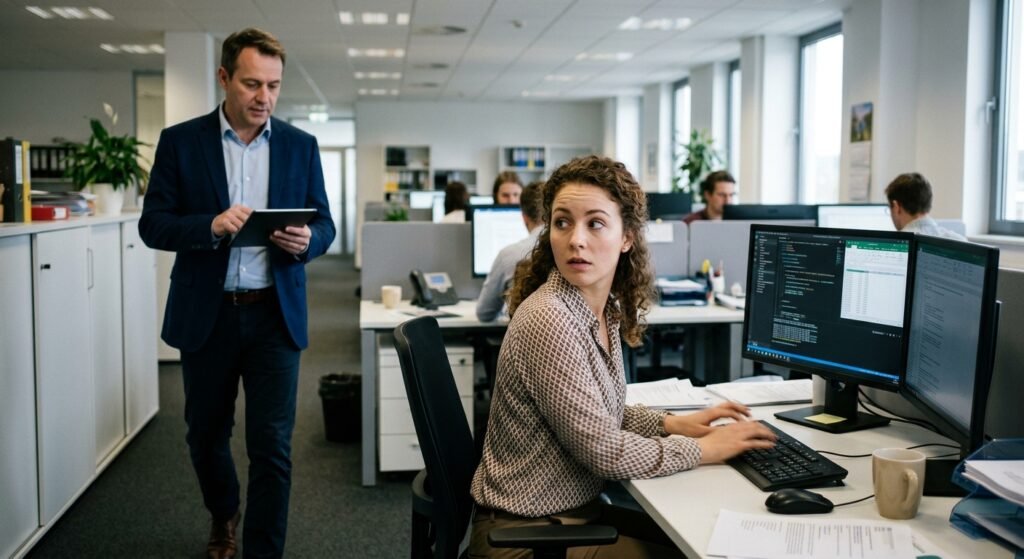
Then, you hear them. The footsteps. They’re coming down your hallway, getting closer by the second. It might be your manager, it might be a coworker who loves to ask quick questions, or it could just be someone heading to the copier. Instantly, your body goes into high alert. Your posture straightens. Your eyes focus. The daydream is gone, replaced by a sudden and urgent need to look like you’re currently dealing with an urgent work dilemma.
Can we talk about this for a second?
What follows is one of the most coordinated, silent performances of your entire day. You don’t just keep sitting there, because sitting quietly feels far too risky. You must look busy. But not just busy, you need to look deeply, intellectually invested in whatever is on your monitor. For some reason, this suddenly feels completely reasonable, even though you’re only looking at an email about the company picnic from three weeks ago.
The Instant Performance
First comes the classic brow furrow. You lean in slightly toward the screen, narrowing your eyes as if you’ve just discovered a fascinating mystery in cell G14 of your budget document. You grab your mouse and make a series of tiny, purposeful movements. You highlight a row of numbers, stare at it with intense concentration, and then unhighlight it. You scroll up two pages, pause to look thoughtful, and then scroll right back down to where you started.
If the footsteps slow down near your desk, you upgrade the performance to the keyboard solo. You place your fingers over the keys and type a few rapid, decisive strokes. It doesn’t actually matter what you’re typing. You could be writing a simulated paragraph of nonsense in a draft folder or just pressing the backspace key over and over again. The goal is simply to create the comforting sound of productivity. In your mind, those quick clacking sounds are the ultimate proof that you’re an indispensable member of the team. You convince yourself that as long as your fingers are moving, nobody can question your dedication.
Sometimes you even throw in a soft, thoughtful sigh. You might nod slowly to yourself, as if you’re quietly agreeing with a complex strategy that you’ve just come up with. Or perhaps you reach for a nearby yellow notepad and scribble a single, meaningless word like “update” or “tomorrow” with an intensity usually reserved for signing important documents. You cap the pen with a satisfying click, place it down, and stare at your notepad as if you’ve just written down the secret to unlimited growth.
Why We Keep Dancing
The funny part is you already know how this looks to everyone else. Your manager probably isn’t walking by to inspect your cursor movements or evaluate the speed of your typing. They’re likely just trying to find where someone left the good stapler, or they’re thinking about their own lunch. But the moment another person enters your immediate workspace, the urge to prove your value becomes completely overwhelming. Somehow this always happens, and we all play our parts without ever talking about it.
At some point, it stops being about the actual work and becomes about the shared belief that we should always look like we’re busy. We’ve created this silent agreement where looking relaxed for even three seconds feels like a confession of defeat. If someone sees you just staring out the window, you worry they’ll think you have nothing to do. So instead, you perform. You click, you scroll, you nod, and you sigh.
There is a gentle sort of comfort in realizing that almost everyone does this. The person walking past your desk has likely performed the exact same keyboard dance twice already today. They know the brow furrow. They know the spreadsheet scroll. They might even recognize your thoughtful sigh because they used it themselves right before their morning meeting.
The Quiet Return to Normal
Eventually, the footsteps fade away. The coworker passes your desk without even glancing at your screen, completely unaware of the theatrical production you just staged for their benefit. You take a deep breath, let your shoulders drop, and slowly close the random spreadsheet you opened to look professional.
Five minutes later, you’re right back to staring blankly at the monitor, wondering about the lasagna again. We all know how this ends. You’ll do the exact same dance tomorrow, and so will the person who just walked past you. It’s just one of those funny little habits that makes office life feel a bit more shared. Honestly, we all do this, and you’ll probably do it again tomorrow. And that is completely okay.