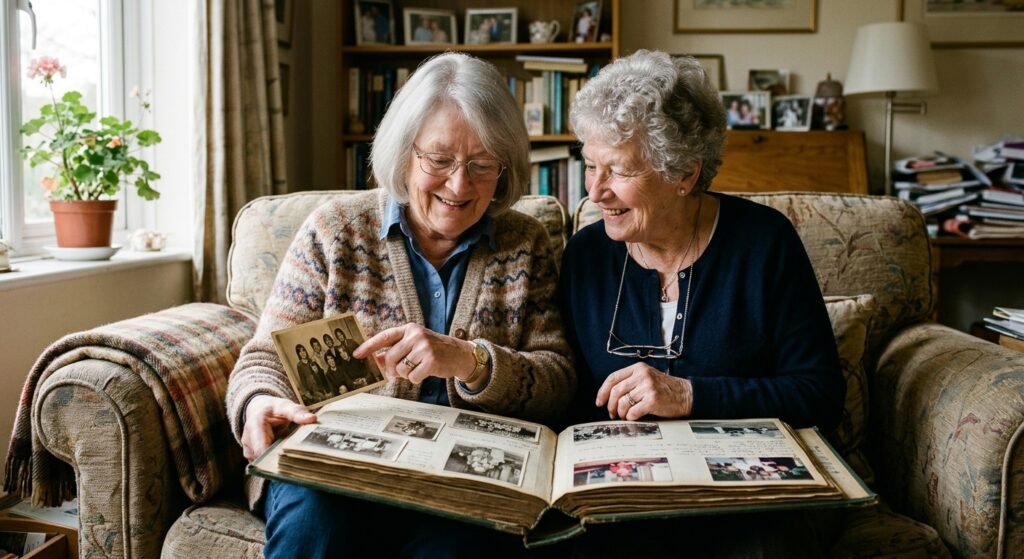
There’s a particular kind of silence that only happens with someone who knew you before your life acquired its current shape. You might be sitting on a worn porch, or across a laminate table in a diner that hasn’t changed its menu in twenty years, holding a lukewarm mug of coffee. You haven’t spoken in six months, maybe longer. Yet within five minutes, the polished version of yourself that you present to the world every day quietly slips away.
You don’t have to explain the context of your family stories. You don’t have to clarify why a certain name makes you cringe, or why a particular song makes you turn up the radio. They were there when the story was actually happening. They remember the haircut you tried to forget, the apartment with the squeaky floorboards, and the version of you that was still trying to figure out how to be an adult.
That kind of friendship feels rare because it is. As years pass, life naturally fills up with new chapters. We collect new jobs, new neighborhoods, new partners, and new responsibilities. We learn how to speak more carefully, manage our time, and navigate complicated social landscapes. But every once in a while, it feels good to step back into a room with someone who remembers who you were before you learned how to do all of that.
The Quiet Comfort Of Shared Memory
Psychologists who study how people maintain their sense of identity over time often talk about narrative continuity. It’s a phrase that simply means we need to feel like the person we were ten years ago is connected to the person we are right now. When too many things change at once, that connection can start to feel thin. We can look at old photos and feel like we’re looking at a stranger.
This is where old friends do something remarkable without even trying. They act like living archives for our personal history. When you’re around someone who knew you during a previous era, your past stops feeling like a distant dream and starts feeling real again. They hold up a mirror that reflects not just who you’re trying to be today, but every version of you that came before.
What makes these connections so comforting isn’t that you constantly talk about the past. In fact, most of the time you’re just talking about your current lives, your current worries, or nothing important at all. The magic is in the unspoken baseline. You don’t have to perform. You don’t have to establish your credentials or prove that you’ve accomplished enough to be taken seriously. The foundation was built long before any of those things existed.
There’s an effortless safety in being with someone who liked you back when you had very little to offer the world except your company.
Why New Connections Feel Different Than Old Ones
Making new friends in adulthood is a wonderful thing, but it requires a different kind of energy. When you meet someone new, you’re constantly presenting the present-tense version of yourself. You share your curated stories, your polished observations, and your current preferences. It takes time and effort to build the scaffolding of a new relationship, block by block, story by story.
With an old friend, that scaffolding was built decades ago. It might be dusty, but the structure is completely solid. You can drop into a conversation right in the middle without needing an introduction. You don’t have to justify your quirks because they saw those quirks develop in real time.
Sociological research around long-term social bonds suggests that shared history acts as a buffer against emotional burnout. When life gets overwhelming, spending time with long-term connections reduces stress faster than almost any other social interaction. It isn’t because old friends have better advice than newer ones. It’s because being around them allows your nervous system to drop its guard. You aren’t being evaluated. You’re just being recognized.
And there is a profound difference between being known and simply being recognized. Being known implies someone understands your current situation. Being recognized means someone understands the path you walked to get there.
Holding Space For Who You Used To Be
As we navigate life transitions, it’s easy to look back at our younger selves with a mix of embarrassment or regret. We remember the clumsy decisions, the awkward confidences, and the naive assumptions we used to make. We spend a lot of energy trying to distance ourselves from those earlier drafts of who we were.
An old friend doesn’t judge those earlier drafts. To them, those years weren’t a mistake; they were just the plot of your life unfolding. When they bring up an old memory, they aren’t trying to pull you back into the past. They’re simply reminding you that the younger version of you was worthy of affection too.
In a world that constantly encourages us to reinvent ourselves, upgrade our habits, and focus on who we’re becoming next, long-term friendships offer a gentle counterweight. They remind us that continuity matters just as much as progress. They keep us tethered to our original values, our original sense of humor, and the quiet dreams we had before life got complicated.
Maybe that’s why seeing an old friend after years apart can make you feel more like yourself than you’ve felt in months. You realize you haven’t actually lost the person you used to be. You’ve just been busy building the rest of your life around them.
An Emotional Home You Can Always Visit
Life has a way of scattering people across different cities, careers, and lifestyles. You might not see an old friend for years at a time. Your daily routines may look completely different, and your political or personal perspectives might have drifted in different directions. Yet, when you pick up the phone or catch each other between flights, the warmth remains intact.
That’s because true long-term friendship isn’t maintained by daily communication. It’s maintained by shared roots. The roots stay deep in the soil even when the branches grow in entirely different directions.
Perhaps keeping old friends close isn’t really about holding onto the past at all. Maybe it’s about making sure we always have a place to go where we don’t have to explain how we became who we are. Maybe shared history is less like a museum of who you were, and more like an emotional home that stays waiting for you, no matter how far you travel from where you started.