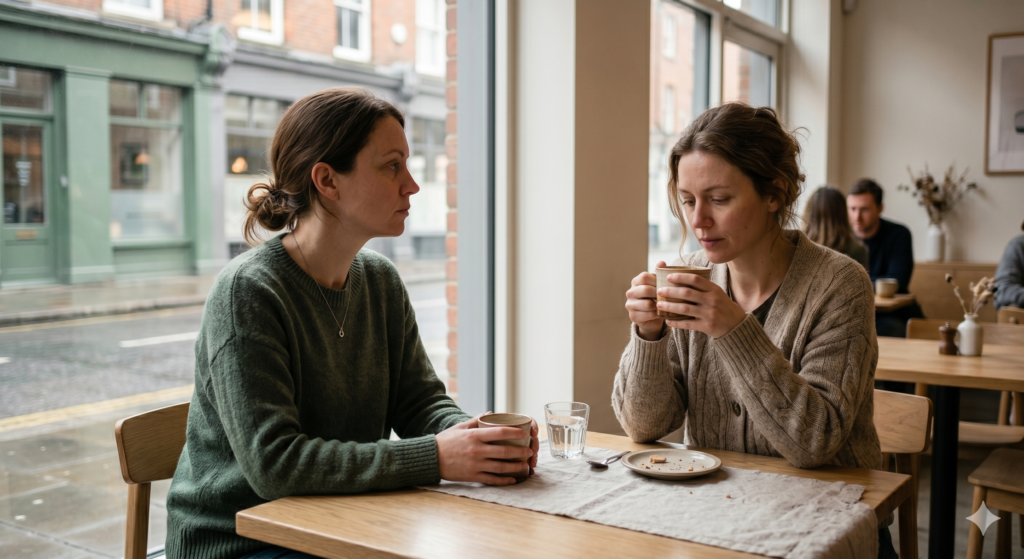
There are days when life feels like an overwhelming blur of responsibilities, and you find yourself sitting on the kitchen floor or staring at an unanswered message, simply out of energy. You don’t necessarily need someone to fix the problem. You don’t even need someone to offer a brilliant piece of advice. What you usually need is far simpler, though much harder to find: a friend who knows how to sit with you in the quiet without trying to tidy up the room.
We’ve all had moments where life drops something unexpected on our doorstep. It could be a sudden change at work, a quiet disappointment in a relationship, or just a slow buildup of daily exhaustion that finally catches up with you. In those moments, answering the simple question “How are you?” feels like a test you didn’t study for. To answer honestly requires too much energy, so you default to a polite nod or a brief “I’m fine,” hoping the conversation moves along.
But then there are those rare friends who see right through the routine. They don’t demand an explanation. They don’t press for details or expect you to entertain them. Instead, they drop off a warm drink on your porch, send a note that explicitly says “no need to reply,” or quietly sit on your living room couch while you sort through a pile of laundry.
The Relief of Low-Demand Connection
When you’re navigating a challenging stretch, social interaction can start to feel like work. You feel obligated to put on a brave face, keep up your end of the conversation, and reassure everyone that you’re handling things well. That performance takes a toll, especially when your emotional reserves are already running low.
That’s why steady friendships feel like such a relief. These are the people who let you drop the act completely. With them, you don’t have to worry about looking untidy, feeling uninspired, or being poor company. You can be quiet, you can be messy, and you can be completely honest about how tired you are.
Psychologists who study close relationships often note that true security in a bond isn’t measured by how much fun you have together on your best days. It’s measured by how little energy it takes to be around each other on your worst days. When you don’t have to manage someone else’s comfort around your pain, your body finally gets a chance to relax.
Why Presence Matters More Than Answers
Most of us are conditioned to be problem solvers. When someone we care about is struggling, our immediate impulse is to search for solutions, reframe the situation positively, or offer words of encouragement. It comes from a place of care, but sometimes, those efforts accidentally create distance.
When someone immediately jumps into advice mode, it can unintentionally send the message that your current state is something to be corrected as quickly as possible. It puts subtle pressure on you to move past the feeling before you’ve even had a chance to process it.
The friends who make hard seasons feel softer operate differently. They understand that some problems don’t have immediate answers, and some pain simply needs to be acknowledged. When a friend sits with you in your discomfort without trying to polish it into a lesson, they are giving you something far more valuable than advice. They’re offering validation.
Research on emotional support regularly points to a simple reality: the physical or emotional presence of a trusted friend can alter how our bodies handle stress. When we feel accompanied, our biological response to difficulty changes. The heart rate stays steadier, and the feeling of being overwhelmed begins to recede. The hardship itself hasn’t vanished, but the isolation surrounding it has.
The Art of the Quiet Gesture
Small Acts That Carry Real Meaning
If you look back at the moments that helped you through a difficult season, they are rarely the grand speeches or elaborate efforts. More often, they are the small, quiet gestures that asked nothing in return.
It’s the friend who shows up with dinner and leaves it on the counter without expecting a long chat. It’s the person who sends you a funny memory just to make you smile, without monitoring how quickly you write back. It’s the companion who offers to run an errand with you so you don’t have to face a crowded store alone.
These acts work because they bypass the usual social expectations. They provide comfort without adding another item to your busy schedule. They remind you that you are remembered, valued, and cared for, even when you feel like you have very little to give back.
Learning to Receive the Softness
Allowing someone to support you in this way isn’t always easy. Many of us pride ourselves on being self-sufficient, reliable, and capable of handling whatever comes our way. Admitting that a season is draining you can feel uncomfortable, almost like a personal failure.
You might worry about taking up too much space in someone else’s life. But steady friendships are built on a mutual understanding that nobody stays strong forever. Accepting help isn’t a sign of weakness; it’s an act of trust. It tells the other person that you value the bond enough to let them see you when you aren’t at your best.
When you let someone sit with you in the quiet, you’re giving them permission to care for you. And strangely enough, that openness often deepens a relationship in ways that easy, cheerful times never could.
A Different Way to See Support
We often measure the quality of our days by the goals we accomplish or the problems we solve. But when life gets difficult, those metrics tend to fade into the background. What remains are the people who stay steady beside us.
Maybe support was never meant to be about fixing what’s broken or erasing the difficulty. Maybe support is simply the quiet agreement that you won’t have to walk through the hard parts alone.
If you have someone in your life who knows how to make a hard season feel a little softer just by showing up, you’ve found something truly special. And if you’re currently in the middle of a difficult stretch, it’s okay to let someone pull up a chair and sit beside you. You don’t have to carry every part of the day by yourself.