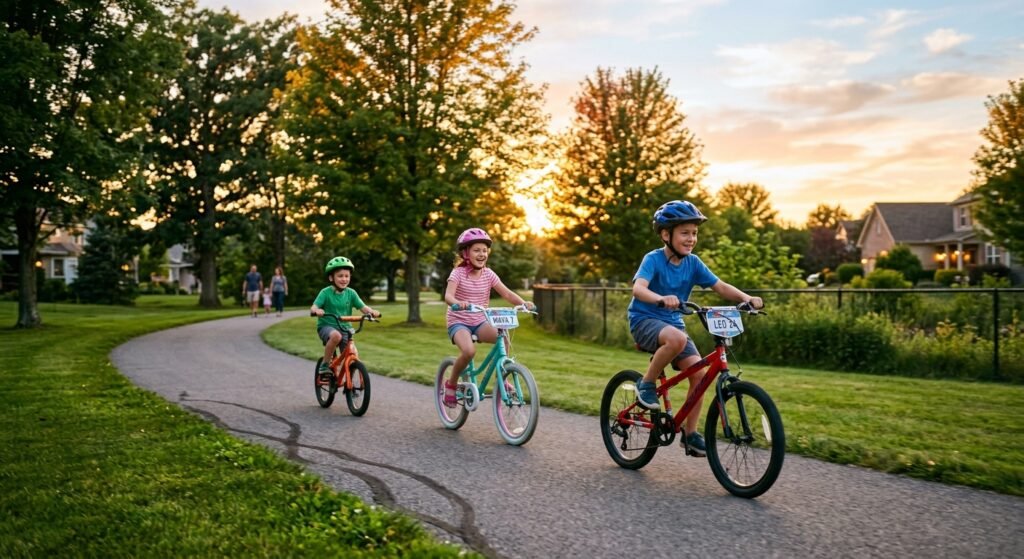
If you close your eyes and think back to the summers of your childhood, you can probably still feel the heat radiating off the driveway. You can probably hear the rhythmic creak of a screen door swinging shut, followed by the distant murmur of kids calling out to each other down the street. Back then, July felt like an entire lifetime. A single afternoon was a vast, uncharted territory waiting to be explored, and September was a distant myth that didn’t deserve your attention.
We didn’t measure those days by hours or appointments. We measured them by how sticky our hands were from melting popsicles, how dirty our knees got from crawling through the grass, or how long we could stay outside before the porch lights finally flicked on. There was a beautiful, quiet slowness to everything. You didn’t worry about what was coming next because the present moment was so big it filled up your entire world.
But then, without anyone announcing it, something changed. You went back to school one autumn, and the next summer felt just a little bit shorter. The year after that, it moved faster still. By the time you reached adulthood, summer had become just another season on a calendar, a brief window of warm days squeezed between work deadlines, grocery runs, and daily responsibilities.
It’s easy to look back on those endless summers with a deep sense of longing. You might find yourself wishing you could go back to that old neighborhood, or that you could find that old group of friends again. But if you sit with that feeling for a moment, you realize you aren’t actually missing a specific place or a specific group of people. You’re missing a way of being alive.
The Way We Used to Experience Time
There’s actually a fascinating reason why those early years felt so spacious. When we’re young, almost everything we experience is brand new. Every tree climb, every bicycle ride down a steep hill, and every quiet afternoon spent watching insects cross the sidewalk is a novel event. Our minds have to work hard to process all this fresh information, storing it in vivid detail.
Researchers often talk about how this mental processing affects our perception of time. When your mind is busy absorbing a constant stream of first time experiences, it creates a highly detailed internal record. When you look back on that period, your memory sees a rich tapestry of events, which makes the entire season feel like it lasted forever. It’s like reading a long book where every single page is packed with rich detail.
As we get older, however, our days become more familiar. We establish routines, we commute along the same roads, we do the same jobs, and we manage the same daily responsibilities. Because our minds don’t need to process familiar information with the same level of intensity, time seems to speed up. The days blend together, and before we know it, another year has slipped by. We aren’t actually losing time; we’re just losing the novelty that once made time feel so slow.
The Grief of Growing Up
Perhaps the most poignant part of this transition is that we rarely realize when we’re experiencing our last endless summer. There isn’t a final ceremony where someone tells you that you’ve run your last race across the lawn or had your last sleepover without a single worry about the future. It just quietly fades into the background as responsibilities take over.
Children are deeply perceptive, even if they don’t have the vocabulary to explain it. Maybe they aren’t actually eager to grow up. Maybe, on some level, they are already grieving a childhood they know they will eventually have to leave behind. They feel the slow pull of the future, even as they try to hold onto the magic of the present.
That longing we feel as adults is a form of grief, but it’s a gentle one. It’s the realization that some doors only open once. We can return to the old neighborhoods, we can walk down the same streets, and we can even buy the same treats we loved as kids. But we can’t recreate the mind that experienced those things for the first time. We can’t bring back the innocence of a world that didn’t require us to plan, prepare, or worry.
Finding the Magic in the Middle of Routine
It’s easy to let this realization make you feel a little sad, but there’s actually a quiet comfort hidden inside it. The fact that you feel this longing means you were fortunate enough to experience a time when you felt safe, loved, and completely present. Those endless summers aren’t truly gone; they’re woven into the fabric of who you are today. They gave you your capacity for wonder, your appreciation for quiet moments, and your understanding of what it means to be fully alive.
You can’t make time slow down to a childhood pace again, and that’s okay. Adulthood brings its own kinds of beauty, even if they’re more complicated and less spacious. We have deep conversations, meaningful connections, and the ability to choose our own paths. We can still find pockets of that old magic when we step out of our routines, even if it’s just for an hour or two.
The next time you find yourself wishing for those long, endless days, try to remember that the feeling itself is the gift. It’s a quiet reminder of what we’re capable of experiencing when we allow ourselves to simply be. You don’t need to go back in time to feel that way again. You just have to slow down enough to let the present moment catch up to you.