Think about the last time you made a wrong turn while driving, or completely burned a simple dinner, or spent forty minutes trying to assemble a toy that came with twenty pages of confusing instructions. You probably felt that familiar spark of irritation. Maybe you sighed a little too loudly, or tossed a plastic piece onto the carpet, or finally just sat back and said, “I don’t think I can get this right.”
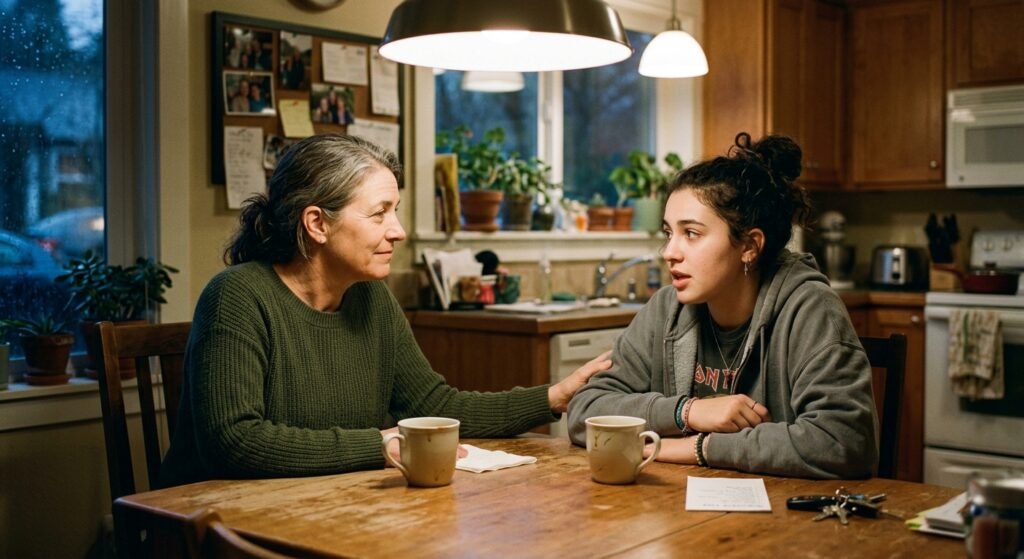
In those moments, the room usually goes quiet. And if you look over, you’ll often find your child watching you. They aren’t looking at you with disappointment. Instead, they’re watching with a quiet, curious intensity. It’s a gaze that feels entirely different from the way they looked at you when they were toddlers.
They’re noticing the slight furrow in your brow, the way you pause, and the simple truth that you don’t automatically know how to fix everything. It’s the moment the golden curtain pulls back. For them, it’s a quiet revelation. For you, it can feel like a small heartbreak.
The Magic of the All-Knowing Parent
When children are small, we exist as giants in their world. We’re the ones who can reach the high shelves, open the stubborn jars, make the pain of a scraped knee vanish with a bandage, and explain why the sky is blue. To a five-year-old, a parent is not just a person. We’re an entire system of safety, a walking library of answers, and a magician who can make any problem disappear.
We get used to wearing that cape. Even on the days when we feel entirely lost, we learn to pretend. We smooth down our hair, keep our voices steady, and put on a brave face because we want them to feel secure. There’s a beautiful, quiet comfort in being their hero, and we quietly begin to rely on that illusion just as much as they do.
But as the years pass, the challenges of life get more complicated than a broken toy or a scraped knee. The world gets bigger, and our ability to keep every single ball in the air begins to falter. We make mistakes. We lose our tempers. We get lost on roads we’ve driven a dozen times. We look at their math homework and realize we don’t have the slightest idea how to solve it.
When the Pedestal Begins to Crack
The first time you realize your child has noticed one of these cracks, it can feel profoundly unsettling. You might feel a sudden rush of vulnerability, or even a sense of failure. We worry that if they see us stumble, they’ll lose their sense of safety. We worry that by showing our limits, we’re somehow letting them down.
Yet, if you look closely at what is happening in those quiet interactions, you’ll see something much gentler than a fall from grace.
When you apologize to your child for reacting too quickly, or when you sit on the floor and admit you’re struggling to figure out a difficult situation, you aren’t breaking their world. You’re actually introducing them to ours. You’re showing them that it is possible to make a mistake, to feel frustrated, and to still be completely worthy of love and respect.
The Growth of a New Kind of Connection
There is some lovely research in developmental psychology that looks at how children begin to understand the minds of the people around them. In their early years, children struggle to separate their own feelings and thoughts from yours. They assume you see what they see and know what they know.
But as they grow, they begin to develop a deeper awareness that you are an independent person with your own private world of thoughts, doubts, and feelings. When they see you make a mistake, it acts as a bridge. They’re realizing that you feel worry, that you experience frustration, and that you have to try, fail, and try again, just like they do.
This isn’t a loss of safety for them. In many ways, it’s a relief. When we pretend to be perfect, we accidentally set an impossible standard for our children to live up to. They look at our effortless lives and feel deeply ashamed of their own messy, clumsy mistakes. By letting them see us stumble, we give them permission to be imperfect too.
Offering Realness Over Perfection
The real freedom of parenting doesn’t come from getting everything right. It comes from how we handle the moments when we get things wrong.
When we can look at our children and say, “I made a mistake, and I’m sorry,” or “I’m really trying to figure this out, but it’s hard,” we’re teaching them the most valuable lesson of all. We’re showing them that mistakes aren’t the end of the story. They’re just the place where we learn how to start over.
We don’t need to be perfect to make them feel safe. In fact, a perfect parent would be a terrible guide for a world that is inherently messy and unpredictable. They don’t need a superhero who never falls. They need a real person who knows how to get back up, dust themselves off, and keep going with grace and a little bit of patience.
So the next time you find yourself apologizing for a burned dinner or admitting you don’t have the answers, take a breath. Look at that child watching you from across the room. They aren’t judging your mistakes. They are simply learning, for the very first time, how to love a real person. And in the end, that is a much better gift than perfection.