You are standing in your driveway, staring at a task that feels just a little too demanding for a Tuesday afternoon. Maybe you are trying to wrangle three overfilled recycling bins while the wind does its best to scatter plastic bottles down the street. Or perhaps you are standing by an open car trunk, looking at several oversized boxes of furniture you foolishly agreed to assemble yourself, realizing you do not quite have the leverage to lift them alone.
Then, someone appears from across the asphalt. It isn’t a close friend you texted in distress, or a family member who feels duty bound to assist. It’s the person from three doors down. You know them as the one who owns the friendly retriever, or the person who keeps an immaculate garden, but you might not even know their last name. They don’t make a grand speech or ask if you have everything under control. They simply grab the other end of the box, walk it up your steps, offer a brief nod, and head back to their own yard.
In a world where we can outsource almost any chore with a quick tap on our screens, these unscripted moments feel increasingly rare. We’ve built lives where we can order groceries, schedule home repairs, and manage our entire existence without ever looking our neighbors in the eye. Yet, there is a distinct kind of comfort in the unsolicited neighborly assist that no modern convenience can replicate. It’s the sudden, warm awareness that you’re not as isolated as you sometimes feel.
The Quiet Art of Watching Out for Each Other
Most of us have been taught to value self sufficiency above almost everything else. We pride ourselves on carrying our own burdens, fixing our own problems, and keeping our struggles behind closed doors. When someone steps across a property line to offer help, it can actually feel a bit startling at first. Your immediate instinct might be to protest, to quickly assure them that you’re fine, or to apologize for causing any trouble. We do this because we’ve come to view needing help as a minor failure of planning.
But when you watch a neighbor wheel your trash cans back up your driveway after a storm, you aren’t thinking about independence. You’re feeling a sudden rush of gratitude. These small gestures require no prolonged commitment, no emotional processing, and no complex negotiations. They are simple, clean transactions of goodwill. A person saw another person struggling, decided to step in for a few moments, and then went back to their day. There is a beautiful simplicity in that kind of care.
Sociologists who study community dynamics often look at what they call social capital, which is essentially the trust and mutual support that exists within a group of people. Research suggests that the strength of a neighborhood doesn’t actually depend on everyone being best friends or hosting elaborate block parties. Instead, it relies on these tiny, low stakes interactions. Knowing someone notices your porch light was left on, or that your mail is piling up, acts as a psychological buffer against stress. It gives us a sense of physical and emotional security that is deeply stabilizing.
The Beauty of Low Stakes Connection
There is something liberating about neighborly relationships because they lack the expectations of our closer bonds. Your friends know your history, your family knows your flaws, and your coworkers know your professional persona. But your neighbors simply know you as the person who lives in the blue house. They see you in your oldest sweatpants, retrieving the morning paper, or struggling to parallel park. They see the unpolished, daily version of you, and they accept you as part of the landscape anyway.
Because there is no pressure to maintain a certain image, these interactions can feel remarkably authentic. When a neighbor stops to tell you that your taillight is out, or offers to share the extra tomatoes from their garden, they aren’t looking for a deep conversation. They are simply acknowledging your shared space. It’s a way of saying, we are both here, navigating the same corner of the world, and we might as well make it a little easier for each other.
We often think of community as something we have to actively build through organized groups, neighborhood councils, or local clubs. We schedule dinners, join online forums, and search for structured ways to feel connected. But maybe we’re looking in the wrong direction. Perhaps community isn’t a project we complete, but a series of quiet, organic choices we make every single day. It’s the decision to leave our porches lit, to wave from across the street, and to keep our eyes open to the people living right beside us.
The Realization of Shared Safety
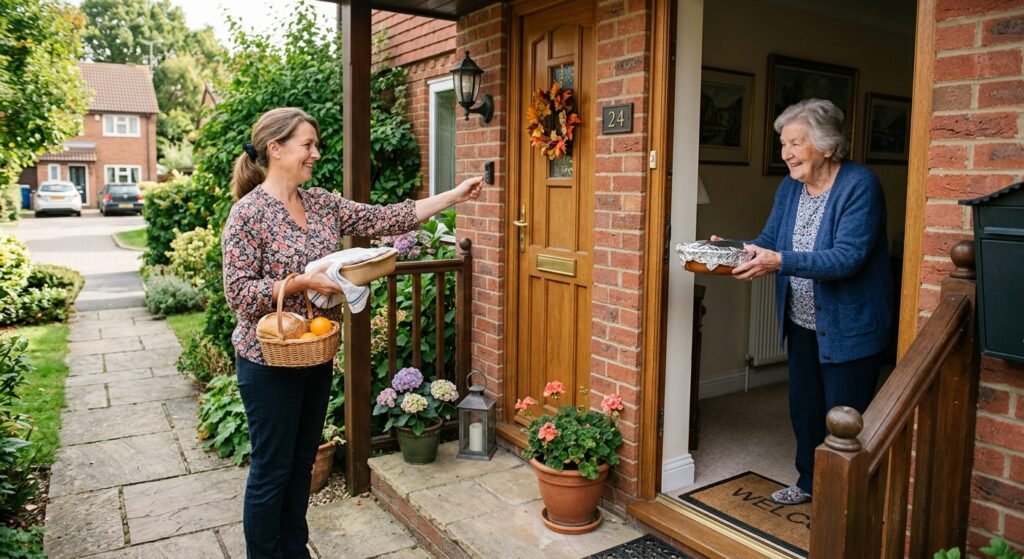
When you look back on the moments that made you feel truly rooted in a place, they are rarely the milestone events. They’re the mornings when you woke up to find your sidewalk already cleared by a neighbor who got up early. They’re the afternoons when someone noticed you were sick and left a small container of soup on your porch table, walking away before you could even say thank you. These actions don’t ask for reciprocity; they simply offer comfort.
These gestures remind us of a truth we often forget when we are busy rushing through our lives. We like to think we are entirely independent, but we are actually held together by a fragile web of mutual care. The person down the street isn’t just an observer of your life; they are a quiet participant in it. And when they show up without being asked, they aren’t just saving you a bit of physical effort.
They are reminding you that you are seen, that your presence matters, and that you belong to a place. Perhaps the real beauty of neighborhood kindness isn’t the work that gets done. It’s the realization that you don’t have to face the wind, the strenuous lifting, or the quiet daily struggles entirely on your own. There are people nearby who are quietly paying attention, ready to step across the lawn whenever you need a hand.