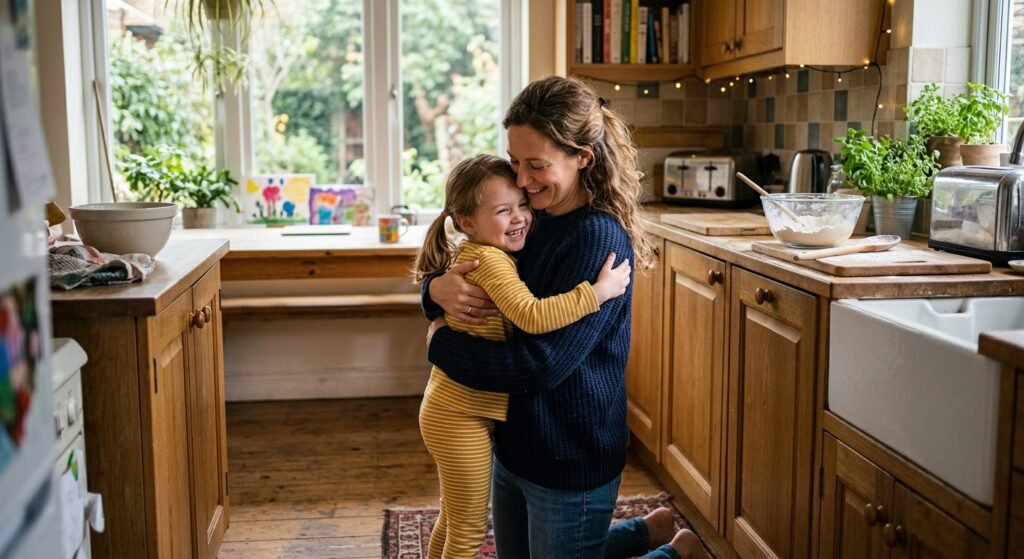
You’re standing in the middle of a messy kitchen, and your child has just spilled a full glass of milk across the floor for the third time today. It’s a tiny, unremarkable accident, the kind of moment that happens in every home with young children. But inside you, a familiar tightness starts to build. Your heart beats a little faster, and for a fraction of a second, an old voice from your own childhood echoes in your mind, ready to react with the same sharp anger, cold silence, or harsh criticism that you grew up with. It’s a reaction that feels almost automatic, like a path already worn deep into the ground by generations of family members who walked it before you.
But then, you do something remarkable. You take a breath. You close your eyes for a brief second, letting the immediate surge of frustration pass through you without letting it take over. You grab a towel, kneel on the floor next to your child, and quietly tell them that it’s okay, that accidents happen, and that you can clean it up together. In that quiet, ordinary kitchen, without any audience or applause, you’ve just done something monumental. You’ve chosen a different path.
The Quiet Decision to Turn Away From the Past
Many of us grow up believing that the way our families functioned is simply the way the world works. We assume that every household has the same unspoken rules, the same emotional secrets, and the same undercurrents of tension. It’s only as we get older that we begin to see the cracks in those old foundations. We start to recognize the patterns of behavior that hurt us, the emotional distance that left us feeling lonely, or the explosive tempers that made us feel unsafe in our own homes. Recognizing those patterns is one thing, but deciding not to pass them on to the next generation is an entirely different challenge.
When you decide to raise your children differently than you were raised, you’re essentially trying to build a house without a blueprint. You don’t have a personal memory of what a calm, emotionally supportive household looks like, so you have to invent it as you go. It’s a process of trial and error that can feel lonely and exhausting. You’re constantly monitoring your own reactions, questioning your instincts, and trying to learn a language of patience and connection that you were never taught to speak.
The hardest part of this journey isn’t the big parenting milestones; it’s the quiet, daily commitment to emotional awareness. It’s choosing to apologize when you lose your temper, even though no adult ever apologized to you when you were small. It’s validation instead of dismissal. It’s showing up for your child’s big feelings even when your own emotional cup is completely dry. These small choices don’t feel heroic in the moment, but over time, they begin to reshape the emotional landscape of your entire family.
The Invisible Work of Breaking the Pattern
There’s a unique kind of exhaustion that comes with breaking old family patterns. Other people might see a parent who is patient, gentle, and present, but they don’t see the immense emotional effort required to maintain that composure. They don’t see the constant inner dialogue, the active dismantling of old defenses, or the grief that often accompanies this progress. Sometimes, as you offer your child the safety and understanding you never received, you’re reminded of how much you needed those very same things when you were young.
That grief is a natural part of the healing process. When you give your child a soft place to land, you’re also quietly mourning the child you used to be, the one who had to navigate emotional storms alone. It’s a strange, bittersweet feeling to realize that you’re capable of providing the very comfort you were denied. But within that grief, there’s also a profound sense of strength. You’re proving that the past doesn’t have to dictate the future, and that pain doesn’t have to be an inheritance.
This path requires you to confront your own vulnerability on a daily basis. It means accepting that you won’t always get it right. There’ll be days when the old family patterns slip through, when you raise your voice too loud or withdraw when things get difficult. The difference is that you don’t stay there. You don’t let those moments define your relationship with your children. Instead, you use them as opportunities to model repair, showing your kids that relationships can be mended and that love is strong enough to survive our mistakes.
The Legacy of Better Choices
We often think of family legacies in terms of heirlooms, names, or financial security. But the most valuable thing you can pass down to your children is an emotional environment where they feel safe enough to be exactly who they are. When you choose to break the patterns of dysfunction, you’re giving your children a gift that’ll benefit them for the rest of their lives. You’re allowing them to grow up without the emotional burdens you had to carry, freeing them to focus on simply being kids.
Think about the future you’re quietly building with every patient response, every thoughtful conversation, and every moment of genuine connection. Your children will grow up knowing that their feelings are valid. They’ll know how to communicate their needs, how to set healthy boundaries, and how to resolve conflicts without anger or blame. When they eventually have families of their own, these healthy behaviors won’t be things they have to fight to learn; they’ll simply be the natural way they show up in the world.
You might never receive a trophy for staying calm during a tantrum or for choosing understanding over punishment. Your children may never fully understand the immense effort it took for you to raise them differently, because they’ll have no memory of the dysfunction you left behind. And in a way, that’s the ultimate victory. Their ignorance of those old family patterns is the proof of your success.
A Different Kind of Family Pride
It’s easy to feel discouraged on the days when parenting feels particularly difficult, or when you feel like you’re falling short of the ideal parent you want to be. But healing isn’t about perfection. It’s about direction. Every time you make a healthier choice, no matter how small it seems, you’re steering your family toward a calmer, more loving future.
Perhaps the real truth of this journey is that you aren’t just raising your children; you’re also raising yourself. By choosing to respond with love and patience, you’re healing the old wounds within your own heart and proving that change is always possible. You’re transforming your family’s story from one of survival into one of connection.
So the next time you find yourself kneeling on the kitchen floor, cleaning up a spill with a patient smile, take a moment to appreciate what you’re actually doing. You aren’t just managing a messy moment. You’re quietly rewriting history, one small choice at a time, and ensuring that the old patterns stop with you.