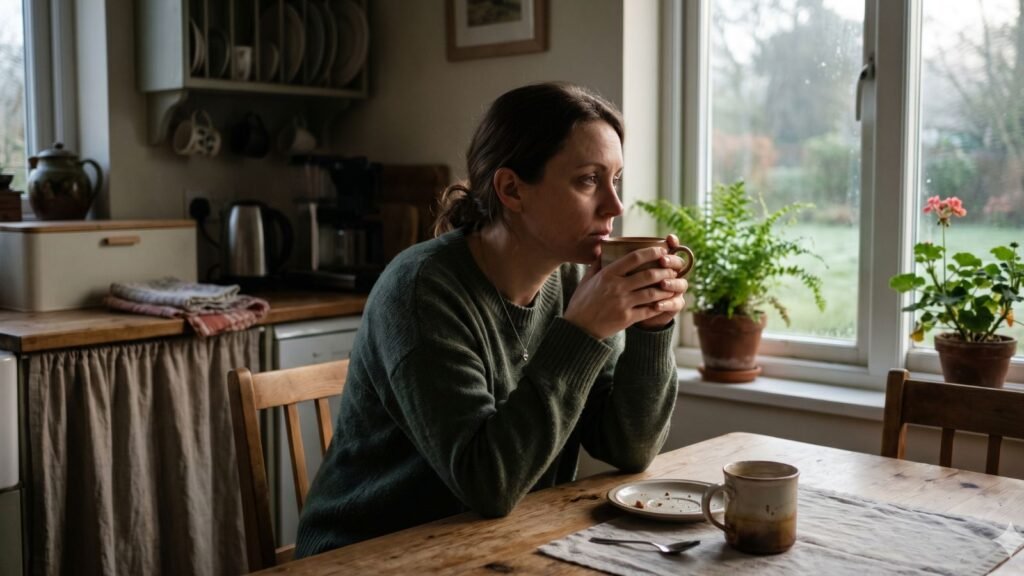
You probably know the feeling of standing in your kitchen late at night, staring at a cupboard that refuses to stay organized, or looking at a schedule that seems to fall apart no matter how carefully you plan it. You spend your days adjusting, nudging, and fixing the little details of your life. You rewrite an email three times to make sure your tone is exactly right. You rehearse a difficult conversation in your head while driving, hoping you can somehow steer the other person’s reaction in the direction you want. It’s a quiet, constant labor, a belief that if you just work a little harder, you can keep everything around you from sliding into chaos.
Most of us live with the unspoken assumption that managing our lives means managing every possible outcome. We treat our days like a series of problems to be solved, believing that peace is something we only earn once everything is perfectly arranged. If the dinner party goes well, if the project is received with enthusiasm, if our loved ones are completely happy, then we can finally take a breath and relax. But you’ve likely noticed that this moment of rest rarely arrives, or if it does, it lasts only a few minutes before the next detail requires your attention.
The Story We Tell Ourselves About Control
There’s a curious pattern in how we navigate the world, one that psychologists sometimes call the illusion of control. Decades ago, researchers began noticing that people naturally overestimate their ability to influence events that are actually decided by chance or external forces. In simple experiments, people would press a button more forcefully if they wanted a larger number to appear on a screen, as if physical effort could somehow dictate a computerized outcome. We do the exact same thing in our daily lives. We lean into our worries with extra force, unconsciously believing that our anxiety acts as a shield against unpredictable events.
Think about how this shows up in your relationships. When someone you care about is going through a difficult season, your immediate instinct is often to step in and fix it. You offer solutions, you suggest books, you try to arrange their environment so they don’t have to face the discomfort. It comes from a place of deep love, but beneath that love is also a quiet fear of helplessness. Watching someone we care about struggle makes us feel exposed, so we try to control their healing process because we don’t know how to sit quietly with their pain.
The Hidden Cost of Fixing Everything
The exhaustion we feel at the end of a long week is rarely just physical. More often, it’s the emotional exhaustion of trying to hold together things that want to go their own way. When you take on the responsibility of managing everyone else’s feelings, reactions, and choices, you’re carrying a burden that was never yours to carry. You become like a stage manager trying to direct an improvisational play, constantly whispering cues from the wings and feeling personally responsible when an actor misses their mark.
In the process, we miss the beauty of what actually is because we’re so focused on what should be. When you’re constantly evaluating whether a moment is matching your expectations, you’re not actually living in that moment. You’re living in your critique of it. The quiet dinner with friends becomes a stressful test of your hosting abilities. The weekend getaway becomes a series of logistics to manage. Even your hobbies can start to feel like tasks when you demand that they yield a perfect result every time.
The Relief of Letting Go
True acceptance doesn’t mean giving up or pretending you don’t care about the people and things in your life. Instead, it’s a decision to stop fighting reality. When you let things be, you aren’t saying that everything is perfect; you’re simply acknowledging that you cannot force the world to cooperate with your timeline or your preferences. There’s an immense relief in realizing that you don’t have to have an opinion on every event, nor do you have to step in and correct every detour life takes.
Psychological research into mindfulness and acceptance suggests that when we stop resisting our current circumstances, our nervous system naturally settles. It’s the resistance to the situation, rather than the situation itself, that creates our deepest suffering. When you stop struggling against the current, you suddenly have access to all the energy you were spending on the fight. You can see the river clearly, you can see where it’s going, and you can finally decide how you want to navigate it from a place of clarity rather than panic.
Finding Peace Where Control Ends
There’s a quiet beauty in those moments when we finally decide to take a step back. When we let the conversation go where it wants to go, or let the evening unfold without a strict itinerary. When we allow the person we love to be sad or frustrated without trying to cheer them up right away. We start to see what happens when we decide to be a guest in our own life for a little while, rather than the host who is constantly worried about the details.
What we find in those moments isn’t chaos, but a strange and comforting kind of order. We discover that people are remarkably resilient when we give them the space to figure things out on their own. We find that moments can be deeply imperfect and still wonderfully sweet. Most importantly, we realize that we don’t have to hold the sky up to keep it from falling. It stays up all on its own, and we are allowed to just walk beneath it, breathing easy, knowing we are not the ones in charge.